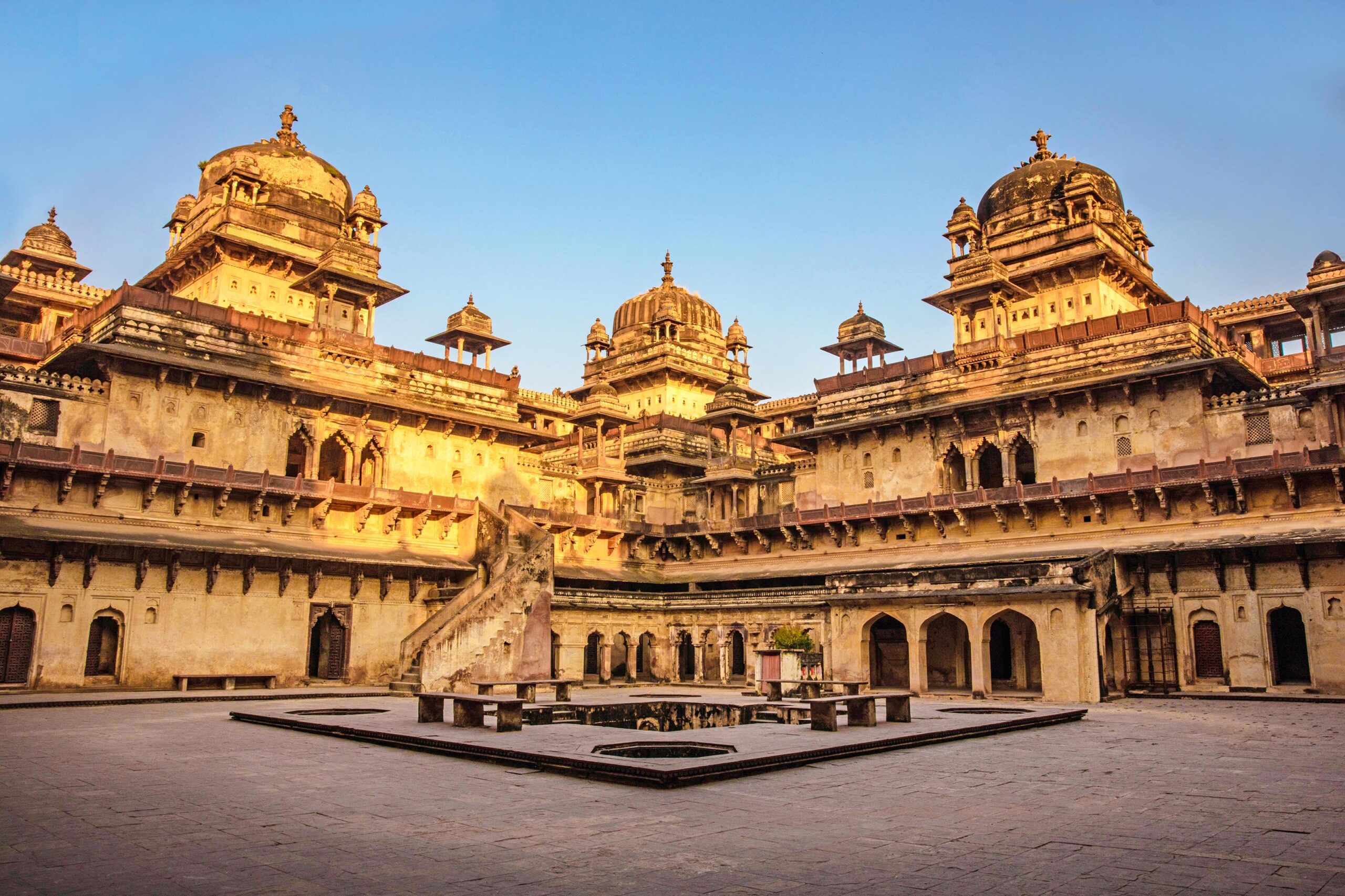
Orchha: Orchha, the forgotten capital of the Bundela Rajputs, lies curled along the Betwa River like a half-remembered dream. Founded in 1531 by Maharaja Rudra Pratap Singh, it was abandoned less than a century later when the court shifted to Tikamgarh. Yet the town refused to die. Its palaces, temples, and cenotaphs stand almost exactly as they did four hundred years ago, wrapped in a silence so deep that every footstep feels like an interruption of an ongoing conversation between gods and men.
Here, mythology is not a story told about the past; it is the very air one breathes.
The Founding Vision on a Riverbank
The Bundelas trace their lineage to the divine hem of Vishnu himself. But Orchha’s true origin is more intimate.
One evening in the early 16th century, Rudra Pratap Singh was hunting along the Betwa when Lord Rama appeared in a dream and commanded: “Build me a palace where I may rest as a king, not merely as a guest in a temple.”
The king obeyed.
- When the magnificent Ram Raja Temple was complete, the idol of Rama—brought from Ayodhya—refused to be installed until the king promised that here Rama would be treated not as a deity but as a living monarch.
- To this day, the temple is officially a palace. Guards in Bundela livery present arms, a sword is placed beside the idol at night, and the state police still stand sentry because, legally, Rama is the eternal king of Orchha.
“The day the idol entered,” recounts Pt. Ramkumar Shastri, hereditary priest of the Ram Raja Temple, “it was so heavy that even elephants could not drag it forward. Only when the queen herself came barefoot, tears in her eyes, and begged, ‘Come home, my lord,’ did the murti glide into place. From that moment Orchha ceased to belong to any mortal ruler.”
The Queen Who Carried God on Her Back
The most beloved tale is that of Rani Ganesh Kunwari, wife of Maharaja Madhukar Shah. A fervent devotee of Rama, she undertook severe penance at Ayodhya. Pleased, Rama gave her his childhood idol with one condition: “Wherever you set me down for the night, there I will stay forever.”
The rani began the long journey back to Orchha, carrying the idol on her own back. When she reached the capital, the palace meant for the god was unfinished. Exhausted, she placed the idol in her own apartments for the night, intending to move it the next day.
Dawn came. The idol would not budge.
Architects, priests, elephants—nothing could shift it. Finally the rani understood: Rama had chosen his home. The queen’s private chambers became the sanctum sanctorum of the Ram Raja Temple.
“Even today,” says local storyteller Brajesh Singh Bundela, “when the temple doors open at 4 a.m., the first aarti is offered in the name of Rani Ganesh Kunwari. The priests sing: ‘Jinki kripa se Ram yahan base, unki seva humein sweekar ho’ (By whose grace Rama resides here, may her service be accepted by us).”
Chaturbhuj: The Temple That Waited in Vain
Across the square rises the soaring Chaturbhuj Temple, its vaulted spires stabbing the sky like frozen lightning. Seven storeys high, its interior is a cavernous hymn in stone. This was the palace originally intended for Lord Rama.
When the idol refused to leave the rani’s rooms, Chaturbhuj stood empty for centuries. An enormous image of Vishnu with four arms was finally installed, but locals still call it “the temple that Rama rejected.”
Climb the dark, bat-haunted staircases to the top, and the wind carries an old couplet carved on the wall:

“Maine banaya tha mahal apne Ram ke liye, Ram ne chuna kunwari ka chhota sa aangan.” (I built a palace for my Rama, Rama chose the small courtyard of the queen.)
The Painter Who Saw God in Every Leaf
Orchha’s palaces are covered in murals that have survived fire, war, and neglect. The most extraordinary are in the Jahangir Mahal and the Raja Mahal, painted during the brief friendship between Bundela king Vir Singh Deo and Mughal emperor Jahangir.
-
“These were not ordinary artists,” explains Dr. Anand Singh Bundela, historian and descendant of the royal family. “They were bhakts who meditated for months before touching a wall… The master painter of the Ramayana cycle fasted for forty days. On the fortieth night, he dreamed that Hanuman himself guided his brush.”
Look closely at the famous scene of Hanuman setting Lanka aflame. The burning city is painted in vivid vermilion, yet the tail itself is left untouched, raw plaster glowing white.
“Why is the tail blank?” He smiled. “Because no mortal hand can paint the fire of Hanuman’s devotion. That part is left for God to fill with real light when the true bhakt stands here.”
The Cenotaphs That Sing at Twilight
Along the Betwa stand fourteen chhatris—cenotaphs of the Bundela kings. At dusk, when the sky bleeds saffron, the river seems to carry their ashes in silent procession.
Local belief holds that every evening at twilight, the spirits of the old rulers gather on the river steps to listen to the Ramayana being recited in the Ram Raja Temple.
“Listen carefully,” whispers guide Ram Gopal when the aarti bells begin. “When the conch is blown three times, you can hear the faint echo of armour. That is the old kings saluting their eternal sovereign.”
The Living Myth
Orchha is one of the few places in India where Ram Navami is celebrated not for a day but for forty—one full month of continuous Ramayan recital. On the final night, a silver palanquin carrying Lord Rama processes through the same streets the Bundela kings once rode as conquerors. Today the king walks barefoot behind the god.
As Pt. Shastri explains: “In other kingdoms, the ruler sat on the throne and the deity stood in the temple. Here the deity sits on the throne and the ruler stands in attendance. That is Orchha’s true victory.”
Four centuries after its abandonment, Orchha remains a kingdom without subjects, a capital without a court, a palace where the only reigning monarch is a small boy-king.
The stones still speak. If you arrive before sunrise, when the mist rises off the Betwa like incense, you can hear them:
“We were built for a god who preferred a woman’s devotion to a king’s grandeur. We stand empty so that the world may remember: True empire is measured not by the size of the palace, but by the weight of the idol that refuses to leave a devotee’s heart.”