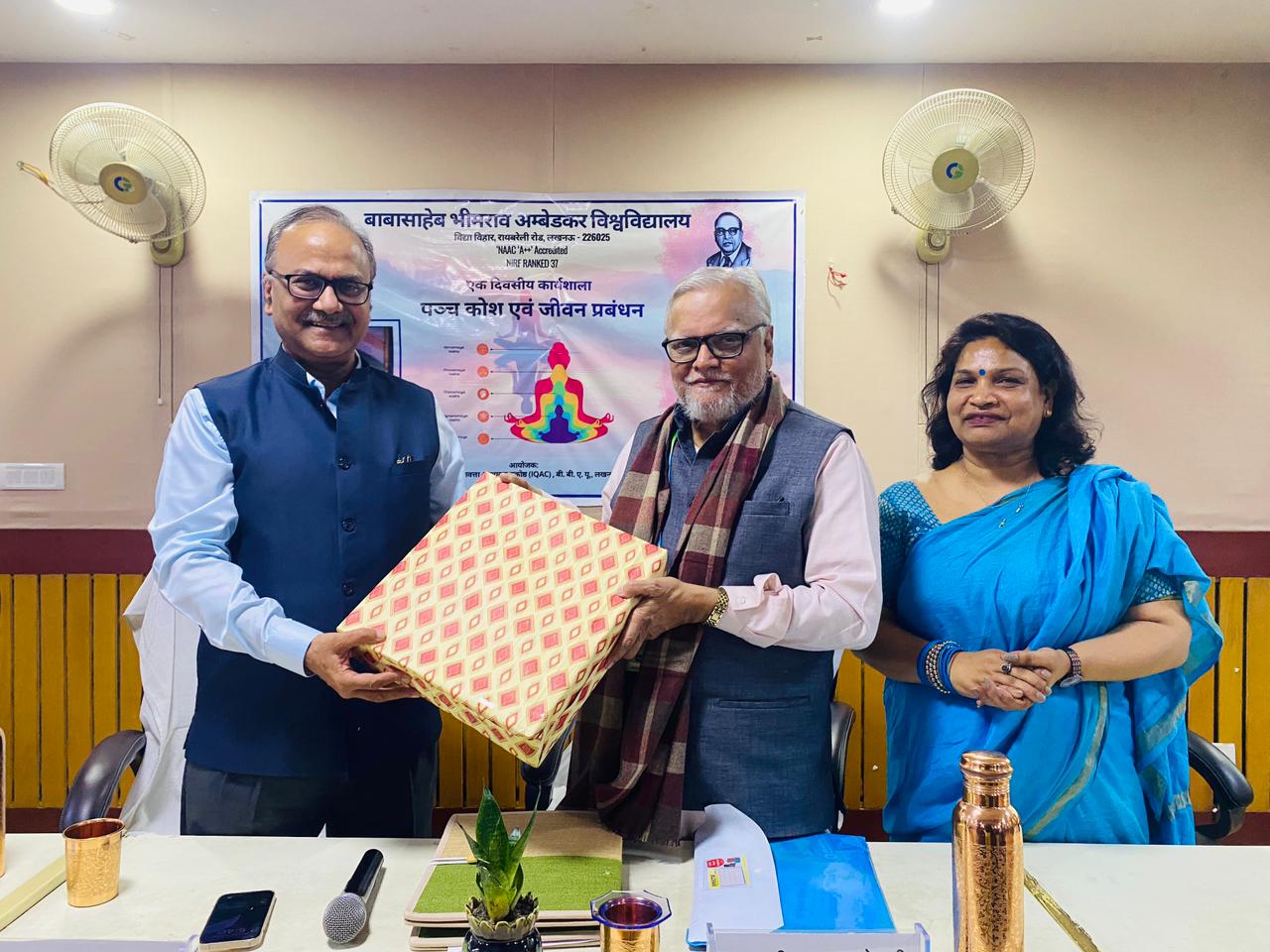
Lucknow: A one-day workshop on the theme ‘Panchkosha and Life Management was organized on November 12 by the Internal Quality Assurance Cell (IQAC) of Babasaheb Bhimrao Ambedkar University, Lucknow. The program was presided over by the Hon’ble Vice-Chancellor, Prof. Raj Kumar Mittal. The Chief Guest and Keynote Speaker of the workshop was Dr. Atul Kothari, National Secretary of Shiksha Sanskriti Utthan Nyas, New Delhi. On this occasion, IQAC Director Prof. Shilpi Verma and Dr. Narendra Singh were also prominently present. The event began with the lighting of the ceremonial lamp and offering of floral tributes to the portrait of Babasaheb. Following the university anthem, members of the organizing committee presented a token of gratitude to the guests. Dr. Narendra Singh extended a warm welcome to all dignitaries and participants, while Prof. Shilpi Verma briefed everyone about the objectives and outline of the workshop. The anchoring was done by Dr. Narendra Singh.
Vice-Chancellor Prof. Raj Kumar Mittal congratulated the organizing committee for conducting such a meaningful and insightful program. He stated that every individual aspires to live a good life and realize their full potential, for which self-awareness is essential. Self-knowledge enables a person to introspect, recognize limitations, and move beyond them. He explained that the concept of Panchkosha provides a holistic path for human development, as it not only balances physical and mental dimensions but also nurtures intellectual and spiritual growth. This harmony, he said, leads to inner positivity and stability in life.
Prof. Mittal further emphasized the importance of good company and the expansion of knowledge, as our understanding and attitude towards society determine the direction of our growth. Comparing Western and Indian philosophies, he observed that while Western culture focuses on material wealth, luxury, and the exploitation of nature, Indian philosophy emphasizes the preservation of nature, culture, and moral values. He urged that one must work keeping Pragya (wisdom), Sheel (character), and Karuna (compassion) at the core of life. Prof. Mittal also suggested that Panchkosha-based education should be integrated into the academic curriculum, a concept already highlighted in the National Education Policy (NEP) 2020.
Dr. Atul Kothari, National Secretary of Shiksha Sanskriti Utthan Nyas, New Delhi, in his address, said that only those who maintain discipline in life can lead a balanced and ethical life. Discipline, he explained, is not confined to external conduct but serves as a means to bring harmony to one’s thoughts, actions, and lifestyle. He emphasized that for success and self-development, it is essential to know oneself, focus the mind, and channel energy in the right direction. Elaborating on the concept of Panchkosha, Dr. Kothari described it as representing five layers of human existence Annamaya Kosha (physical body), Pranamaya Kosha (vital energy), Manomaya Kosha (mind), Vigyanamaya Kosha (intellect), and Anandamaya Kosha (bliss or consciousness). The balance among these five sheaths forms the foundation of true health and inner peace. Through the practice of yoga, pranayama, meditation, and a disciplined lifestyle, an individual gradually purifies these layers and moves toward self-realization. Dr. Kothari further stated that NEP 2020 has incorporated several thematic objectives to promote ancient Indian knowledge systems, spirituality, and cultural values.

He highlighted the benefits of yoga, pranayama, subtle postures, and meditation, stating that regular practice leads to a healthy body, a peaceful mind, and a blissful soul. Yoga, he said, is not merely a means to physical fitness but also a path to mental and spiritual elevation. In today’s world of stress and imbalance, the wisdom of yoga and the Panchkosha framework provide a way toward holistic development. He urged everyone to integrate these invaluable aspects of Indian knowledge traditions into their daily lives to build a healthy, balanced, and empowered society.
During the interactive session, teachers and students asked several questions, which were answered by the Hon’ble Vice-Chancellor and the Chief Guest. The event concluded with a vote of thanks, followed by the presentation of a memento and shawl to the Chief Guest as a token of appreciation.
The program was attended by deans of various schools, heads of departments, faculty members, non-teaching staff, research scholars, and students.