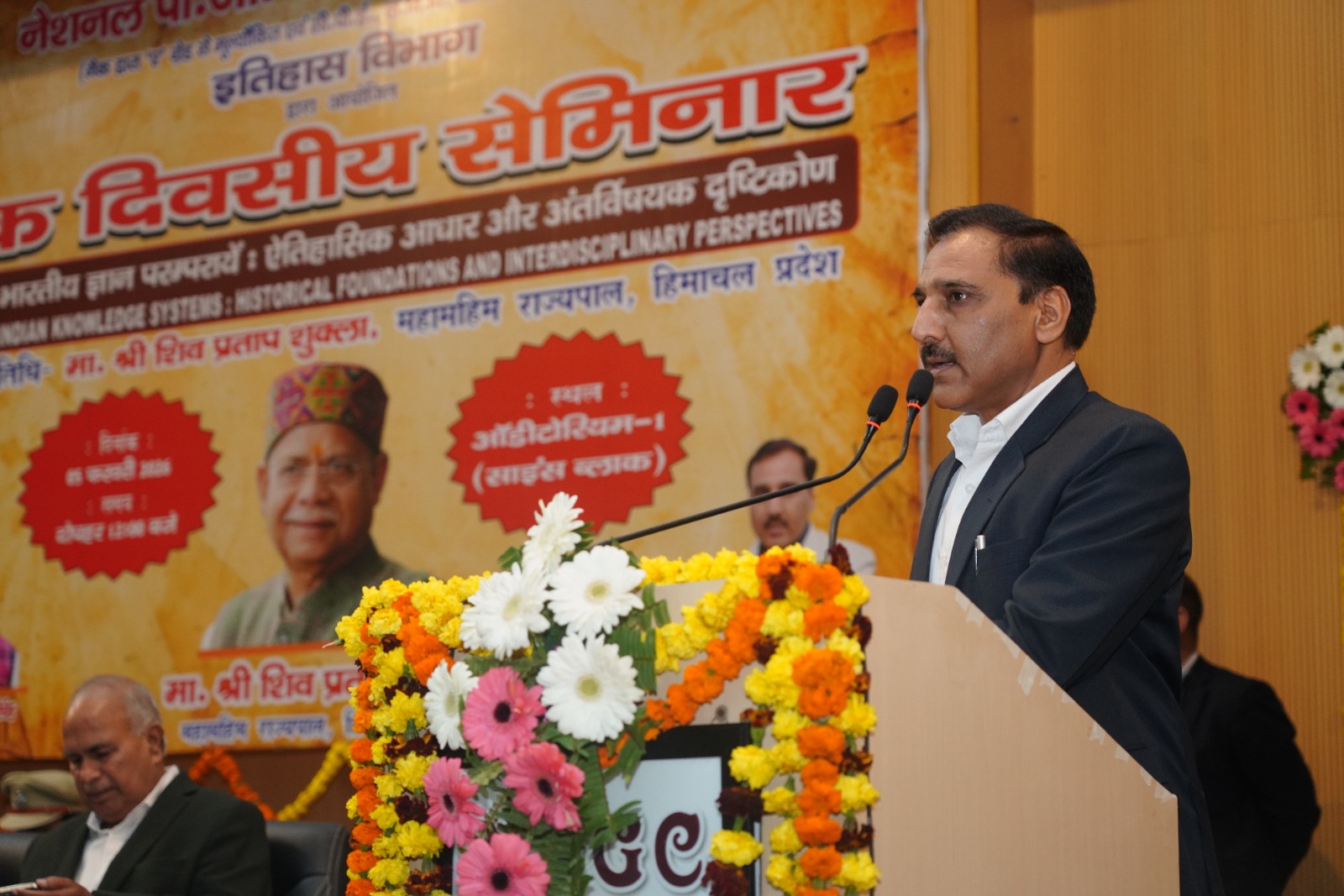
Lucknow: A One-Day Seminar on “Indian Knowledge Systems: Historical Foundations and Interdisciplinary Perspectives” was successfully organised by the Department of History at National P.G. College on 5 February 2026. The seminar aimed to explore the historical depth, contemporary relevance, and interdisciplinary potential of Indian Knowledge Systems (IKS), particularly within the framework of higher education.
The programme was graced by Shiv Pratap Shukla, Governor of Himachal Pradesh, as the Chief Guest and Keynote Speaker. He was accompanied on the dais by Dr Ashok Bajpayee, Former Member of Parliament and President, Bharat Seva Sansthan, Lucknow; Rajesh Singh, General Secretary; Principal Prof. Devendra K. Singh; and distinguished members of the Board of Governance of National P.G. College, including Ranvijay Singh, Ajay Shankar Rai, and Sudhir Halwasiya.
In his keynote address, the Governor described Indian Knowledge Systems as a continuous and living intellectual tradition—deeply rooted in historical experience yet profoundly relevant to present-day challenges. He noted that IKS spans diverse domains such as philosophy, science, governance, ecology, health, mathematics, ethics, and social organisation, making it inherently interdisciplinary.
Highlighting the role of IKS in higher education, he emphasised that Indian knowledge traditions should not remain confined to textual study alone, but should actively inform teaching–learning processes, research methodologies, and institutional values. Referring to the National Education Policy (NEP) 2020, he observed that IKS closely aligns with the policy’s vision of holistic, experiential, and skill-based education.
Delivering an erudite address, the Governor elaborated on India’s rich philosophical, scientific, and ethical traditions. He explained that IKS represents an integrated knowledge framework combining bahari gyaan and antarman gyaan, reflected in traditions ranging from Charvaka philosophy to the ideal of Vasudhaiva Kutumbakam. Stressing the importance of revisiting the Vedic knowledge tradition in a contextual and rational manner, he referred to India’s early advances in geometry, the decimal system, astronomy (khagol darshan), and encyclopaedic knowledge traditions (samanvit gyankosh), which made significant contributions to global science and were later acknowledged by Western scholars such as Max Müller.
He also cited the accounts of Chinese travellers Fa-Hien and Hiuen Tsang, who countered colonial stereotypes of India as merely a “land of snake charmers” and instead portrayed it as a major centre of learning. Referring to thinkers and texts such as Aryabhata, Bharadwaj, Charaka, Sushruta, Ayurveda, Shalya Chikitsa, and Kautilya’s Arthashastra, he highlighted India’s seminal contributions to mathematics, medicine, surgery, aviation concepts, governance, and political economy—many of which influenced intellectual developments far beyond India.
Emphasising the contemporary relevance of IKS, the Governor strongly advocated its systematic inclusion in modern curricula and underlined its growing significance in the job market. Illustrating the ethical foundations of Indian thought, he shared a traditional anecdote in which a purohita reminds a raja that even the king is governed by dharma, underscoring the supremacy of law and moral order. Clarifying common misconceptions about the varna system, he stated that it was originally based on guna and karma, not birth. He also referred to the Gurukul tradition, particularly under Rishi Vashishtha, highlighting narratives of equality, inclusiveness, and the absence of bhed-bhav among students. Concluding his address, he reaffirmed India’s civilisational role as Bharat—Vishwaguru and called for a balanced, context-sensitive adoption of Indian Knowledge Systems to strengthen education, ethics, and national development.

Principal Prof. Devendra K. Singh, in his address, drew attention to the remarkable rock-cut architecture of the Ajanta Caves, carved from top to bottom during the reign of the Rashtrakuta ruler Krishna I. He highlighted how the engineering brilliance of the caves has continued to astonish scientists and scholars from the United States and Australia who have studied the site.
Addressing the gathering, Dr Ashok Bajpayee appreciated the University Grants Commission’s initiative to incorporate Indian Knowledge Systems into the academic curriculum. He noted that this step has provided students, faculty members, and research scholars across disciplines with an opportunity to study and engage with IKS within their respective fields.
Delivering the vote of thanks, Rajesh Singh emphasised the academic significance of the seminar for both students and faculty members. He urged the Governor to facilitate a Memorandum of Understanding (MoU) between National P.G. College and Himachal Pradesh University to promote research collaboration, student progression, and exchange programmes. He also proposed an additional MoU with the Indian Institute of Advanced Study (IIAS) to strengthen research-oriented initiatives and collaborative projects, while highlighting National P.G. College’s status as a leading institution of higher education in Lucknow and Uttar Pradesh.
The seminar also underscored the importance of IKS for faculty members. The Governor observed that teachers and researchers could greatly benefit by adopting Indian epistemological perspectives in pedagogy, curriculum design, and interdisciplinary research. Indian Knowledge Systems, he noted, offer alternative frameworks of inquiry, encourage contextually grounded scholarship, and open new avenues for research, publication, and academic collaboration.
The seminar concluded with an interactive session featuring paper presentations by students and faculty members. The event reaffirmed the institution’s commitment to promoting a rooted, inclusive, and forward-looking educational approach aimed at the holistic development of both learners and educators.