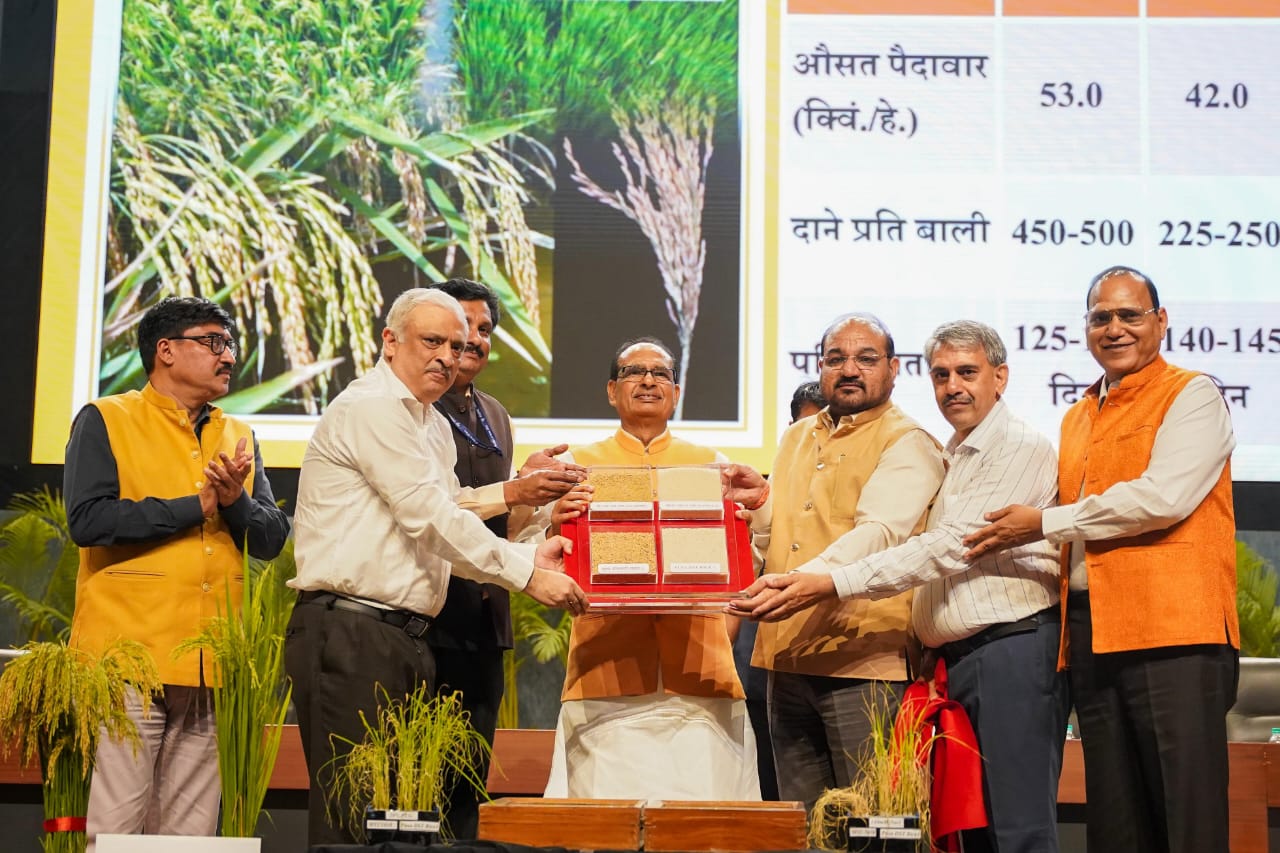
New Delhi : Union Minister for Agriculture, Farmers Welfare, and Rural Development Shivraj Singh Chouhan unveiled two groundbreaking genome-edited rice varieties developed in India, declaring them as a major step toward ushering in a second Green Revolution. Addressing a press conference at the Indian Council of Agricultural Research (ICAR) headquarters in New Delhi, the Minister emphasized the urgent need to make these new varieties accessible to farmers across the country.
“These rice varieties are not only a scientific breakthrough but also a catalyst for improving yields, ensuring food security, and adapting to climate challenges,” said Chouhan. He directed concerned officials to expedite the distribution process so that the benefits of this innovation reach farmers at the earliest.
One of the new varieties, Kamala (DRR Dhan 100), has been developed by ICAR–Indian Institute of Rice Research (IIRR), Hyderabad. It is a genome-edited version of the popular fine-grain variety Samba Mahsuri (BPT 5204), with enhanced grain number, better drought tolerance, and nitrogen-use efficiency. Remarkably, Kamala matures 20 days earlier than its parent variety. In nationwide trials, its average yield was found to be 5.3 tonnes per hectare — 19% higher than Samba Mahsuri’s 4.5 tonnes.
The second variety, Pusa DST Rice 1, developed by ICAR-IARI, Pusa, New Delhi, is a genome-edited version of the widely grown MTU 1010 variety. By modifying the DST gene responsible for drought resistance and salinity tolerance, scientists have enhanced its resilience in challenging soil conditions. “MTU 1010 is already a farmer-favorite in southern India for Rabi season rice. The improved version gives 20% higher yield in saline and alkaline soils,” said the Minister.

Chouhan highlighted that these varieties are targeted for adoption across key rice-growing states, including Andhra Pradesh, Telangana, Karnataka, Tamil Nadu, Puducherry, Kerala, Chhattisgarh, Maharashtra, Madhya Pradesh, Odisha, Jharkhand, Bihar, Uttar Pradesh, and West Bengal. Cultivation across 5 million hectares in these regions could potentially boost rice production by 4.5 million tonnes.
The Minister also pointed to significant environmental and agronomic benefits. “These varieties will reduce greenhouse gas emissions by approximately 3,200 tonnes and save nearly 7,500 million cubic meters of irrigation water due to shorter maturity duration and fewer irrigation cycles,” he said. Faster crop cycles will enable timely sowing of successive crops and promote multi-cropping systems, leading to increased agricultural productivity.
Chouhan assured that India has adequate food reserves to withstand any crisis and reaffirmed the government’s commitment to enhancing productivity through science-led innovation. “We are working at full speed to increase production capacity and ensure that these varieties reach farmers without delay,” he said in conclusion. The press conference marks a pivotal moment in Indian agriculture, with genome editing poised to redefine sustainable farming practices and ensure food security for future generations.