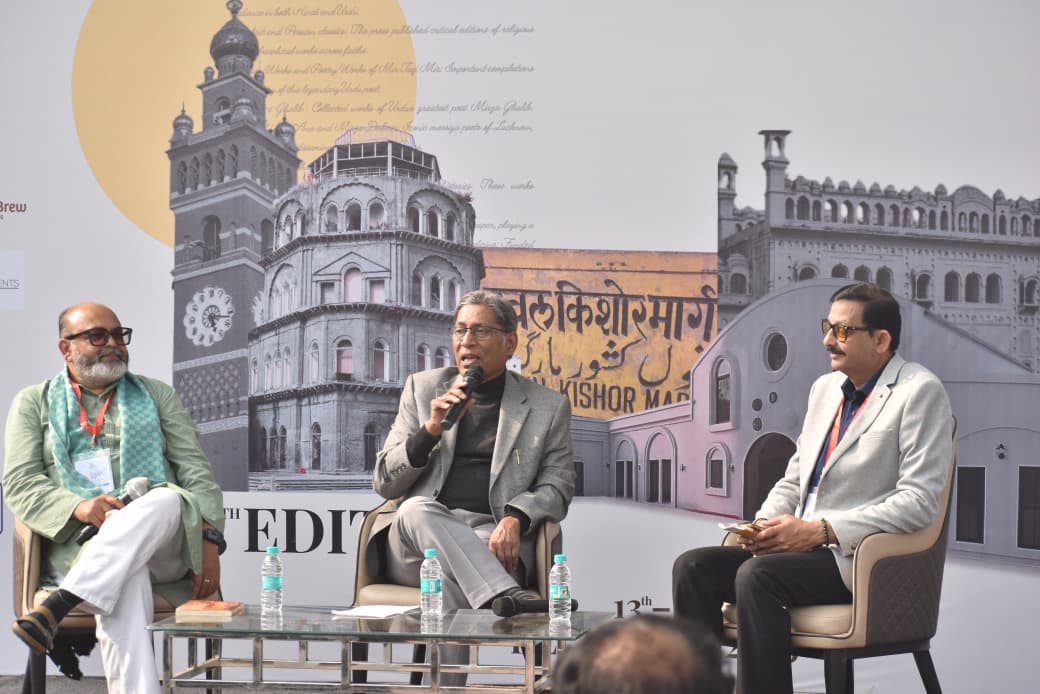
Lucknow: The third session of the Metaphor Literature Festival, titled “Baaten Ghazlon-Nazmon Ki”, brought together eminent poets Amitabh Singh Baghel, Chandra Shekhar Verma, and Anisur Rahman for a captivating discussion on the traditions, history, and spiritual depth of Urdu poetry.
Opening the session, Anisur Rahman remarked, “Just as in the previous session we spoke about healing diseases, poetry too can heal a patient.” He highlighted the importance of distinguishing between the two primary forms of Urdu poetry—nazm and ghazal—noting that while difficult, understanding this distinction is essential. Rahman also referenced stalwarts like the Progressive Writers’ Movement, Faiz, Sahir, Janisar Akhtar, and Nazar Mohammad Rasheed, emphasizing that Rasheed’s work continues to enjoy global recognition. He invited Baghel to share his experiences with Rasheed.
Smiling, Amitabh Singh Baghel said, “Ishq is both a cure and a disease,” recalling his early meetings with Azmi and Sahir, which ultimately led him to Rasheed. Baghel compiled Rasheed’s scattered works into a comprehensive collection. During the session, Rasheed’s nazm “Hasan Kozagar” was hailed as one of the finest Urdu nazms of the 20th century, and Baghel delivered a beautiful recitation for the audience. Rahman noted the contrast in style: while Faiz’s poetry is musical, Rasheed’s carries profound solitude and depth, “it impacts even more when read alone at night.”
Chandra Shekhar Verma shared his journey in ghazal writing, recalling guidance that one must first listen and read extensively before attempting to compose. His celebrated couplet:
“Dil mohabbat mein hai toota to marammat kijiye,
Aur marammat ke liye phir se mohabbat kijiye”
was widely appreciated by attendees. Verma explained that in a ghazal, even the slightest change in a single zer can disrupt the entire verse, underscoring the meticulous craft, refinement of words, and humility essential to a poet.

Anisur Rahman emphasized that poetry is not merely spirituality, but a respect and devotion to words. He described nazm as expression and ghazal as expansion—“our sorrow hides within our expansion.”
The session concluded with reflections on literary generations, evolving audience preferences, and the slow, painstaking process through which great literature establishes its place. Rahman observed, “Great literature makes its place slowly and painfully,” citing Rasheed as a living example. The discussion celebrated the rich partnership of Urdu, Hindi, and multilingual Indian literature, leaving the audience inspired by the depth and beauty of poetic traditions.