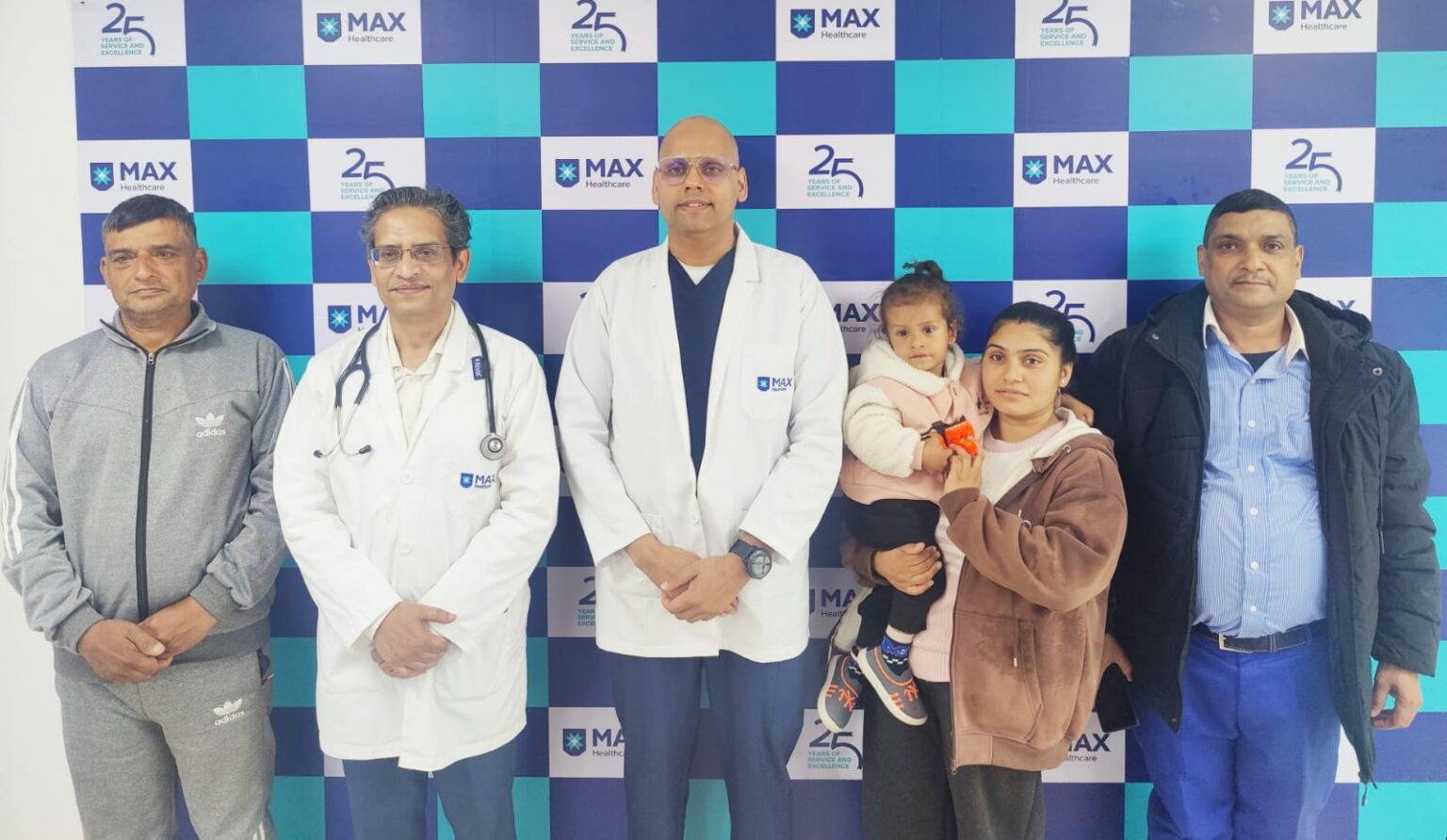
Lucknow: Doctors at Max Super Specialty Hospital, Lucknow, have successfully treated a 19-month-old child from Nepal suffering from an exceptionally rare and complex combination of congenital kidney and gallbladder disorders, giving the toddler a new chance at a healthy life.
The child was diagnosed before birth with a horseshoe kidney — a rare congenital condition in which both kidneys are fused together — along with bilateral ureteropelvic junction obstruction (UPJO), a condition that blocked urine drainage from both kidneys. As a result, both kidneys became grossly enlarged, occupying most of the abdominal cavity and placing the child at high risk of kidney failure. Compounding the complexity, the infant was also found to have gallbladder stones and a stone in the common bile duct (CBD), an extremely unusual combination in such a young patient.
After being assessed at multiple medical centres in Nepal, the child was deemed too young and the condition too complex for surgery. The family subsequently approached Max Hospital, Lucknow, known for its advanced expertise in paediatric urology and minimally invasive surgery.
Explaining the challenges involved, Dr Rahul Yadav, Director, Urology, Andrology, Kidney Transplant & Robotic Uro-Oncology at Max Hospital, Lucknow, said that both kidneys were massively enlarged, leaving very limited space to operate. “Operating on such a small child with such extensive abnormalities is exceptionally demanding. We therefore planned a single-anaesthetic, multidisciplinary surgical approach involving multiple specialties,” he said.
During a four-hour procedure, the urology team performed minimally invasive laparoscopic surgery to correct the obstruction in both kidneys and placed stents to ensure proper urine flow. At the same time, the gastro-surgery team carried out a laparoscopic removal of the gallbladder, while the gastroenterology team managed the bile duct stone medically and prepared for endoscopic intervention if required.
Highlighting the coordinated approach, Dr Ajay Yadav, Director & Head, Robotic Surgery, Gastrosurgery & GI Oncology, said that the same surgical ports were used for both urology and gallbladder procedures. “By avoiding additional ports and repeat surgeries, we reduced trauma, prevented repeated anaesthesia exposure, and ensured faster recovery for the toddler,” he said.
Despite the extreme complexity and the child’s small abdominal size, the surgery was completed successfully. Feeding was resumed within 12 hours, and the child was discharged in just four days with excellent recovery.
Stressing the importance of timely treatment, Dr M.U. Hasan, Director & Head, Department of Paediatrics & Neonatology, Max Hospital, Lucknow, said the child was at very high risk. “Without early surgical correction, his growth and survival could have been severely compromised. Today, he has a real opportunity to lead a normal and healthy life,” he said.
The case underscores the growing capabilities of advanced paediatric and minimally invasive surgical care in India, offering hope to patients even from beyond national borders.