
New Delhi: As India steps into 2026, its defence sector stands on the threshold of a historic transformation. What began as an ambitious policy vision under Atmanirbhar Bharat has evolved into a measurable, system-wide shift—one marked by indigenous manufacturing breakthroughs, record-high budgetary support, accelerated weapon inductions, and a decisive push toward becoming a global defence exporter.
The year is not merely about new platforms entering service; it represents a structural realignment of India’s military-industrial ecosystem. From advanced fighter aircraft and stealth submarines to next-generation missiles and space-enabled warfare systems, 2026 is shaping up as the year when India’s defence ambitions transition from intent to irreversible momentum.
Fuelled by the Union Budget 2025–26, which places self-reliance, technology integration, and operational readiness at its core, India’s defence establishment is moving rapidly to reduce import dependency—still hovering around 60 percent for select critical systems—while strengthening deterrence amid an increasingly volatile regional security environment.
Weapon Inductions in 2026: Building Capability Across Domains
One of the clearest indicators of India’s defence evolution in 2026 is the scale and diversity of weapon inductions scheduled across air, naval, and land forces. These inductions not only enhance combat readiness but also underscore the growing maturity of India’s domestic defence manufacturing base.
Tejas Mk-1A: Backbone of Indigenous Air Power
The Light Combat Aircraft Tejas Mk-1A will be a central pillar of the Indian Air Force’s modernization drive in 2026. At least five aircraft are scheduled to be delivered by March 2026, marking the end of the financial year. These deliveries are part of a massive 180-aircraft programme—83 jets ordered in 2021 and an additional 97 cleared in 2025.
Equipped with advanced avionics, AESA radar, electronic warfare suites, and beyond-visual-range missile capability, the Tejas Mk-1A significantly enhances India’s aerial combat capacity while reducing reliance on imported fighters. Hindustan Aeronautics Limited (HAL), the programme’s prime integrator, is expected to ramp up production capacity steadily through 2026.
Medium Weight Fighter (Tejas Mk-2): Bridging the Capability Gap
Another milestone expected in 2026 is the rollout of the prototype of the Medium Weight Fighter (MWF-1), also referred to as Tejas Mk-2. Slated for rollout by April, the aircraft is designed to fill the capability gap between light fighters and heavier platforms.
With enhanced payload, improved thrust, advanced stealth features, and potential supercruise capability, the Mk-2 moves India closer to the 4.5 to 5th-generation fighter category. Its development is also critical as a technological bridge toward the Advanced Medium Combat Aircraft (AMCA).
C-295 Transport Aircraft: Logistics Made in India
In the transport segment, September 2026 is expected to see the rollout of the first indigenously assembled C-295 medium tactical transport aircraft. Manufactured in Vadodara under a ₹21,935-crore deal between the Tata-Airbus consortium and the Government of India, the programme covers 56 aircraft.
The C-295 will replace the Indian Air Force’s aging Avro fleet and significantly enhance troop transport, logistics, and disaster response capabilities. The project is a landmark in private-sector participation, marking a shift away from exclusive public-sector dominance in aerospace manufacturing.
Naval Power in Focus: Submarines and Stealth Frigates
India’s maritime ambitions gain critical depth in 2026, particularly in the context of nuclear deterrence and blue-water naval capability.
INS Aridaman: Strengthening the Nuclear Triad
Early 2026 is expected to witness the commissioning of INS Aridaman, the third Arihant-class nuclear-powered ballistic missile submarine (SSBN). As a stealth platform capable of launching nuclear-tipped ballistic missiles, Aridaman significantly enhances India’s second-strike capability—an essential pillar of credible nuclear deterrence.
With this induction, India strengthens the sea-based leg of its nuclear triad, ensuring survivability and strategic stability amid evolving regional threats.
Project 17A Frigates: The New Face of Surface Warfare
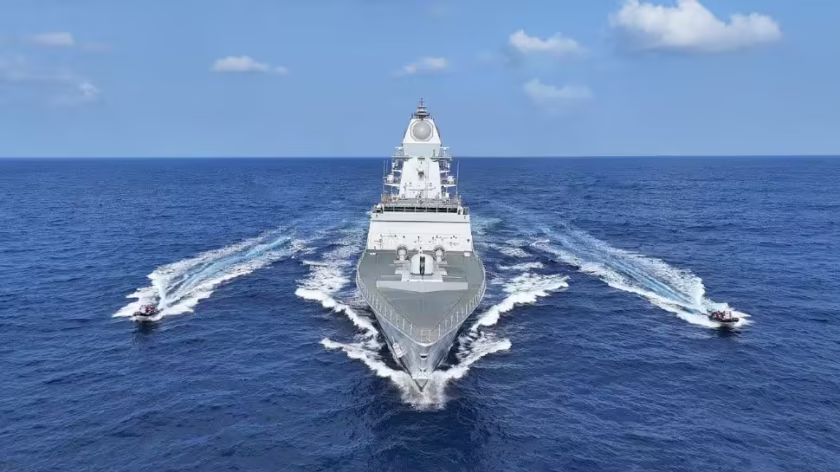
Four stealth frigates under Project 17A—Taragiri, Mahendragiri, Dunagiri, and Vindhyagiri—are scheduled for commissioning between August and September 2026. Valued at approximately ₹45,000 crore, the programme represents a major leap in naval surface combatant design.
Featuring advanced stealth geometry, state-of-the-art sensors, and modern weapon systems, these Nilgiri-class frigates enhance the Indian Navy’s ability to operate in contested maritime environments, particularly in the Indo-Pacific.
Missiles, Rockets, and Precision Warfare
India’s missile and munitions ecosystem continues its rapid expansion in 2026, reinforcing both defensive and offensive capabilities.
The next-generation Akash surface-to-air missile system, featuring improved range, accuracy, and response time, is slated for multiple inductions throughout the year. This system strengthens India’s layered air defence network, particularly around critical assets.
Simultaneously, long-range rockets and loitering munitions—designed for precision strikes and extended reach—are expected to be inducted across ground forces. These systems reflect India’s growing emphasis on network-centric and precision warfare.

Budgetary Backbone: Union Budget 2025–26 Sets the Stage
The foundation for this transformation lies in the Union Budget 2025–26, which allocated ₹6,81,210 crore (approximately US$78.57 billion) to defence—an increase of 9.5 percent over the previous year. Of this, capital expenditure stands at ₹1,80,000 crore, underscoring the priority accorded to modernization.
Key Budgetary Focus Areas
-
Indigenous Manufacturing: Strong emphasis on reducing imports through domestic production, supported by policies aligned with Atmanirbhar Bharat.
-
Technology Integration: Increased funding for AI-driven systems, cyber security, and advanced surveillance, including groundwork for a 52-satellite constellation planned by 2030.
-
Research and Development: Nearly 3.93 percent of the defence budget earmarked for R&D, fostering collaboration with private firms, startups, and academia.
-
Infrastructure and Training: Enhanced investment in border infrastructure, particularly along the Line of Actual Control, and upgrades to military training facilities.
-
Personnel Welfare: Expanded healthcare coverage, pensions, and welfare schemes for serving personnel and veterans.
Collectively, these measures build on 2025’s designation as the “Year of Reform,” aimed at streamlining procurement processes and improving execution efficiency.
Export Ambitions: From Buyer to Global Supplier
Perhaps the most striking shift in India’s defence narrative is its export trajectory. By March 2026, India aims to achieve ₹30,000 crore in defence exports, up from ₹23,622 crore in FY25. The longer-term target is ₹50,000 crore by 2029.
Systems such as the BrahMos missile are at the forefront of this push, with ongoing deliveries to international partners including the Philippines. These exports not only generate revenue but also enhance India’s strategic influence.
With domestic defence production already reaching ₹1.3 lakh crore in FY24, India is steadily positioning itself as a reliable supplier in the global arms market. Analysts note that this momentum could elevate India’s standing as one of the world’s top military powers.
Economic and Strategic Ripple Effects
The defence sector’s growth is creating significant economic spillovers. Manufacturing expansion is generating skilled employment, strengthening MSME participation, and contributing to GDP growth. Defence-related stocks, particularly HAL and BEL, rallied sharply in 2025, with gains of up to 45 percent—reflecting investor confidence in sustained structural growth through 2026 and beyond.
Strategically, enhanced capabilities—ranging from S-400 air defence systems to upgraded Su-30 fleets—reinforce deterrence at a time of heightened geopolitical uncertainty. Indian Air Force combat exercises and operational readiness indicators further signal a force prepared for modern, multi-domain warfare.
Challenges Ahead: Execution Matters
Despite the progress, challenges remain. Supply-chain constraints, production bottlenecks, and technology absorption issues could delay timelines. Bridging the gap between design, testing, and serial production—particularly for advanced platforms like AMCA—will be critical.
Nevertheless, 2026 represents a decisive inflection point. The scale of investments, the breadth of inductions, and the clarity of policy direction suggest that India’s defence transformation is no longer aspirational—it is structural.
2026 as the Turning Point
In sum, 2026 emerges as the year India’s defence sector truly comes of age. Through self-reliance, sustained budgetary commitment, accelerated modernization, and growing export strength, India is redefining its role from a major arms importer to a credible global defence manufacturing hub.
While challenges persist, the milestones expected in 2026 could permanently alter India’s strategic posture—enhancing deterrence, boosting economic resilience, and positioning the country as a key pillar of security in an increasingly uncertain world.