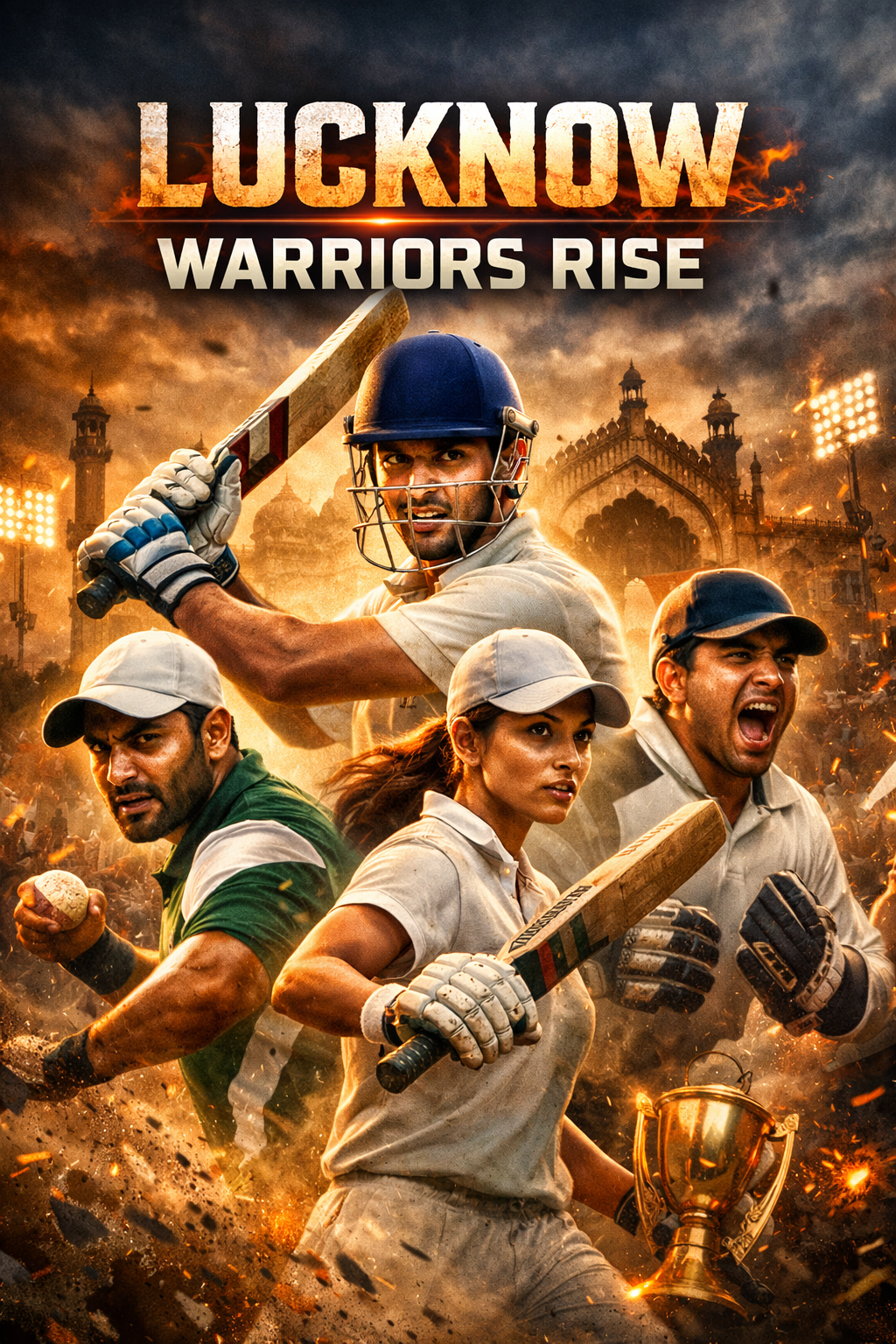
In the narrow, fragrant lanes of old Lucknow, where the air carried the scent of kebabs sizzling on coal fires and the distant call of the Azaan mingled with temple bells, cricket was more than a game—it was religion, escape, and rebellion all at once. The city, once the seat of Nawabs and poets, now pulsed with the restless dreams of its young. Amid this chaos rose a ragtag group that dared to call themselves the Lucknow Warriors.
At the heart of the team was Arjun Singh, a 22-year-old opening batsman from the crowded alleys of Aminabad. Son of a rickshaw puller, Arjun had learned to read the game the way his father read the moods of passengers—by instinct and survival. Tall, lean, with calloused hands and eyes that burned with quiet fire, he could pierce the field with elegant drives or clear the boundary with raw power. But his greatest battle was not against bowlers; it was against the voice in his head that whispered he would always remain “the rickshaw-wallah’s son.”
His closest ally and fiercest rival on the field was Zain Khan, the team’s lightning-fast left-arm pacer from the Muslim-dominated areas of old Lucknow. Zain’s father, a retired tailor, had stitched cricket kits for local clubs before his eyesight failed. Zain bowled with the grace of a dancer and the fury of someone who had seen his community looked down upon. Off the field, he was soft-spoken, poetic, often quoting Ghalib under his breath. On it, he was a storm—his yorkers could make even seasoned batsmen dance.
Then there was Ritu Sharma, the only girl in the core group and the team’s explosive middle-order batter and part-time spinner. At 19, she was the daughter of a conservative schoolteacher who believed cricket was “not for girls.” Ritu practiced in secret, wearing her brother’s oversized jerseys, her long braid tucked under a cap. Her wrists were made of steel; she could play the most delicate late cuts or launch the ball into the stands with shocking power. She joined the Warriors after Arjun saw her smashing sixes in a local mohalla tournament and personally convinced her father with a heartfelt promise: “She will make Lucknow proud.”
Completing the core was Rahul “Chhotu” Yadav, the wicket-keeper and the team’s jester. Short, stocky, and endlessly energetic, Chhotu came from a family of vegetable vendors in Chowk. He had the quickest hands in the city and an uncanny ability to lift the team’s spirits with his mimicry and one-liners. Behind the jokes lay a deep insecurity—he had failed his Class 12 exams twice and feared he had no future beyond cricket.
Their mentor was Coach Vikram “Vikky” Malhotra, a 58-year-old retired Ranji Trophy player who had once represented Uttar Pradesh. Vikky Sir had been forced to retire early after a knee injury against Mumbai. Bitter and broken at first, he had returned to Lucknow and opened a small coaching academy in a crumbling ground near the Gomti River. The academy had no nets, no proper pitch, and equipment held together by duct tape and prayers. But Vikky saw raw hunger in these four youngsters. “Talent is cheap,” he would growl during training, sweat dripping from his graying mustache. “Heart is expensive. Show me your heart.”
Every evening, as mango trees cast long shadows and the call for Maghrib prayers floated across the river, the Warriors gathered at the dusty Maidan. They had no turf, no bowling machine, no physiotherapist. Their “nets” were two frayed ropes tied between poles. The balls were old and scuffed; some still carried the marks of previous owners. The scorching 42°C heat turned the ground into an oven, yet they trained until their shirts clung to their bodies and their lungs burned.
They faced endless obstacles. Local bullies from richer clubs mocked them as “the gutter team.” Sponsors ignored them. Once, during monsoon, their only decent bat was stolen. Another time, Zain’s father fell seriously ill, and Zain nearly quit to work at a garment factory. Arjun’s father begged him to stop “this nonsense” and help earn money for the family. Ritu’s family threatened to marry her off if she didn’t stop playing. Yet every time someone wavered, the others pulled them back.
Coach Vikky added layers of wisdom beyond technique. He taught them the Lucknowi art of tehzeeb—grace under pressure. He made them read about Kapil Dev’s 1983 World Cup triumph and Imran Khan’s leadership. He drilled into them the importance of reading the game like a chessboard, not just hitting and bowling blindly. Slowly, the team transformed. Arjun learned patience at the crease. Zain mastered variations—slower balls, cutters, and the occasional mystery delivery. Ritu developed an unorthodox carrom-ball spin that baffled batsmen. Chhotu became a master of psychological warfare behind the stumps, sledge-talking in chaste Awadhi dialect.
As the Uttar Pradesh Premier League (UPPL) approached, the Warriors were still underdogs. Wealthier teams from Kanpur, Varanasi, and Ghaziabad had imported players, shiny kits, and corporate sponsors. The Warriors’ jerseys were stitched by Zain’s father on an old Singer machine—simple white with “Lucknow Warriors” handwritten in bold blue.
But something magical was happening in the narrow galis of Lucknow. Word spread about the “Gomti ke Sher” (Tigers of Gomti). Local chaiwalas started keeping scoreboards on their walls. Women in burqas and sarees began gathering at the boundary. Schoolchildren skipped tuitions to watch them. Even elderly Nawab descendants sent quiet blessings.
The league began with a shock. In their first match against the heavily favored Kanpur Kings, the Warriors were 47/4 in the 8th over. Arjun and Ritu stitched a 112-run partnership of elegance and audacity. Zain tore through the batting line-up with 5 wickets. They won by 23 runs. Lucknow erupted. For the first time, people chanted: “Warriors! Warriors!”
Match after match, they defied expectations. Against Varanasi, they chased 189 in the final over, with Chhotu hitting the winning six while cramping mid-stride. Against another side, Ritu scored a blazing 87 not out after being mocked for being a girl. Each victory built their legend—and their burden.
But cracks formed beneath the glory. Arjun received offers from elite clubs. Zain’s father’s health worsened. Ritu faced online abuse and threats. Coach Vikky suffered a mild heart scare but hid it from the team.
The semi-final against the Lucknow Royals was brutal. Armaan Qureshi, their arrogant captain, called them “street dogs pretending to be lions.” The match turned heated, almost violent. But Arjun’s unbeaten 94 and Zain’s fiery spell sealed a dramatic win.
The final was set against the Gorakhpur Gladiators—champions with elite facilities and three former first-class players.
The night before the final, by the Gomti River, Coach Vikky said softly:
“You are not playing for a trophy. You are playing for every boy who pulls a rickshaw instead of holding a bat. For every girl told her place is in the kitchen. Tomorrow, show them what Lucknow’s soul looks like.”

At Ekana Stadium, over 25,000 spectators filled the stands. The Gladiators posted 198/6. The chase began poorly—Arjun out for 12, middle order collapsing.
98/5 in 14 overs. The dream was fading.
Then Ritu walked in.
She and Chhotu revived hope with a fearless stand. When Chhotu fell, Zain joined her. 12 needed off the last over.
Zain smashed a six first ball. Chaos followed. Two wickets fell. 3 runs needed off 2 balls.
Ritu faced the final bowler.
She stepped out, read the length like destiny itself, and lofted the ball over long-on.
It sailed into the Lucknow sky—and never looked like coming down.
SIX.
The stadium erupted. Fireworks lit the night. The Lucknow Warriors had done the impossible.
Arjun embraced his father. Zain’s father raised trembling hands in prayer. Ritu’s mother cried openly. Coach Vikky stood at the boundary, silent—broken not by pain, but overwhelmed by pride.
That night, Lucknow did not sleep. It celebrated.
Because the victory was never just about cricket.
It was about defiance. Identity. And belief carved out of dust.
The Lucknow Warriors had not merely won a tournament.
They had ignited a revolution.
And this… was only the beginning.