Lucknow: As India’s railways script a new chapter in high-speed, passenger-centric travel, the Vande Bharat Express has emerged as the most visible symbol of this transformation. Since its launch in 2019, the semi-high-speed train network has expanded rapidly, with over 150 Vande Bharat services operational by November 2025, spanning 25 states and covering more than 50,000 kilometres. Cutting travel time by up to 30 per cent, these trains combine speed with comfort—rotatable seats, onboard Wi-Fi, infotainment systems and bio-vacuum toilets—bringing a distinctly modern experience to Indian Railways.
At the heart of this evolving network lies Lucknow. More than just the capital of Uttar Pradesh, the city has become a strategic rail hub—India’s eighth-busiest junction—where history, geography and policy converge. With multiple Vande Bharat services originating, terminating or halting here, Lucknow is steadily acquiring a new identity: a “Vande Bharat gateway” for North and Central India.
The Lucknow–Kashi Link: When Heritage Meets High Speed
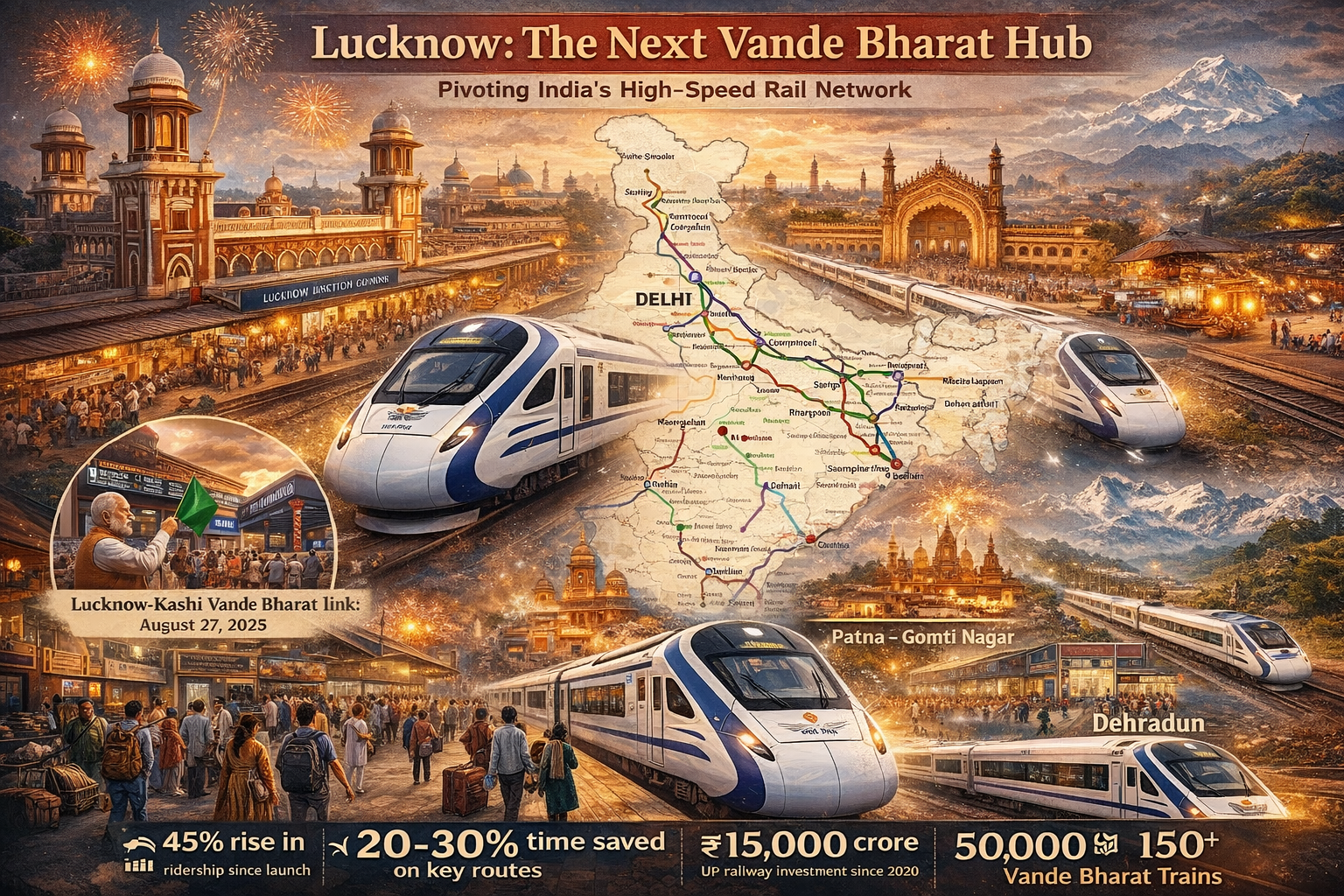
The most symbolic addition to this network came on August 27, 2025, when the Meerut City–Varanasi Vande Bharat Express (Train Nos. 22490/22489) was extended from Lucknow to Kashi. What was earlier a Meerut–Lucknow service has now become a 783-kilometre corridor connecting western Uttar Pradesh, the state capital, Ayodhya and India’s spiritual epicentre—Varanasi.
Flagged off virtually by Prime Minister Narendra Modi, the extension fits squarely into his vision of a rail network that “converges culture, faith and development.” The train now departs Meerut City early morning, reaches Lucknow NER by late morning, halts at Ayodhya Dham Junction—home to the Ram Temple—before continuing to Varanasi by evening. In the reverse direction, it enables a same-day return for business travellers and pilgrims alike.
For passengers travelling between Lucknow and Varanasi, the journey now takes just over five hours, a 30 per cent reduction compared to conventional trains. Fares range from around ₹1,800 for Chair Car to ₹3,200 for Executive Class. Northern Railway data indicates a 45 per cent spike in ridership since the extension, with over 70,000 passengers using the service weekly.
Beyond numbers, the impact is deeply cultural. Pilgrims can now leave Lucknow in the morning, attend darshan at Kashi Vishwanath Temple, witness the Ganga Aarti in the evening and return the next day—without overnight halts. For Uttar Pradesh’s tourism economy, estimated at nearly ₹2 lakh crore annually, the implications are significant.
Lucknow as a Rail Nerve Centre
Lucknow’s growing prominence in the Vande Bharat ecosystem builds on its long-standing role as a rail crossroads. The city interfaces with three major railway zones—Northern, North Central and North Eastern—handling nearly 3.5 lakh passengers daily across its stations: Charbagh (Lucknow Junction), Gomti Nagar, Alamnagar and Lucknow NER.
Charbagh, inaugurated in 1914 and famed for its Indo-Saracenic architecture, is undergoing a massive transformation under the Amrit Bharat Station Scheme. With redevelopment costs crossing ₹1,200 crore, the station is being reimagined with segregated arrival and departure zones, AI-enabled crowd management, solar roofs and modern concourses. Officials estimate congestion has already reduced by a quarter, with full completion expected by mid-2026.
Gomti Nagar, meanwhile, has broken new ground as Uttar Pradesh’s first privately managed railway station. Since August 2025, it has introduced airport-style amenities—escalators, lounges and food courts—resulting in a sharp rise in passenger footfall. Together, these upgrades reinforce Lucknow’s capacity to absorb rising traffic from high-speed services like Vande Bharat.
Strategically, Lucknow also helps decongest the Delhi-centric rail corridors by channeling traffic through the Gangetic plains. More than 400 trains halt here daily, enabling seamless transfers between northern, eastern and central India. Freight movement—particularly agricultural produce and industrial goods—adds another layer to its importance.

A Star-Shaped Vande Bharat Hub
The Lucknow–Varanasi extension is only one spoke in a rapidly expanding hub. The city anchors three other major Vande Bharat routes:
-
Lucknow–Dehradun, connecting the plains to Uttarakhand’s hills and boosting tourism.
-
Patna–Gomti Nagar, an eastern lifeline facilitating talent and trade flows between Bihar and Uttar Pradesh.
-
Lucknow–Saharanpur, launched in November 2025, linking western UP and the Doon industrial belt.
Together, these routes create a star-shaped connectivity pattern, positioning Lucknow as a connector city for a population belt of nearly 240 million people. Short halts of 10–15 minutes at Lucknow stations allow quick transfers, with occupancy levels consistently above 80 per cent—translating into robust revenue and operational viability.
Environmentally too, the impact is notable. With over 95 per cent electrification achieved in the region, Vande Bharat services through Lucknow are estimated to cut thousands of tonnes of carbon emissions annually compared to equivalent road travel.
Looking Ahead
With more Vande Bharat rakes under production and ambitious rail capital expenditure planned nationwide, Lucknow’s role is set to deepen further. Proposed future links—such as Lucknow to Indore or Ranchi—would integrate the city even more tightly into India’s emerging high-speed rail tapestry.
Challenges remain: track doubling, signalling upgrades and capacity augmentation are works in progress. Yet the direction is clear. As Prime Minister Modi remarked at a recent flagging-off ceremony in Varanasi, India’s pilgrimage sites, economic centres and cultural capitals are being woven together by steel, speed and technology.
In that tapestry, Lucknow is no longer just a stop on the map. It is fast becoming the axis—where heritage meets high speed, and where the future of Indian rail connectivity quietly but decisively converges.