Lucknow: Lucknow, the City of Nawabs, has always been a tapestry of elegance—its tehzeeb, architecture, cuisine, and cultural refinement weaving together a story that is both timeless and deeply rooted in India’s artistic soul. From the Gomti River’s calm ripples to the scent of kebabs drifting through Chowk’s bustling alleys, the city holds an old-world charm that refuses to fade. And yet, over the last decade, another narrative has taken shape—one where Lucknow emerges not just as a cultural capital, but as Bollywood’s most magnetic new playground.
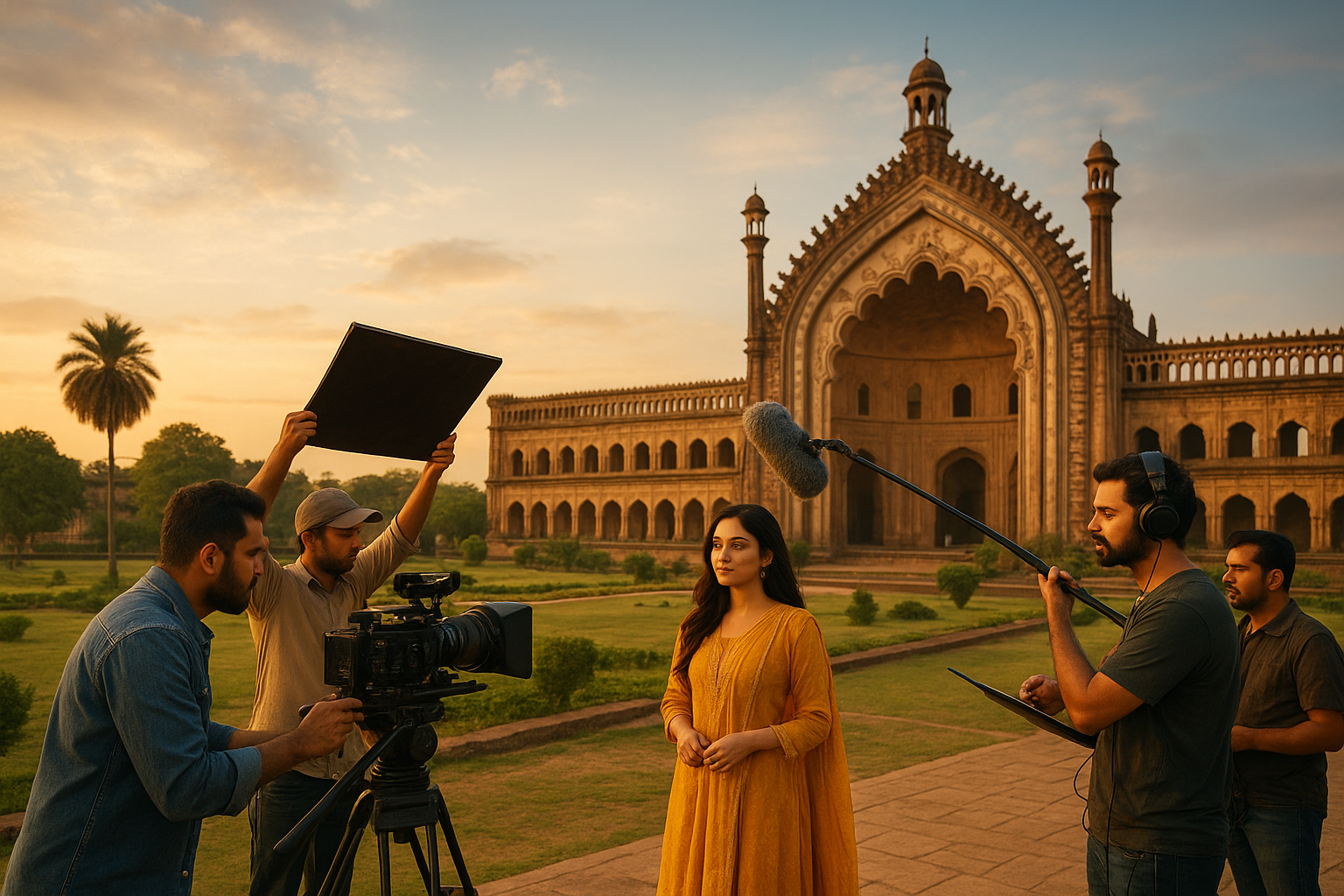
Once used sparingly as a backdrop for classical or period films, Lucknow today stands tall as a full-fledged production hub for mainstream cinema, web series, independent films, and OTT giants. What began as scattered shoots has transformed into a cinematic movement. Production vans now line the streets of Hazratganj, spot boys sip chai in Kaiserbagh, and actors rehearse lines against the arches of Rumi Darwaza. Lucknow is no longer a character cameo—it is a star.
A Relationship Rooted in History
The connection between Lucknow and Indian cinema was forged long before the first film crew landed with cameras. The city’s artistic legacy—poetry, music, storytelling, and theatre—has contributed to Bollywood’s very foundation.
From the lanes of Lucknow emerged poets like Mir Taqi Mir and Mirza Ghalib, whose Urdu verses inspired Bollywood’s most lyrical dialogues. Music maestros Naushad Ali, Talat Mahmood, and Begum Akhtar carried the city’s melodic heritage into film studios, shaping the golden era of Hindi film music. Writers such as Kaifi Azmi and Javed Akhtar infused scripts with the poetic cadence of Lucknow’s cultural refinement.
Cinema first turned its lens towards Lucknow in Pakeezah (1972). The hauntingly beautiful “Chalo Dildaar Chalo,” filmed along the Gomti River, captured the city’s serene charm in a way no film had before. But it was Umrao Jaan (1981), directed by Muzaffar Ali, that immortalized Lucknow on screen. With Rekha’s luminous portrayal of the courtesan Umrao and the film’s visual homage to kothas, bazaars, and havelis, Lucknow appeared not just as a backdrop but as a living character—full of nostalgia, melancholy, and unmatched elegance.
Satyajit Ray’s Shatranj Ke Khiladi (1977) deepened this bond further, using the Bara Imambara and the bhool bhulaiya to narrate a tale of political intrigue during the fall of Awadh. Ray’s meticulous attention to Lucknow’s historical architecture set the tone for future filmmakers exploring the city’s visual and cultural richness.
Yet, despite these landmark moments, Lucknow remained a cameo player for decades. Film studios in Mumbai dominated, and foreign locations became Bollywood’s fascination. Only in the 2000s did directors rediscover the appeal of authentic Indian landscapes—and Lucknow began rising again.
The Turning Point: Why Filmmakers Can’t Resist Lucknow
What changed? Why did Lucknow shift from an occasional muse to a constant creative haunt?
1. A Visual Treasure Trove
Lucknow is cinematic gold. Filmmakers love that they can shoot a rustic drama in Old Lucknow at dawn, a high-gloss romance in Gomti Nagar by afternoon, and a historical sequence at the Residency in the evening—all without leaving the city.
The Rumi Darwaza, the British Residency, Safed Baradari, La Martiniere College, and the narrow galis of Chowk offer a diversity matched by few Indian cities. Directors frequently praise the authenticity visible in every frame—whether it’s the dusty charm of a 19th-century courtyard or the shimmering skyline along the Gomti Riverfront.
2. The Economic Advantage
Uttar Pradesh’s aggressive film promotion policies have turned the state into one of India’s most cost-effective shooting destinations. Subsidies, single-window clearances, and lower logistical costs make Lucknow significantly cheaper than Delhi or Mumbai. Where permissions and crowd management can drain budgets in larger metros, Lucknow remains welcoming, organized, and easy to navigate.
This difference is substantial—producers often save 30–50% simply by choosing Lucknow. The result? Over a hundred film and OTT projects shoot in UP every year, with Lucknow at the center of this boom.
3. A Culture of Hospitality
Lucknow’s famed tehzeeb isn’t a cliché—it’s a daily reality for film crews. Locals greet actors warmly, crowds cooperate during shoots, and neighborhoods often turn into extended film families. Stars frequently mention their delight in feasting on home-cooked biryani or kebabs brought by residents during late-night schedules.
The city’s language, flavors, and warmth infuse a natural authenticity into films that aim to depict the complexities or charm of North Indian life. This blend of courtesy and cultural energy makes Lucknow irresistible.

4. A Perfect Fit for Modern Storytelling
As Bollywood explores more grounded narratives—crime dramas, family sagas, socio-political thrillers—Lucknow provides an atmospheric canvas. Its mix of tradition and modernity, its old money and new ambition, its cosmopolitan rise amid deep-rooted heritage—all offer storytellers a layered environment.
Films That Defined Lucknow on Screen
Over the last fifteen years, Lucknow’s presence in Bollywood has expanded dramatically.
Ishaqzaade (2012) brought national attention to the city’s gritty alleys and politically charged college culture. Dawat-e-Ishq (2014) brought food into the spotlight, portraying Lucknow as a gastronomic wonderland. The architecture of Chowk, the lanes of Old Lucknow, and the grand arches of monuments added character to the narrative.
Movies like Tanu Weds Manu, Bullet Raja, Mulk, and Article 15 used Lucknow and its outskirts to depict stories anchored in realism and social commentary. Gulabo Sitabo (2020), with Amitabh Bachchan and Ayushmann Khurrana, turned a decaying Lucknow haveli into an unforgettable metaphor for greed and survival.
The post-pandemic period accelerated this trend. Crews of mainstream and OTT projects—Gunjan Saxena, Thappad, Raid 2, Subedaar, Maalik, Nishanchi—all found Lucknow to be visually rich, cost-efficient, and artistically inspiring.
Today, even international production houses and high-end web series makers are circling the city, drawn to its unique storytelling potential.
How This Boom Is Reshaping Lucknow
The rise of film shoots has sparked a significant cultural and economic transformation.
Hotels, guest houses, rental studios, and catering services have seen surges in business. Local artisans, from chikankari workers to set decorators, find new opportunities. Taxi drivers, junior artists, makeup crews, and security professionals benefit too.
Film tourism has taken off—with fans exploring shooting spots, from Ahmad Manzil to Idris Kebabs. The city’s identity is no longer confined to its Nawabi past; it now resonates with contemporary creative energy.
At the same time, filmmakers acknowledge Lucknow’s role in shaping narratives. More women-centered stories, caste-conscious scripts, and socially rooted themes have emerged, inspired in part by real-life landscapes and lived experiences of the city.
A City and an Industry Growing Together
What began as a gentle cinematic flirtation has blossomed into a robust creative partnership. Bollywood has discovered in Lucknow a city of countless moods—romantic, rebellious, contemplative, festive, and deeply human. Lucknow, in turn, has discovered a spotlight that amplifies its heritage while embracing its modern ambitions.
From the candlelit elegance of Umrao Jaan to the chaotic chase sequences of Raid 2, Lucknow has proven its versatility. As new subsidies roll in, OTT platforms expand, and the appetite for grounded Indian stories intensifies, Lucknow’s prominence will only grow.
The City of Nawabs has found a new title—the City of Cinematic Dreams. And this is only the beginning of its blockbuster journey.