Lucknow — The 17th edition of the Mahindra Sanatkada Lucknow Festival (MSLF) 2026 continued on Saturday with a rich and immersive second day across the historic Qaiser Bagh Complex, expanding the festival’s exploration of cultural connections under the theme “Raabta Lucknow Calcutta Ka.”
Day 2 offered a diverse programme spanning heritage walks, literary conversations, craft showcases, theatre, music, and cultural dialogue, drawing participants into the layered histories and shared traditions of the two cities.
Heritage Walks Trace Forgotten Histories
The day began with multiple curated heritage walks and guided car tours, each offering a distinct perspective on Lucknow’s evolving social and cultural landscape.
The walk “Feminists of Awadh,” led by Saman Habib, traced the lives and legacies of women writers and thinkers such as Atia Hosain and Ismat Chughtai, mapping their presence through homes, institutions, neighbourhoods, and memorial sites.
“Lucknow ki Reha’ish,” conducted by Adity Chakravarty, explored havelis, kothis, and colonial-era bungalows, highlighting changing patterns of residence and urban life from the old city to the British period.
Participants of the Qaiser Bagh Heritage Walk, led by Deep Dive India, were taken through the historic complex and its associated structures, situating them within their political, architectural, and cultural contexts.
Another theme walk, “Calcutta in Lucknow,” mapped Bengali cultural presence in the city, covering landmarks such as the Bengali Club, Sunder Bagh Colony, and Jogendra Pathak Road, illustrating enduring cross-cultural exchanges.
Crafts Bazaar Highlights Living Traditions
The Crafts Bazaar continued to draw attention with diverse craft practices and live demonstrations. Among the notable participants was AH Clothing Co., a Delhi-based brand integrating poetry into sustainable, handcrafted garments made from natural fibres such as cotton, linen, banana yarn, and bamboo yarn.
Shawlstory, led by Lubna Mirza from Dehradun, presented textiles rooted in Najibabad’s traditions, focusing on Rafoogari, Kalamkari, and Kashidakari, while also engaging in sustainability and social initiatives.
Kolkata-based Kadam Haat Basketry Barn Pvt. Ltd. showcased functional and decorative basketry crafted from grass and bamboo, supporting artisan communities across West Bengal, Kashmir, Odisha, and Uttar Pradesh.
Literary Conversations Take Centre Stage
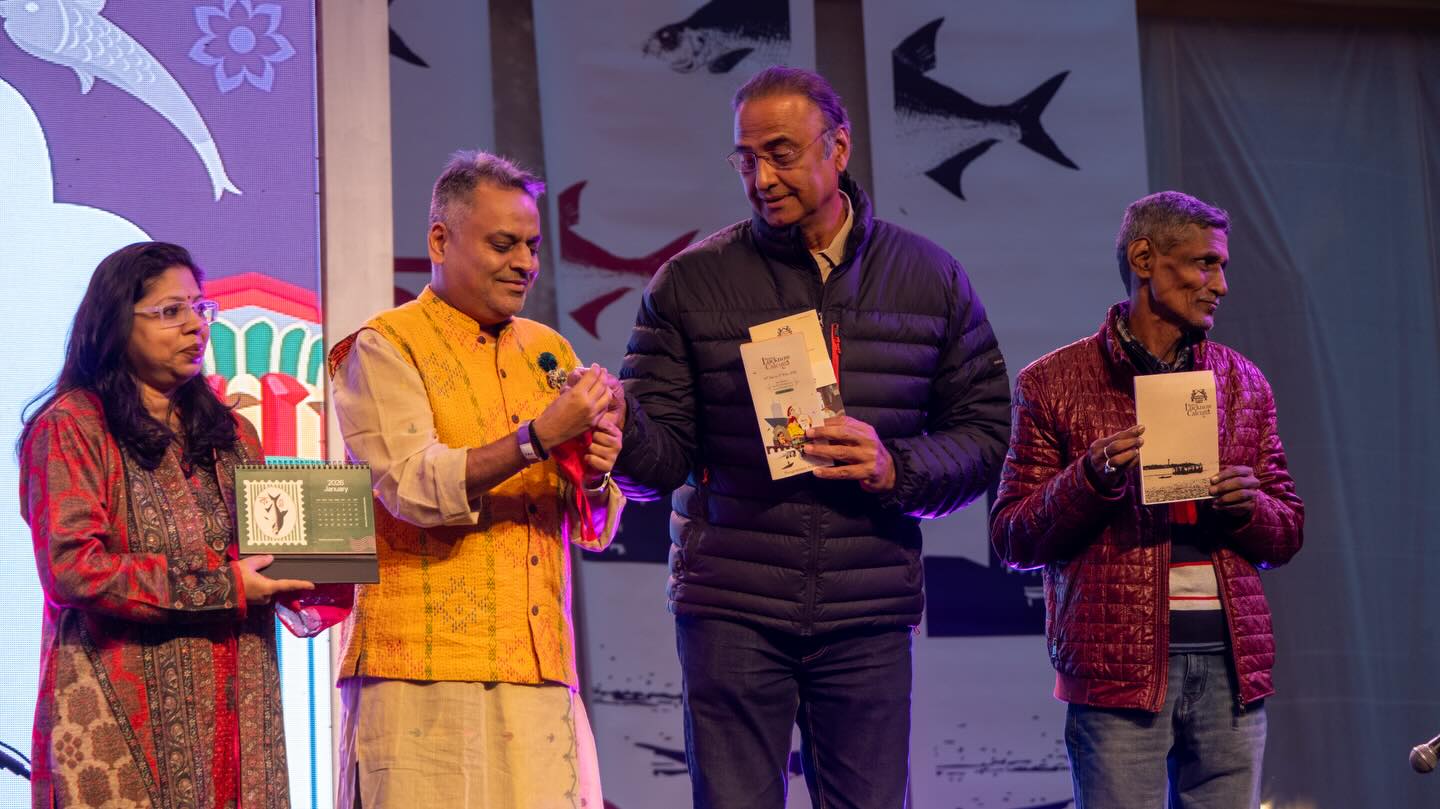
One of the major highlights was the Naseem Iqtidar Ali Literary Guftugu. In the session “Cities Built of Bricks & Narratives,” architect Neeta Das marked the pre-launch of her book Lucknow Architectural Heritage Guide. Reflecting on her relationship with the city, she spoke about understanding identity through architecture, language, and storytelling, while drawing comparisons between Lucknow and Calcutta’s contrasting power structures.

Another conversation, “Taana Baana: Lucknow–Kolkata Ka,” brought together Srila Chatterjee, Subrata Pandey, and Paola Manfredi, who discussed craft, design, and shared cultural ownership. The speakers highlighted how everyday objects, motifs, and design practices form bridges between cities and communities.
In “Sur, Adaa Aur Sheher,” renowned sarod artist Anindya Banerjee traced musical and performative traditions connecting Lucknow and Calcutta, reflecting on the journeys of classical forms and instruments.
The day also saw the release of “Shadows on the Wall,” an English translation by Fatima Rizvi of Javed Siddiqi’s Urdu pen portraits. In conversation with Shantanu Ray and Shubhra Pandey, the speakers discussed memory, translation, and the cultural contexts that shape storytelling.
Saleem Kidwai Lucknow Lectern
The Saleem Kidwai Lucknow Lectern hosted “Chhaunk,” a conversation between Nobel Laureate Abhijit Banerjee and illustrator Cheyenne Olivier, examining food as a lens to understand society and economics. Banerjee reflected on how everyday choices reveal deeper social realities and spoke about the origins of his food writing and the collaborative journey behind Recipes to Save Lives.
Cultural Programme and Performances
Under the Amrit Lal Nagar Takht, the Nayaab Nageene series featured Noor Khan (Noor Aapa) — educationist, feminist, trustee of the Sanatkada Trust, and former Principal of Karamat Husain Muslim Girls PG College. Through memories, letters, and reflections, she spoke about education, the city’s changing relationship with its river, student movements, and personal journeys shaped by Lucknow.
A new initiative, the Husn-e-Karigari Showcase, foregrounded master artisans from Lucknow and Kolkata, offering visitors direct interaction with craftspeople and their processes. The fashion walk featured collections by AH Clothing, 145 East, Khatri Ji’s Ajrakh, The Bindi Project, Naghma, Urmul, and Marm’s Chanderi sarees, with Sanatkada’s Tukdi and Muqaish collection as the showstopper.
The segment also included a Kathak and belly dance fusion performance by Leena Vile, using dance as a medium for women’s rights advocacy.
The evening programme featured the play “Bawli Betiyaan,” directed by Purva Naresh, a contemporary theatre production exploring themes of sharam, rebellion, and self-expression. The night concluded with a powerful dhaak performance by Gokul Das and his all-women troupe.
Festival Continues
With its blend of heritage, craft, literature, and performance, Day 2 of the Mahindra Sanatkada Lucknow Festival 2026 reaffirmed the festival’s role as a space for dialogue, memory, and cultural continuity. The celebrations continue, further unfolding the many strands of raabta that bind Lucknow and Calcutta.