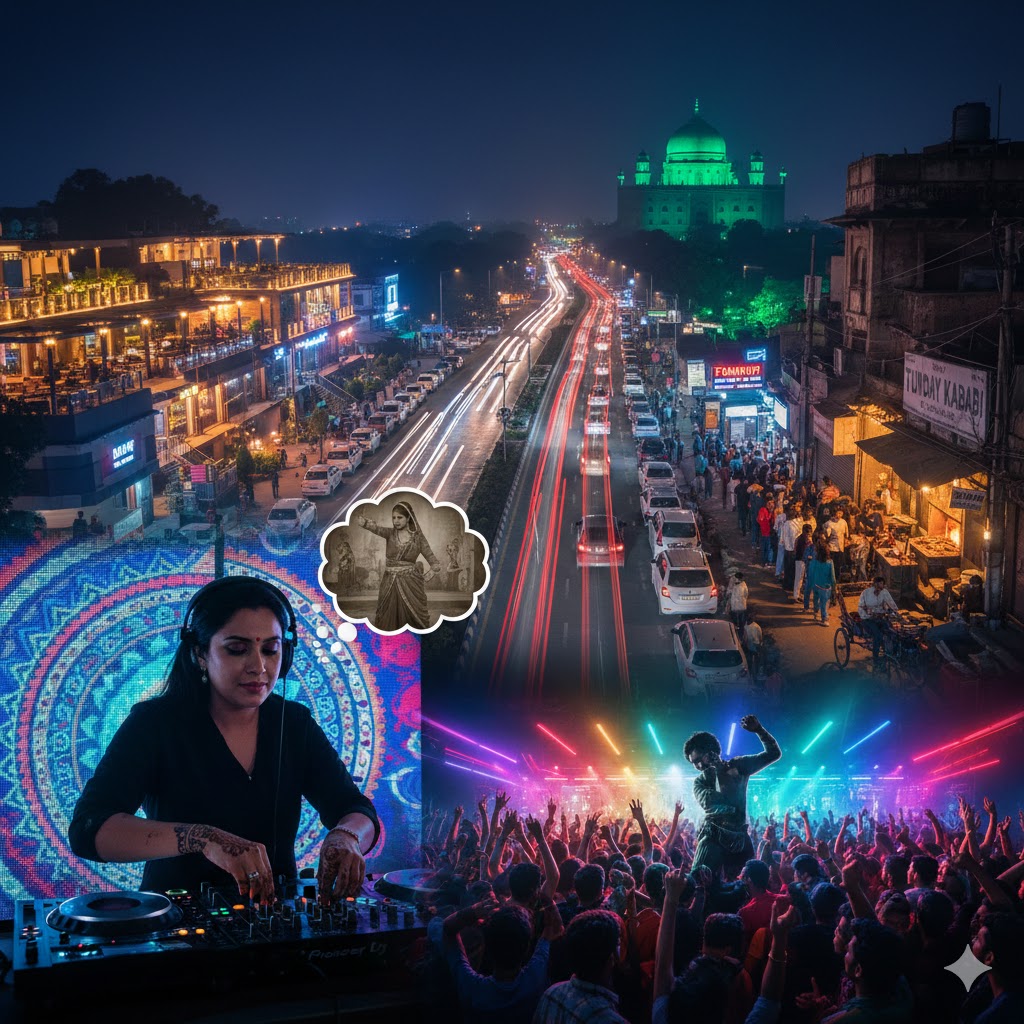
Lucknow: Lucknow goes to bed early, or so the old saying claims. The kebab shops roll down their shutters by eleven, the paanwallahs wipe their counters, and the grand gates of Hazratganj’s colonial façades seem to yawn shut. Yet the moment the last azaan fades from the minarets, the city changes its skin. A second Lucknow awakens—one that the 19th-century chroniclers never imagined and the 21st-century guidebooks still struggle to describe. It is younger, louder, and deliciously unapologetic. This late-night persona is not a rejection of the city’s storied past, but rather a vibrant, bass-thumping conversation with it, a perfect blend of Awadhi tehzeeb (etiquette) and contemporary hustle.
Gomti Nagar: The New Capital of After-Hours
If old Lucknow is a qasba of courtesans and chikankari, Gomti Nagar is its brash grandson who studied in Delhi and came home with money. This planned, expansive section of the city, dominated by glass and steel, has little patience for the slow grace of the past. Marine Drive (yes, they named a riverside boulevard after Mumbai’s) is the undisputed artery of the new nightlife. Between 10 p.m. and 3 a.m., the entire stretch becomes a single open-air party, a long procession of flashing headlamps and thumping music.
Cars idle bumper-to-bumper, music systems competing in a bass duel that rattles the Gomti’s black water. Rooftop lounges like Sky Bar, Farzi Café, and The Terrace at Renaissance spill light and laughter into the sky. On weekends, the crowd is a cross-section no sociologist could have predicted twenty years ago: college girls in crop tops and bindis, tech bros in linen kurtas, old-money Begums sipping single malt beside influencers live-streaming their cocktails. The energy is kinetic, driven by the feeling of being free from the day’s conservative gaze. “People think Lucknow is still asleep at midnight,” laughs Arjun Singh, owner of Lord of the Drinks. “We do more business between 12 and 2 a.m. than most Delhi clubs do all night. The Nawabi blood just needed the right temperature to boil.” The night here is a celebration of Lucknow’s modern economic and social confidence.
The Secret Society of Underground Bars
Because Uttar Pradesh is officially dry on paper—liquor laws are stricter than in most states—Lucknow perfected the art of the speakeasy long before it became a global trend. This necessity fostered a culture of exclusivity and theatrical secrecy, where the journey to the drink is as important as the drink itself. You won’t find these places on Google Maps; entry relies on word-of-mouth, trust, and a willingness to play the game.
Percy’s is hidden behind a nondescript tailor shop in Hazratganj; you press a buzzer shaped like a sewing machine to enter, transforming a mundane errand into an illicit adventure. Inside, the decor is a nod to colonial-era whimsy, with vintage typewriters serving as table lamps and the bartenders mixing a mean Awadhi Old Fashioned with saffron-infused bourbon. Zero Minus One in Gomti Nagar requires you to walk through a functioning cold-storage warehouse—past crates of frozen peas—to reach a steel door guarded by a man who only speaks in Ghalib couplets, a delightful and absurd literary test.
The most legendary is Underdoggs, tucked beneath a multi-level parking garage. It hosts invite-only gigs where Lucknow’s underground rap scene—MC Kaur, Smokey, D-Cypher—spit in Awadhi dialect about police raids and lost love, channeling the city’s hidden struggles into powerful verse. “Yeh sheher raat ko jaagta hai kyunki din mein saans lene ki ijazat nahi,” raps Smokey (The city stays awake at night because it isn’t allowed to breathe during the day). These subterranean venues are the true, unfiltered pulse of Lucknow’s youth, a place where anonymity grants freedom.
The Tawaifs Reincarnated as DJs
The kothas of Chowk may be museums now, but the spirit of the tawaif—the educated, independent courtesan who commanded kings and was the true arbiter of art, music, and fashion—never died; it simply migrated to the DJ console. The women who control the modern city’s beat carry the mantle of artistic command and fierce independence once held by the classical performers.
DJ Barkha, born in old Lucknow’s Aminabad, trained in classical thumri before moving to Electronic Dance Music. When she drops her signature track “Bazaar-e-Husn 2.0,” the dance floor erupts into a bhangra-meets-trap frenzy. Her ability to fuse classical melody with powerful contemporary rhythms speaks to the continuity of Lucknow’s performance arts. “My great-grandmother danced for Wajid Ali Shah,” she shouts over the beat. “Tonight, I make 2,000 people dance for me.” It is a potent, generational reclaiming of power.
Across town, DJ Akriti “AK” Singh remixes 150-year-old dadra couplets over future-bass drops. Her sets at Skyhigh and Ministry of Sound pop-ups are so popular that tickets sell out within minutes on insider WhatsApp groups. These artists understand that the Nawabi ear is tuned to complexity and rhythm, whether it’s delivered via a tabla or a synthesizer. They are the new cultural custodians, holding the past in one hand and the future in the other.
The Late-Night Kebab Republic
No night in Lucknow, no matter how modern the venue, is truly complete without the ancient, unmatchable taste of its meat. Between 1 and 4 a.m., the city’s most revered culinary institutions, masters of the subtle art of Awadhi cuisine, reopen their tandoors exclusively for the after-party crowd, turning the sidewalks into impromptu fine-dining venues.
Tunday Kababi’s Aminabad outlet runs a “ghost kitchen” from midnight onward; the same galawati that emperors waited for is now handed over car windows to tipsy revellers who argue about whether Rahat Fateh Ali Khan or Arijit Singh deserves the aux cord, blending the sublime and the ridiculous. A few lanes away, Wahid Biryani in Chowk serves mutton biryani so fragrant that Uber drivers park and join the queue, drawn by the irresistible aroma.
The newest cult favourite is Dastarkhwan on Lalbagh, whose “3 a.m. menu” includes a chicken changezi so fiery it comes with a signed disclaimer. This late-night service is more than just food; it is a ritual of comfort and grounding. Owner Asif Ali laughs, “We don’t serve drunk people food. We serve food to sober the drunk.” The quality remains non-negotiable, a final, polite nod to the city’s deep-seated pride in its kitchen.

The Rooftop Revolution
Lucknow discovered its skyline late, but it is making up for lost time. Every new hotel and mall competes to build the highest open-air venue, offering a breathtaking, contrasting view of the old and new city. These rooftops are literally and metaphorically elevated spaces, offering a vantage point that grants perspective.
The view from 360° at Hotel Levana is pure vertigo: the domes of Bada Imambara glowing emerald, the Gomti glittering like spilled diamonds, and the distant lights of old Lucknow twinkling like a memory refusing to fade. At Oudh 1590’s terrace in Gomti Nagar, they serve kebab platters on silver thalis while a live qawwali troupe competes with the DJ, a deliberate staging of the old meeting the new.
But the most magical rooftop belongs to The Piccadilly hotel’s Sky Lounge. On Thursdays, they screen vintage Bollywood under the stars; strangers end up slow-dancing to “Yeh Raatein Yeh Mausam” while the city’s minarets blink in approval. These spaces provide a sense of expansive freedom, allowing the city to breathe out and admire its own beauty, a luxury previously reserved for the Nawabs themselves.
Gay Nights and Safe Spaces
Lucknow’s queer scene operates like a secret society within a secret society, a necessary layer of protection and intimacy. Once a month, “Rainbow Raat” events move locations announced only hours earlier via encrypted Instagram close-friends lists, a clandestine network of joy and self-expression. Drag queens named Rani Begum and Chameli Jaan perform to thumri-house remixes while gender-fluid poets read Urdu verse about unrequited love, channeling the poignant tradition of ghazal into modern queer experience.
Humsafar Trust runs an unofficial safe house in Aliganj that doubles as an after-hours café and resource center. “We open at 11 p.m.,” says coordinator Zain, “because that’s when many of our community finally feel free to leave home.” For the queer community, the night is not just for pleasure, but for profound liberation.
The All-Night Addas That Never Died
For every neon club, there are ten quiet corners where Lucknow reverts to its soul. These are the addas—the traditional gathering spots—that are the city’s true all-night institutions. Rahim’s kulfi stall under the clock tower in Hazratganj stays open till 5 a.m., serving falooda to insomniac poets, heartbroken lovers, and UPSC aspirants on their tenth attempt, a cross-section of the city’s dreamers.
Sharma Tea Stall is where theatre kids, journalists, and Marxist professors argue about Faiz until sunrise, fueling their debates with tiny, powerful glasses of chai brewed with nostalgia. The cost is negligible, the intellectual and social currency is immense. These addas are the city’s constant, providing a space for conversation and introspection that anchors the faster pace of the new nightlife.
The Dawn Pilgrimage
By 4:30 a.m., the energy gently shifts. The city’s nocturnal pulse begins to slow, not in exhaustion, but in a graceful transition. Party buses empty out near the Gomti ghats where early-morning walkers are already doing yoga. Club kids in sequins sit beside aunties in tracksuits, watching the same sun rise over the same river that once carried royal barges. The contrasts of the night are dissolved in the communal quiet of the dawn.
At Moti Mahal, the first batch of sheer khurma comes out at 5 a.m.—a sweet porridge that signals the night has officially surrendered to morning. It is a sugary, comforting benediction. As the azaan for Fajr floats across the city, a girl in last night’s glitter removes her heels and walks barefoot toward the sound. A boy who spent the night chasing basslines now bows his head on the same pavement where his grandfather once bowed. The circle completes itself.
Lucknow’s nightlife is not about rebellion against its past; it is conversation with it. The city that taught the world tehzeeb (etiquette) has simply expanded the definition to include 808 beats and rainbow flags. The same fingers that once moved delicately across sitar strings now grip microphones. The same lips that recited Ghalib now rap in Awadhi slang. Old residents complain that the city has lost its soul. Regulars at Sky Bar counter that the soul just learned new dance steps. Either way, when the clock strikes twelve, Lucknow does something no one taught it in any history book: it smiles, loosens its achkan, and steps onto the floor. The night is young. And for the first time in centuries, so is the City of Nawabs.