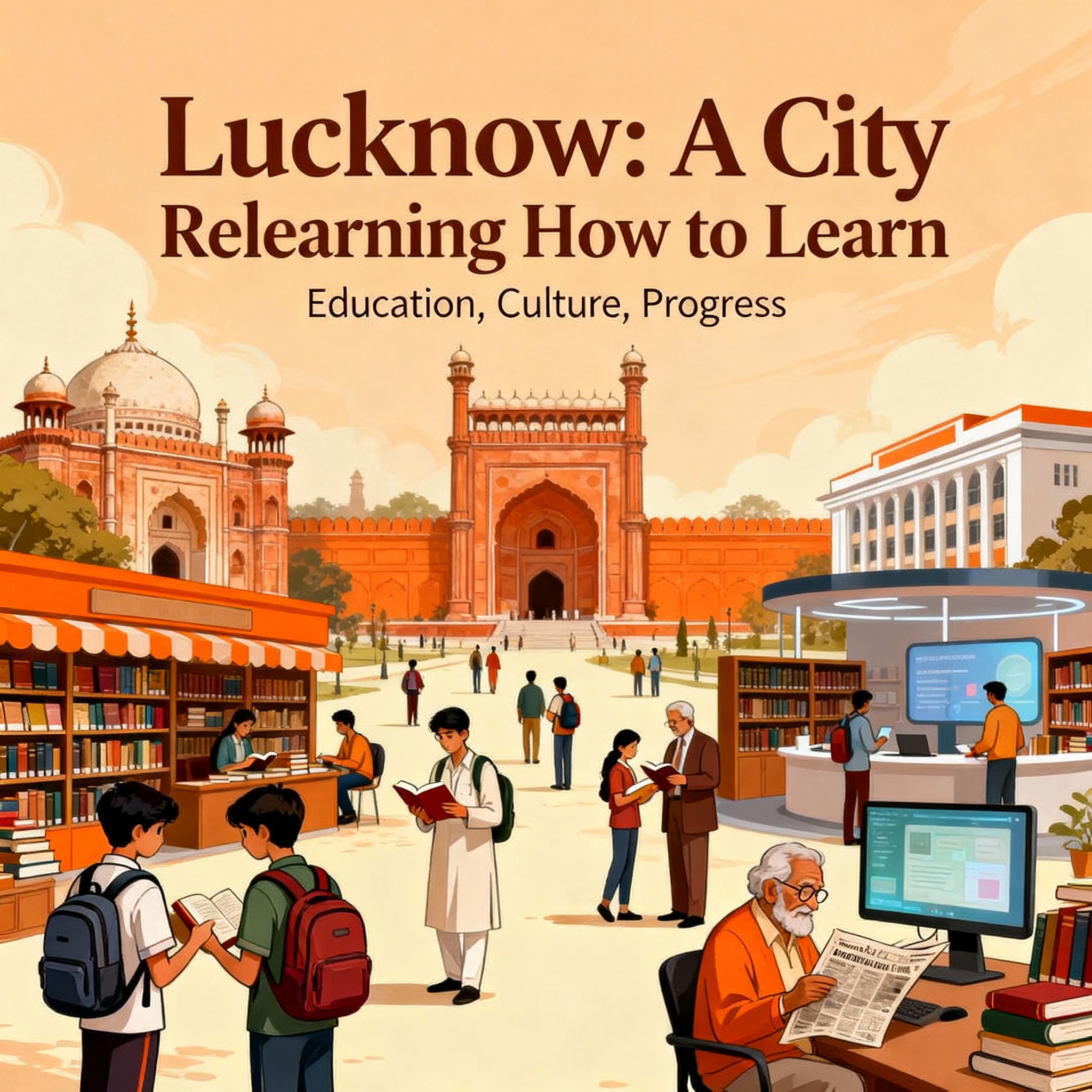
Lucknow: On a winter morning in Gomti Nagar, a Class 10 student slips on a VR headset—not to escape reality, but to enter it more deeply. She walks through a digital reconstruction of the Bara Imambara, pausing to examine its labyrinthine bhool bhulaiya while an AI tutor explains Mughal engineering principles. A few kilometres away, an undergraduate law student debates the legal liabilities of autonomous drones, while a medical intern consults patients in Bundelkhand via a telemedicine node.
This is Lucknow in 2026.
Once celebrated primarily for its culture, courtesy and cuisine, the City of Nawabs is quietly undergoing its most profound transformation since Independence—an education revolution that is redefining schools, universities and aspirations alike. Powered by the full rollout of the National Education Policy (NEP) 2020, unprecedented state funding, and aggressive private investment, Lucknow is emerging as one of northern India’s fastest-growing education hubs.
The numbers tell a compelling story. The Gross Enrolment Ratio (GER) in higher education crossed 38% in 2024–25, up sharply from 31% in 2021. School infrastructure alone has seen ₹3,800 crore worth of upgrades in the last three years, ranging from smart classrooms to advanced laboratories. But beyond statistics lies a deeper shift: a move from rote learning to relevance, from legacy to lifelong learning.
Schools: From Heritage Campuses to Future-Ready Classrooms
City Montessori School (CMS): Reinventing the World’s Largest School
With over 60,000 students across 21 branches, City Montessori School remains the Guinness World Record holder for the world’s largest school by pupil numbers. Yet scale is no longer its defining feature—innovation is.
In 2025, CMS became the first Indian school to deploy a full-campus Metaverse platform for Classes 9–12. Students now attend virtual heritage walks through Lucknow’s monuments, simulate UN climate negotiations, and collaborate live with international institutions, including NASA-linked science programmes.
Prof. Geeta Gandhi Kingdon, President of CMS, captures the shift succinctly:
“NEP has freed us from the tyranny of textbooks. Our students now earn micro-credentials in AI ethics, climate modelling, and Awadhi calligraphy alongside board exams.”
Education here has become both global and rooted.
La Martiniere College: Tradition Meets Technology
Established in 1845, La Martiniere’s Constantia campus has long symbolised colonial-era academic excellence. In 2025, it took a decisive step into the future by introducing the International Baccalaureate Career-related Programme (IBCP) alongside ICSE and ISC.
The most striking addition is its five-acre Innovation Quadrangle—home to robotics bays, a Formula-1-scale wind tunnel, and a heritage conservation lab. Students learn cutting-edge engineering while restoring 18th-century architectural elements using 3D printing.
Principal Gary Dominic Everett reflects:
“We are preserving 180 years of tradition while producing engineers who can protect and rebuild heritage using tomorrow’s tools.”
Seth M.R. Jaipuria School, Gomti Nagar: Teaching Money, Making Innovators
Ranked No. 1 in Uttar Pradesh and No. 7 nationally (EducationWorld 2024–25), Jaipuria School has become a benchmark for future-focused education.
In 2025, it launched India’s first K–12 Financial Literacy and Entrepreneurship track, certified by NSE Academy. Its new 42,000 sq ft Atal Tinkering Lab + BioNEST Incubator has already produced three patent filings by Class 11 students—a statistic once unimaginable in Indian school education.
DPS, K.R. Mangalam, Study Hall: Specialisation and Inclusion
-
Delhi Public School (DPS) campuses collectively educate over 28,000 students. DPS Shaheed Path’s 22-acre campus now houses a dedicated Aerospace and Defence Studies vertical, complete with a Cessna 172 flight simulator and drone assembly line.
-
K.R. Mangalam World School stands out as Lucknow’s only institution offering both IB-PYP and Cambridge IGCSE, with a “Future Skills Passport” ensuring every child earns digital credentials in coding, design thinking and emotional intelligence by Class 8.
-
Study Hall and The Millennium School have pushed the boundaries of inclusive education. Study Hall’s Dosti programme for differently-abled children earned a shortlist for the UNESCO Hamdan Prize in 2025, placing Lucknow on the global education map.
Higher Education: Research, Rankings and Relevance
IIM Lucknow: Management Education with a Public Purpose
Ranked #6 in NIRF Management Rankings 2025, IIM Lucknow continues to be one of India’s most prestigious business schools. This year, it launched a two-year MBA in AI & Analytics and a one-year Executive MBA in Public Policy & Smart Governance, aligning leadership education with India’s development priorities.
The highest domestic package in 2025 touched ₹1.28 crore, with an average of ₹34.8 lakh per annum. A new 65-acre Noida extension campus, operational from 2027, will add 1,000 seats—signalling scale without compromise.

University of Lucknow: The NEP Laboratory
Few universities have embraced NEP as aggressively as the University of Lucknow (LU). Having celebrated its centenary in 2021, LU is now acting as a national testbed for reform.
Key milestones include:
-
India’s first one-year Master’s degree for four-year honours-with-research graduates
-
38 new affiliated colleges approved in 2025
-
Launch of B.Tech in AI & Machine Learning
-
100+ skill courses via Coursera and SWAYAM with full credit recognition
Vice-Chancellor Prof. Alok Kumar Rai outlines an ambitious vision:
“By 2028, every LU student will graduate with at least one industry certification and one research publication.”
AKTU, KGMU and Law & Social Sciences
-
Dr. A.P.J. Abdul Kalam Technical University (AKTU) now offers next-generation B.Tech programmes in Electric Vehicles, Blockchain and Drone Technology across 49 colleges in the region. Its Innovation & Incubation Foundation funded 42 start-ups in 2025, including two potential unicorns.
-
King George’s Medical University (KGMU), ranked #9 in NIRF Medical Rankings, made national headlines by starting MBBS teaching in Hindi medium from the 2025 batch. Its telemedicine network now connects 180 district hospitals, while new super-speciality blocks for cardiology and oncology were inaugurated in March 2025.
-
Dr. Ram Manohar Lohiya National Law University (RMLNLU) introduced integrated majors in Technology Law and Sports Law, propelling its moot court ranking to #3 nationally.
-
Babasaheb Bhimrao Ambedkar University (BBAU) launched India’s first Department of Ambedkar Thought & Social Justice Studies, alongside a School of Yoga and Naturopathy.
The Private Surge and the State Vision
Private universities have matched public ambition. Amity University, Lucknow, expanded to 120 acres with new schools of Film & Drama and Aviation. Integral University introduced Robotics and Automation and became the first NAAC A++ private university in Uttar Pradesh.
Chief Minister Yogi Adityanath, addressing the Lucknow University convocation in November 2025, summed up the moment:
“Lucknow is no longer just the capital of Uttar Pradesh; it is becoming the education capital of New India.”
With ₹8,500 crore earmarked under the State Higher Education Plan (2025–30) and 200 new PM-SHRI schools in the pipeline, the city’s academic future looks both expansive and assured.
The Classroom as the New Courtyard
In old Lucknow, learning thrived in courtyards—through poetry, debate and observation. In 2025, the courtyard has expanded into campuses, cloud servers and global classrooms. What remains unchanged is the city’s belief in ilm—knowledge as grace.
As students code, research, heal, litigate and innovate, Lucknow is not abandoning its past. It is educating its future with it.