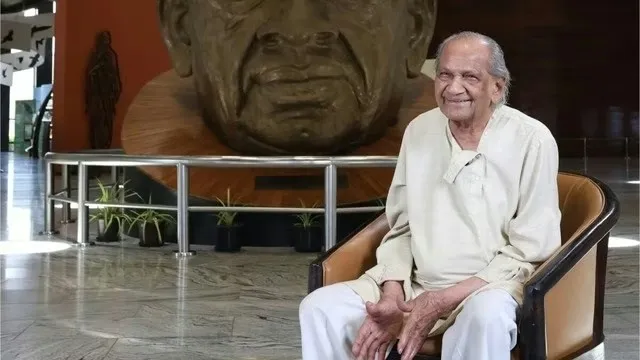
Noida | Renowned sculptor and Padma Shri awardee Ram Sutar Vanji, celebrated worldwide for giving shape to some of India’s most iconic statues, passed away late Wednesday night at his residence in Sector 19, Noida. He was 100. His demise has cast a deep pall of gloom over the art and cultural fraternity in India and abroad.
Ram Sutar breathed his last after a prolonged illness. His son Anil Sutar confirmed that the veteran artist had been unwell for several days. The Padma Bhushan awardee passed away peacefully at his Noida home. His last rites will be performed today at the cremation ground in Sector 94, Noida. Since morning, a steady stream of admirers, artists, and well-wishers has been arriving at his residence to pay their final respects. Anticipating a large gathering, the district administration and police have made elaborate security arrangements.
Only recently, Ram Sutar was honoured with the prestigious Maharashtra Bhushan Award by the Maharashtra government. On that occasion, the Chief Minister and the entire state cabinet had visited his Noida residence to felicitate him. Over the course of his illustrious career, he received numerous national and international awards and accolades.
Ram Sutar etched his name in history by sculpting the 182-metre-tall Statue of Unity, the world’s tallest statue, dedicated to Sardar Vallabhbhai Patel. News of his demise has prompted an outpouring of tributes from political leaders, sculptors, artists, and social figures across the globe. Social media platforms are flooded with condolence messages remembering his monumental contribution to Indian art.
Born on February 19, 1925, in Gondur village of Dhule district, Maharashtra, Ram Sutar hailed from a humble family. His father, Vanji Hansraj, was a carpenter by profession. Inspired by his guru Ramakrishna Joshi, Ram Sutar enrolled at Mumbai’s prestigious Sir J.J. School of Art, where he won the Mayo Gold Medal in 1953 for excellence in modelling.

Between 1954 and 1958, while working with the Archaeological Department in Aurangabad, he played a vital role in the restoration of sculptures at the ancient Ajanta and Ellora caves. He later served as a technical assistant in the Audio-Visual Department of the Ministry of Information and Broadcasting but voluntarily resigned in 1959 to pursue a full-time career as a professional sculptor. He subsequently settled in Noida with his family.
Ram Sutar was not merely a sculptor but an artist who brought the nation’s pride to life through stone and bronze. Apart from the Statue of Unity, his notable works include the 45-foot Chambal Devi statue at Gandhisagar Dam (Madhya Pradesh), 21-foot Maharaja Ranjit Singh statue in Amritsar, 18-foot Sardar Vallabhbhai Patel statue at Parliament House, New Delhi, 17-foot Mahatma Gandhi statue in Gandhinagar, 9-foot Dr B.R. Ambedkar statue in Jammu, the bust of former President Shankar Dayal Sharma, sculptures for the Ram Temple in Ayodhya, and the Krishna–Arjuna chariot at Brahma Sarovar, Kurukshetra.
Through his chisels and vision, Ram Sutar transformed dreams into enduring symbols of national identity. His legacy will continue to inspire generations of artists and stand tall—quite literally—in the cultural history of India.