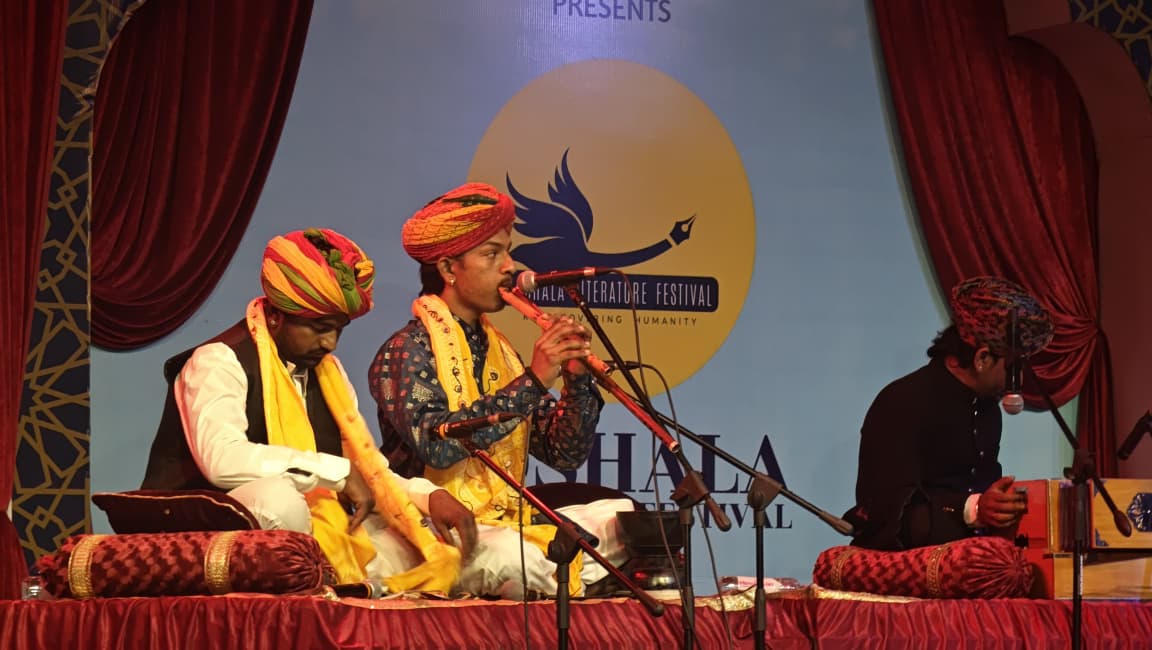
Lucknow: The Koshala Literature Festival unfolded as a vibrant confluence of ideas, artistic expression, and socio-cultural conversations, with multiple sessions exploring themes ranging from activism and mythology to cinema, ethics, and the preservation of Awadhi heritage. Across the sessions, writers, performers, filmmakers, and cultural custodians engaged audiences with thought-provoking insights, reaffirming the festival’s role as a significant literary platform.
Session 1: Revolutionary Voices of Lucknow
The opening session, “Revolutionary Voices of Lucknow,” brought together four young social activists—Versha Verma, Rakhi Kishore, Nilay Agarwal, and Harshit Singh—in conversation with moderator Aanchal Awasthi.
The panel highlighted grassroots initiatives across India, including nationwide blood-donation networks, education and welfare programmes for underprivileged children, and ongoing debates around animal-welfare laws and street dog management.
The speakers stressed the growing role of youth-led activism and how Lucknow’s emerging changemakers are influencing the country’s social landscape. The session set the tone for the festival, placing the city’s young voices at the heart of social revolution.
Session 2: Clash of Ideals — Myth and Modernity
Writer Sharad Bindal led a provocative discussion in the session “Clash of Ideals: Myth and Modernity,” examining the gap between popular beliefs and original scriptural references in Indian mythology.
Bindal presented his hypothesis on Rameswaram—suggesting the name may refer not to Lord Ram but to Parashuram, whose southern presence fits several cultural and geographic clues. He cited examples where well-known narratives diverge from the Valmiki Ramayana, such as the absence of references to Lakshman Rekha and Ravan’s devotion to Shiva.
The session also touched on multicultural versions of myths, mytho-fiction as a growing genre, and the limitations of modern science in interpreting ancient structures like the pyramids and the Kailasa Temple. The speakers agreed that mythology, history, and fiction each serve unique cultural purposes—faith, fact, and imagination.
Session 3: Living Legacies — The Intangible Art of Awadh
The panel titled “Living Legacies: The Intangible Art of Awadh” gathered cultural practitioners Taha Ahmed, Maroof Culmen, Taqi Abbas, Devanshi Seth, and designer Asma Hussain to examine Awadh’s rich heritage.
Devanshi Seth highlighted her digital platform Naav Lucknow, which documents the city’s cultural ecosystem beyond surface-level perceptions.
Content creator Taqi Abbas shed light on the economic precarity of traditional artisans, using the painstaking craft of mukaish embroidery as an example.
Veteran designer Asma Hussain spoke about promoting Awadhi crafts—chikankari, zardozi, Turkish embroidery, jamdani—on global platforms to generate fair incomes.
Photographer Maroof Culmen emphasized the need to document lesser-known heritage sites for younger audiences.
The session underscored an urgent message: cultural preservation must extend beyond documentation to ensuring artisans’ economic survival and intergenerational transmission of skills.
Session 4: Scripted Realities — Writing a Streaming Nation
In “Scripted Realities: Mirror of a Streaming Nation,” acclaimed screenwriter Vaibhav Vishal, in conversation with Soumya Singh, shared insights into his research-driven approach behind shows like Scam 1992 and Rana Naidu.
He highlighted that realism emerges from character behaviour, not plot, explaining how he “becomes” the character while writing. Vishal described his travels to Hyderabad, Rohtak, and Kolkata to absorb local dialects and criticized Bollywood’s distorted portrayal of languages like Bhojpuri.

He argued that storytelling should mirror society rather than moralize it, allowing flawed heroes and empathetic villains to coexist.
Session 5: Unspoken — Writing Lives in Conflict
Authors Neha Dixit and Aarti Jamal, in conversation with Jigyasa Mishra, explored the ethics of documenting real-life stories in the session “Unspoken: Writing Lives in Conflict.”
Neha reflected on the emotional depth required to tell the story of Saida, a migrant labourer, emphasising trust-building and sensitivity. Aarti spoke about gathering 16 stories in Kashmir, where anonymity, fear, and memory loss often shaped narratives.
The conversation highlighted how honest storytelling must balance truth with dignity, especially when dealing with vulnerable communities.
Session 6: Rajat Ranjan’s Spellbinding Literary Performance
Narrator-performer Rajat Ranjan delivered one of the festival’s most emotionally charged sessions, weaving poetry, satire, and Partition-era prose.
Beginning with a tribute to Lata Mangeshkar, he recited his celebrated ode “Aye Gulistan-e-Awadh, Aye Dayar-e-Lucknow.”
Verses by Faiz Ahmed Faiz drew thunderous applause, while his dramatic readings of Harishankar Parsai’s “Bholaram Ka Jeev” and Gulzar’s “Ravi Paar” moved the audience from laughter to silence.
His performance reaffirmed the enduring power of live literary art.
Session 7: Tell All the Truth, Tell It Slant
A powerful dialogue unfolded between writer Amy Singh, photojournalist Soumya Khandelwal, and filmmaker Wamiq in the session “Tell All the Truth, Tell It Slant.”
The panel examined how truth is mediated through nuance, metaphor, and emotional sensitivity. The speakers argued that when representing real lives, creators must protect dignity, privacy, and consent.
They cautioned against stereotyping in polarized times, insisting that truth without empathy becomes cruelty.
Session 8: The Tigmanshu Effect
In a compelling conversation titled “The Tigmanshu Effect,” filmmaker Tigmanshu Dhulia spoke with Devanshi Seth about his journey from NSD to becoming one of India’s most authentic storytellers.
He criticized the glorification of hyper-masculinity and violence in cinema, urging filmmakers to embrace ethical storytelling. Dhulia also lamented the crisis created by multiplex culture and advocated reviving single-screen theatres for audience inclusivity.
Fondly remembering Irrfan Khan as “irreplaceable,” he announced upcoming projects including a literary adaptation, a murder mystery, and a biopic on filmmaker K. Asif.
A Festival of Insight, Identity, and Imagination
Across its diverse sessions, the Koshala Literature Festival showcased Lucknow’s intellectual vigour and cultural depth. From activism and mythology to cinema, ethics, and heritage, the festival celebrated voices shaping contemporary India—reaffirming literature’s power to question, preserve, imagine, and inspire.