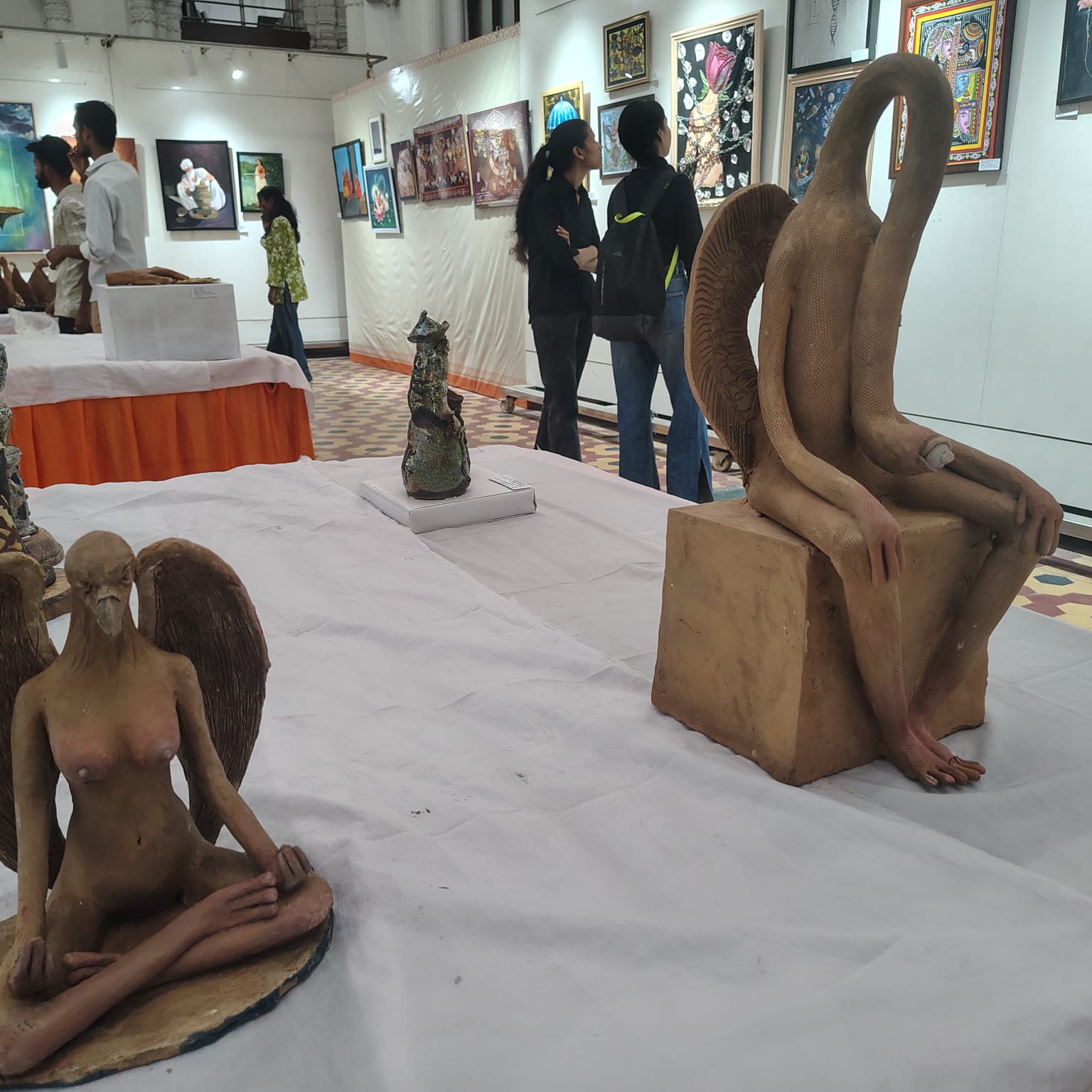
Lucknow: The art exhibition “Kaladrishya”, held at the Uttar Pradesh State Lalit Kala Akademi in Lal Baradari, emerged as a significant cultural intervention in the city’s artistic landscape, presenting a compelling reflection of contemporary creative expression.
Organised jointly by Kalarav, AISA, and Jan Sanskriti Manch, the exhibition redefined art not merely as a visual experience but as a medium articulating memories, struggles, emotions, and voices of resistance of the present time.
The event witnessed participation from a large number of artists, students, cultural activists, educators, and citizens, transforming it into a dynamic platform for public cultural dialogue.
The exhibition was inaugurated by Prof. Laljeet Ahir, who praised the creative energy of young artists and emphasized that art plays a vital role in shaping social consciousness and determining the cultural direction of the future.
The session was presided over by noted sculptor Sushil Kannaujia, while senior art critic Shahenshah Hussain attended as the chief guest. Addressing the gathering, Hussain remarked that artists are extraordinary individuals who write the history of their time through their creations, describing the exhibition as an important document of the ideological and aesthetic restlessness of the contemporary generation.
In his presidential address, Sushil Kannaujia reflected on the complex relationship between art and market forces, cautioning that while institutions can provide platforms for display, the responsibility of preserving artistic integrity ultimately rests with the artists themselves.

The exhibition showcased a total of 78 artworks, including paintings, textile art, and sculptures, created by 46 artists. Each piece offered a unique narrative, capturing personal experiences and contemporary realities, and engaging viewers in a meaningful artistic dialogue.
The organising committee included key contributors such as Atul, Purvi, Neeraj, Rukhmanni, and Janhvi from Kalarav; Shantam Nidhi; and Suchit along with Prof. Dharmendra Kumar.
Organisers stated that the exhibition was not just an art display but an initiative to promote people’s culture, alternative aesthetics, and democratic cultural engagement. They emphasized that art is not confined to galleries but is shaped by collective memory, social realities, and the spirit of resistance.
The success of Kaladrishya reaffirmed the role of such platforms in fostering dialogue between artists and society, with organisers expressing their commitment to expanding such initiatives in the future.