
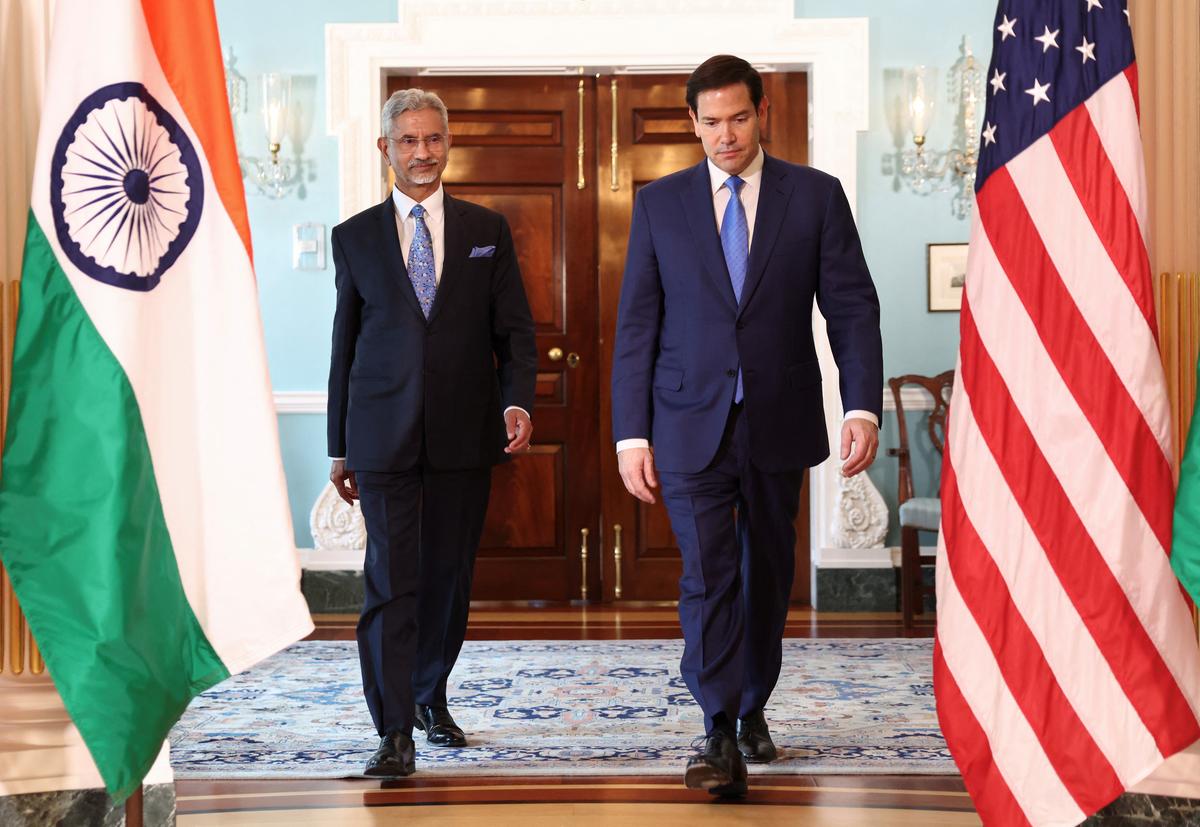
Washington, DC: External Affairs Minister S. Jaishankar held high-level talks with US Secretary of State Marco Rubio in Washington on Tuesday, marking another step in the accelerating strategic and economic convergence between India and the United States.
The meeting took place on the eve of the inaugural Critical Minerals Ministerial, a major international gathering hosted by the US that will bring together representatives from more than 50 countries. The ministerial is aimed at strengthening cooperation on securing, diversifying, and stabilising global supply chains for critical minerals essential to modern economies and national security.
Jaishankar’s engagement with Rubio forms part of his three-day official visit to the United States, reflecting the growing breadth of bilateral dialogue spanning trade, technology, defence, and strategic resources. Secretary Rubio is scheduled to chair the ministerial, with opening remarks expected from Vice President JD Vance and other senior American officials.
Critical minerals—key inputs for batteries, semiconductors, renewable energy systems, and advanced defence platforms—have emerged as a central geopolitical issue amid supply disruptions and growing concern over excessive concentration of production and processing capacities. The US-led initiative seeks to promote trusted partnerships as part of a broader effort to reduce global reliance on single-country supply chains.
Earlier in the day, Jaishankar also met US Treasury Secretary Scott Bessent, with discussions focusing on expanding economic cooperation and reinforcing strategic alignment. In a social media post, the external affairs minister described the exchange as productive and centred on advancing the India–US economic partnership.
The diplomatic engagements come shortly after the announcement of a new India–US trade agreement, revealed on Monday following a phone conversation between Prime Minister Narendra Modi and US President Donald Trump. Under the agreement, the US has reduced reciprocal tariffs on Indian goods from 25 per cent to 18 per cent, a move welcomed by New Delhi as a boost to bilateral trade.

Jaishankar noted that the tariff reduction is expected to support job creation, economic growth, and innovation while strengthening India’s “Make in India” initiative and encouraging trusted technology partnerships between the two countries.
For India, participation in the Critical Minerals Ministerial is strategically significant. New Delhi is actively seeking to diversify sources of rare earths and battery materials to support its electric mobility plans, renewable energy expansion, semiconductor ambitions, and defence modernisation efforts. Greater collaboration with the US and partner countries could also help India emerge as a key processing and manufacturing hub.
India–US relations have continued to deepen during President Trump’s second term, driven by shared concerns in the Indo-Pacific, growing technology cooperation, and a convergence of economic and security interests. Jaishankar’s Washington visit highlights this evolving partnership, blending trade diplomacy with long-term strategic coordination.
Outcomes from the ministerial are expected to shape future cooperation in mining, refining, recycling, and advanced manufacturing—areas critical to sustaining economic resilience and technological leadership in the coming decade.