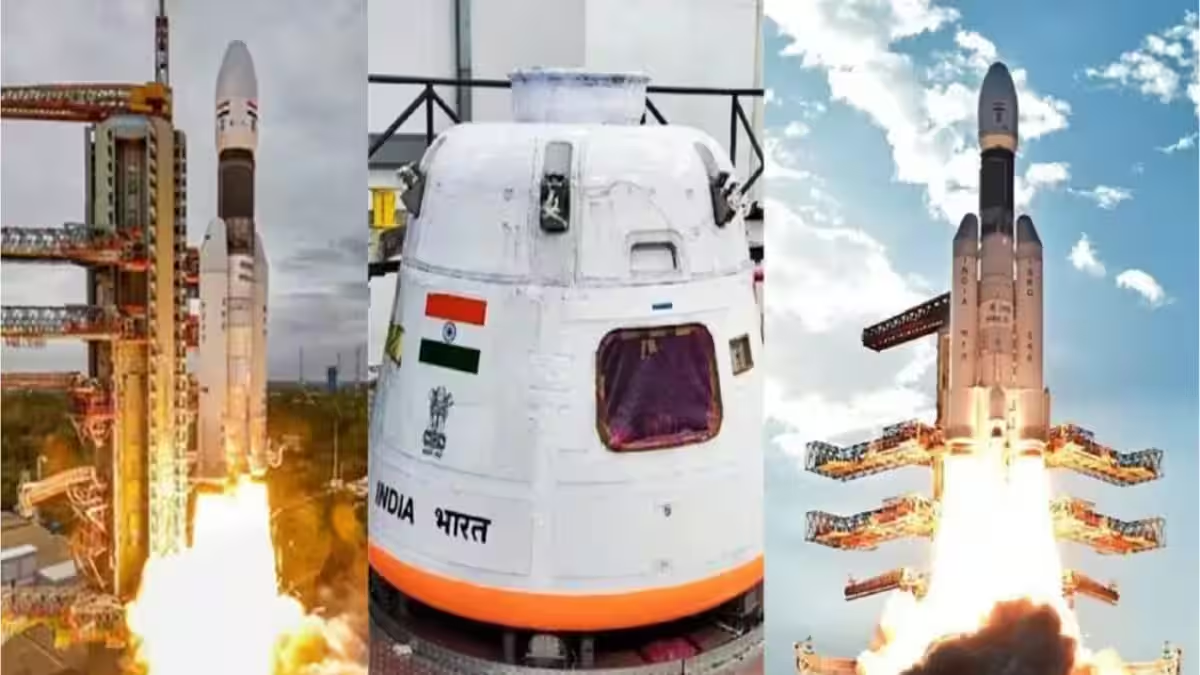
New Delhi | The Indian Space Research Organisation (ISRO) has stepped up preparations for the Gaganyaan mission, India’s first human spaceflight programme, with extensive testing underway ahead of the first uncrewed launch planned for March 2026. Despite recent setbacks in other launch programmes, ISRO has reiterated that the flagship mission remains firmly on track for a crewed launch in 2027.
ISRO Chairman V. Narayanan said that the upcoming uncrewed mission, designated G1, will serve as a critical validation phase before astronauts are sent to space. Speaking in New Delhi last week, he stressed that astronaut safety remains the organisation’s top priority. “Every system must perform flawlessly. There is no margin for error in a human mission,” he said.
G1 Mission Nears Completion
According to ISRO officials, the G1 mission is nearly 90 per cent ready, with more than 8,000 ground and subsystem tests already completed. These include structural qualification, vibration endurance, thermal vacuum exposure and electromagnetic compatibility tests. The programme is now moving into advanced software simulations and environmental validations in preparation for launch.
A key feature of the G1 mission will be Vyommitra, ISRO’s humanoid robot astronaut. Vyommitra will test life-support systems, crew module functions, re-entry behaviour and recovery procedures in real flight conditions. The G1 mission is the first of three uncrewed flights planned before astronauts are cleared for space travel.
Crewed Mission Planned for 2027
The eventual crewed mission will carry Indian astronauts—popularly known as Gaganyatris—into low Earth orbit at an altitude of around 400 kilometres aboard the human-rated LVM-3 launch vehicle. The mission will last approximately three days before the crew module returns to Earth via controlled re-entry and splashdown.
The four astronauts selected for the programme—Shubhanshu Shukla, Prasanth Balakrishnan Nair, Ajit Krishnan and Angad Pratap—have undergone extensive training in India and abroad, including modules on microgravity adaptation, emergency response and spacecraft operations.

PSLV Issues Not Linked to Gaganyaan
Addressing concerns over recent Polar Satellite Launch Vehicle (PSLV) failures, Narayanan clarified that those incidents would not affect Gaganyaan. He explained that the human spaceflight mission uses a different launch system with independent qualification and safety protocols. Investigations into the PSLV anomalies are ongoing, but the LVM-3 rocket has its own dedicated testing pathway.
Long-Term Space Vision
ISRO officials said the success of Gaganyaan would mark a major milestone for India’s space programme and pave the way for future ambitions, including the proposed Bharatiya Antariksh Station by 2035 and a human lunar mission by 2040.
The mission has also boosted domestic industry participation, with several Indian private firms contributing to propulsion systems, avionics and crew module components under the government’s self-reliance initiative.
With the March 2026 uncrewed launch approaching, preparations are intensifying at the Satish Dhawan Space Centre in Sriharikota. A successful G1 mission is expected to significantly advance India’s goal of joining the world’s elite group of human spacefaring nations.