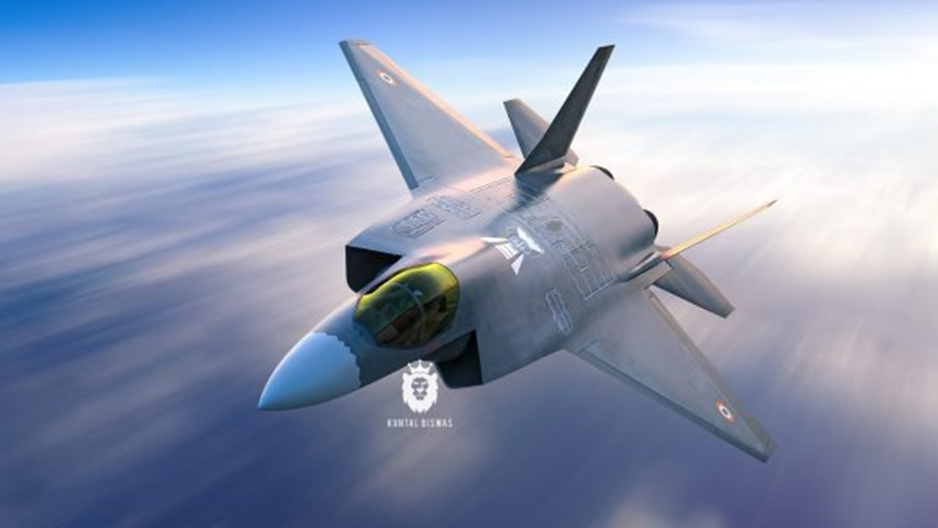
This pivot comes at a time when the nation’s Advanced Medium Combat Aircraft (AMCA), a fifth-generation stealth fighter, commands an estimated ₹15,000 crore investment. Yet DRDO’s gaze extends further, targeting quantum avionics, morphing structures, and artificial intelligence-driven warfare.
These technologies promise to redefine aerial combat, rendering legacy systems obsolete and positioning India as a peer to programs like the United States’ Next Generation Air Dominance (NGAD) and the European Future Combat Air System (FCAS)/Global Combat Air Program (GCAP).
At the heart of this initiative lies quantum inertial navigation systems (QINS). These sensors deliver centimetre-level precision over extended durations, independent of GPS signals vulnerable to jamming or denial. Traditional inertial systems drift over time, but quantum variants leverage atomic interferometry to maintain accuracy, enabling unerring strikes in contested electromagnetic environments.
Quantum magnetometry adds another layer of superiority. By sensing infinitesimal magnetic field fluctuations, these devices can detect submerged submarines or buried metallic threats from stratospheric altitudes. High-altitude reconnaissance missions could thus identify naval assets or underground bunkers without risking low-level penetration, transforming strategic surveillance.
Quantum radar and lidar further shatter stealth paradigms. Employing entangled photons, they exploit quantum illumination to penetrate radar-absorbent materials that confound classical systems. Stealth fighters like China’s J-20 or America’s F-35, designed to evade conventional detection, may prove vulnerable, restoring transparency to the battlespace.
Beyond sensors, DRDO is exploring morphing wing technology to transcend fixed aerodynamic compromises. Conventional aircraft rely on flaps and slats for variable performance, but morphing wings enable seamless surface flexing. This optimises lift and drag across subsonic, transonic, and supersonic regimes, enhancing fuel efficiency, manoeuvrability, and payload capacity in a single airframe.
Complementing these advances are nano-stealth coatings with self-healing properties. Metamaterial layers, infused with microcapsules of repair agents, autonomously mend scratches or ablation from hypersonic flight or enemy fire. This maintains low-observable signatures throughout missions, reducing maintenance burdens and extending operational tempo.
The sixth-generation paradigm elevates the fighter from solitary hunter to swarm orchestrator through manned-unmanned teaming (MUM-T). India’s vision encompasses optional manning, where pilots command fleets of loyal wingman drones from a central cockpit. This integrates seamlessly with the Ghatak stealth unmanned combat air vehicle (UCAV) program, multiplying force projection while minimising human exposure.
Private industry’s involvement marks a departure from the historical ‘HAL-only’ model. The Ministry of Defence now mandates early-stage partnerships, harnessing the National Quantum Mission’s ₹6,000 crore allocation. Funds target milestones in silicon photonics for quantum chip fabrication and cryogenic cooling for sensor stability, fostering an ecosystem of indigenous suppliers.
This technology-first strategy anticipates a formal sixth-generation program definition phase by 2030. By then, quantum ‘brains’—encompassing sensors, AI processors, and adaptive structures—should achieve technology readiness levels sufficient for integration. Prototypes could follow in the mid-2030s, aligning with AMCA’s maturation.
Geopolitically, this positions India to counter regional threats from China and Pakistan, whose air forces lag in quantum and adaptive technologies. Beijing’s J-XX sixth-generation concepts remain conceptual, while Indo-Pacific tensions demand resilient, sovereign capabilities. India’s approach also strengthens bilateral ties, potentially drawing on Russian expertise in hypersonics while prioritising Atmanirbharta (self-reliance).
Challenges persist, including cryogenic miniaturisation for airborne use and quantum decoherence in turbulent environments. Yet RCI’s EOI underscores DRDO’s resolve, with industry consultations already yielding prototypes. The National Quantum Mission provides the fiscal backbone, ensuring sustained R&D amid fiscal constraints.
In essence, India’s quantum leap heralds a new era of aerial dominance. No longer a fast follower, New Delhi is scripting its own technological narrative, laying foundations for high-tech sovereignty by 2040. This 2025 inflection point, rooted in DRDO’s bold mandate, promises to reshape global airpower balances.
(With Agency Inputs)
---------------------------------------------------------------------------------------------------