By Dr Atul Malikram, Political Strategist
New Delhi: Indian democracy derives its strength from its remarkable diversity and its inclusive spirit that embraces all communities. Among these, the Sikh community has played an exceptionally proud and inspiring role. From the freedom struggle to the building of modern India, Sikh leaders have demonstrated outstanding courage and commitment across politics, administration, social service and national security. Guided by the core Sikh principles of Kirat Karo (honest labour), Vand Chhako (sharing with others) and Naam Japo (spiritual remembrance), their contributions have left an indelible mark on India’s political landscape.
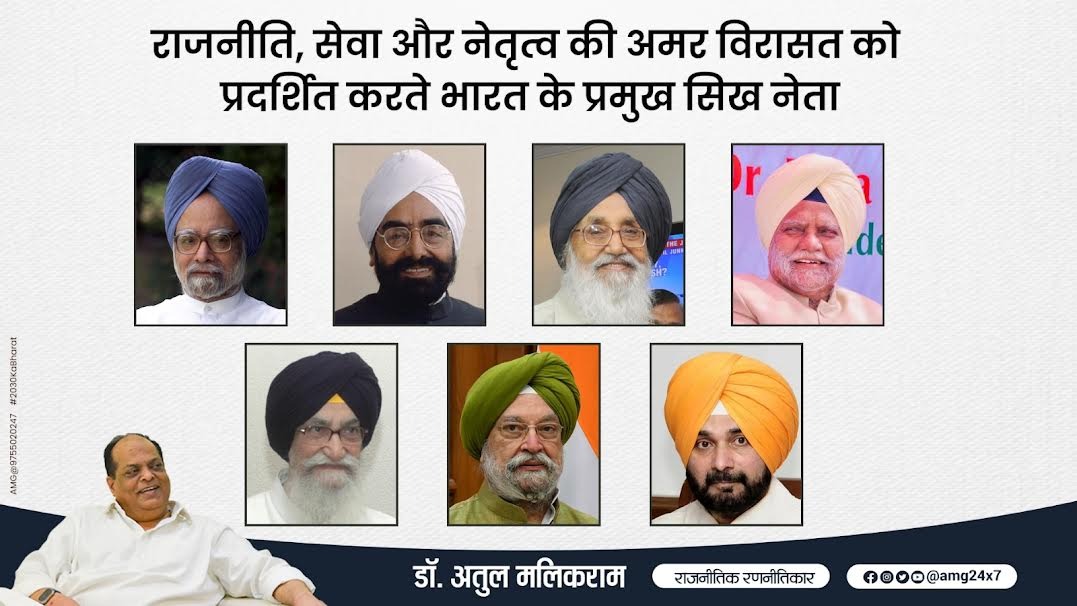
Dr Manmohan Singh’s name will forever be written in golden letters in India’s economic history. Rising from a modest background to the highest office in the country, his journey is a source of inspiration for generations. As Finance Minister in 1991, at a time of severe economic crisis, he laid the foundation of bold economic reforms, dismantled the licence raj, opened up the economy and integrated India with global markets. These reforms unleashed entrepreneurship and placed India among the world’s fastest-growing economies. During his two terms as Prime Minister from 2004 to 2014, the country witnessed sustained economic growth. His calm, scholarly and honest persona set a rare benchmark in public life, proving that integrity and action speak louder than words.
Giani Zail Singh occupies a special place in the history of the Indian Republic as a President who brought simplicity and accessibility to the highest constitutional office. Hailing from a humble farming family in Punjab, his rise to the presidency reflected the true strength of Indian democracy. Before becoming President, he served as Punjab’s Chief Minister and a Union Minister. His tenure coincided with challenging events such as Operation Blue Star and the anti-Sikh riots, yet he discharged his constitutional duties with commitment, striving to uphold national unity and integrity during testing times.
In Punjab politics, Parkash Singh Badal remains a towering figure and a symbol of an era. A stalwart of the Shiromani Akali Dal, he served as Chief Minister of Punjab a record five times. His leadership is remembered for development initiatives, particularly in agriculture, irrigation and rural infrastructure. Deeply rooted in the grassroots, his simplicity and experience earned him respect both in state and national politics. During the era of coalition governments, his role at the national level was significant, and he consistently placed Punjab’s interests at the forefront, leaving behind a strong regional legacy.
Buta Singh carved a unique space for himself by representing the Sikh community in Bihar’s political landscape and achieving national prominence. He held several key portfolios in the Union Government, including Home Affairs and Agriculture. His efforts towards the upliftment of backward and marginalised communities remain noteworthy. His success as a Sikh leader in a state like Bihar stands as a living example of India’s cultural unity and secular ethos, demonstrating that service and dedication transcend regional boundaries.

Surjit Singh Barnala was another pillar of Punjab politics. A senior leader of the Shiromani Akali Dal and a former Chief Minister of Punjab, he is remembered for his focus on law and order and developmental initiatives. Known as a strong organiser and a leader with foresight, he played a vital role in strengthening his party. His straightforwardness and firmness earned him the reputation of a responsible and capable administrator.
Captain Amarinder Singh represents a unique blend of tradition and modern leadership in Punjab politics. Despite belonging to the former royal family of Patiala, he was widely regarded as a leader of the common farmer. After serving in the Indian Army, he entered politics and went on to serve twice as Chief Minister of Punjab. Under his leadership, the state made notable progress in agriculture-related initiatives and infrastructure development.
Hardeep Singh Puri’s journey from a seasoned diplomat to a successful politician highlights administrative excellence. After a distinguished career in the Indian Foreign Service, he entered politics and became a member of the Union Cabinet. As Minister for Housing and Urban Affairs, his role was crucial in strengthening urban infrastructure, particularly in the implementation of the Pradhan Mantri Awas Yojana. His work exemplifies discipline, transparency and effective execution.
Navjot Singh Sidhu is a personality who seamlessly transitioned from the cricket field to the political arena. From an aggressive cricketer to an energetic politician, his journey made him immensely popular with the masses. Active in Punjab politics through both the BJP and later the Congress, his sharp wit, punchlines and distinctive public presence set him apart.
The lives and contributions of these leaders clearly demonstrate that the Sikh community has enriched Indian democracy not merely through numbers, but through quality leadership. Though they hail from different ideologies, regions and backgrounds, they are united by a shared commitment to patriotism, service and integrity. Their legacy serves as a reminder that true leadership rises above religion, caste and region, and is ultimately rooted in the service of humanity and the nation.