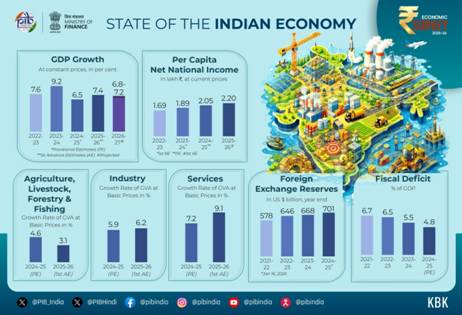
New Delhi: India’s economy is projected to grow by 7.4 per cent in FY26, driven by robust domestic consumption and sustained investment momentum, reaffirming the country’s position as the world’s fastest-growing major economy for the fourth consecutive year. This outlook was presented in the Economic Survey 2025–26, tabled in Parliament by Union Finance Minister Nirmala Sitharaman.
Looking ahead, the Survey estimates real GDP growth in FY27 at 6.8–7.2 per cent, with India’s medium-term growth potential placed at around 7 per cent, despite a challenging global environment.
Consumption and Investment Drive Growth
Domestic demand continues to anchor economic expansion. Private Final Consumption Expenditure (PFCE) rose to 61.5 per cent of GDP in FY26, supported by low inflation, stable employment conditions, improving real incomes, and steady rural demand backed by favourable agricultural performance. Urban consumption has also gained traction following tax rationalisation measures.
Investment remained a key growth pillar, with Gross Fixed Capital Formation (GFCF) accounting for 30 per cent of GDP and expanding by 7.6 per cent in the first half of FY26, exceeding pre-pandemic averages.
Sectoral Performance
-
Agriculture and allied activities are estimated to grow by 3.1 per cent, aided by a favourable monsoon and steady expansion in livestock and fisheries.
-
The industrial sector showed clear signs of strength, with manufacturing growth at 8.4 per cent in the first half of FY26. Construction activity remained resilient, supported by public infrastructure spending.
-
Services continued to lead on the supply side, with GVA rising 9.3 per cent in the first half of the year, reflecting broad-based growth across most sub-sectors.

Inflation, Fiscal and Monetary Support
Inflation moderated sharply during FY26, with headline CPI falling to 1.7 per cent, primarily due to easing food prices. This disinflation, combined with fiscal discipline and accommodative monetary policy, supported consumption and investment.
The government’s fiscal strategy was reinforced by strong tax collections, controlled revenue expenditure, and higher capital outlays. Meanwhile, cumulative repo rate cuts of 125 basis points and liquidity measures improved credit transmission. The banking sector strengthened further, with gross NPA ratios declining to a multi-decade low of 2.2 per cent.
External Sector and Trade
India’s total exports reached a record USD 825.3 billion in FY25, with services exports continuing to offset merchandise trade pressures. The current account deficit remained moderate at 0.8 per cent of GDP in the first half of FY26, supported by remittances and a services trade surplus. Forex reserves remained comfortable, covering over 11 months of imports.
The Survey also noted progress on trade diversification, including the conclusion of a Free Trade Agreement with the European Union, alongside agreements with the UK, Oman, and New Zealand.
Outlook
Despite global uncertainties stemming from geopolitical tensions and trade fragmentation, India’s macroeconomic fundamentals remain strong. Healthy balance sheets, resilient consumption, improving private investment sentiment, and sustained public capital expenditure provide a solid foundation for steady growth in FY27.