
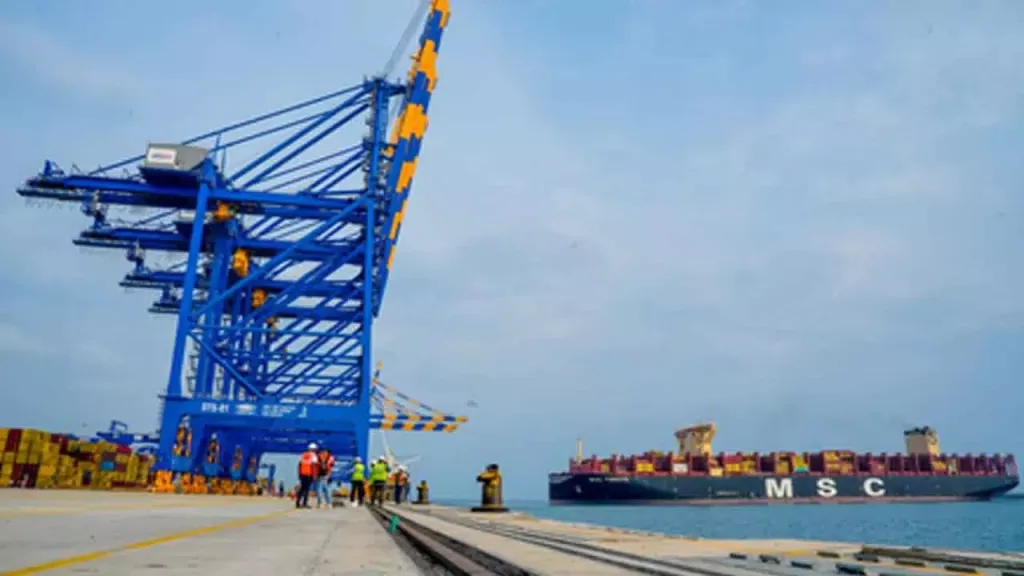
VIZHINJAM (KERALA): After decades of planning, delays, and determined efforts, India’s first automated deep-sea port—the Vizhinjam International Seaport—has officially commenced operations in May 2025, marking a historic moment in the country’s maritime sector.
Originally conceptualised in 1991, the Vizhinjam port project faced numerous challenges over the years including legal disputes over bidding, national security concerns, lack of investor interest, and natural disasters. It wasn’t until August 2015 that the project gained concrete momentum when the Kerala government partnered with Adani Ports and SEZ Ltd (APSEZ) under a Public-Private Partnership (PPP) model.
“Vizhinjam represents a leap forward in India’s marine commerce ambitions,” said a senior official from the Ministry of Ports, Shipping and Waterways.
Despite multiple failed attempts to launch the project—in 1995, 2004, 2008, and 2010—it was restructured in 2014 with financial support from both the Kerala government and the Centre through Viability Gap Funding (VGF). In 2015, Adani Ports emerged as the sole bidder, winning a 40-year concession to build and operate the port, with a potential 20-year extension.
However, the project wasn’t without further setbacks. Cyclone Ockhi in 2017 caused extensive damage, particularly to the breakwater, while supply chain disruptions due to the COVID-19 pandemic, a shortage of construction materials like limestone, and local protests over coastal erosion and loss of livelihood all contributed to significant delays.
Despite these challenges, the Adani Group remained committed. The port reached a major milestone in July 2024, when it received its first mothership, the San Fernando, for trial operations. In September 2024 and April 2025, it welcomed MSC Claude Girarde and MSC Turkiye, two of the largest container ships ever to dock at an Indian port.
Since its soft launch, Vizhinjam has handled over 280 vessels and processed more than 6 lakh TEUs (twenty-foot equivalent units), marking a strong beginning for a port that promises to become a global maritime hub.

What makes Vizhinjam truly transformative is its natural deep draft of 18 meters, allowing even the largest next-generation container vessels to dock without expensive dredging. Located just 10 nautical miles from the key east-west international shipping route, the port is strategically positioned to become a major transshipment hub, potentially reducing India’s dependence on ports in Dubai, Singapore, and Colombo.
The port is equipped with AI-powered vessel traffic management systems and houses India’s tallest ship-to-shore cranes, making it the country’s most advanced maritime facility. Its operational efficiency is expected to reduce logistics costs for Indian exporters by 30–40%, significantly improving India’s trade competitiveness.
By 2028, the port’s capacity is expected to expand to 5 million TEUs, driven by the latest technology and automation systems.
So far, the Adani Group has invested over ₹4,500 crore, with plans to invest an additional ₹20,000 crore in the next phase. The project is expected to generate more than 5,000 direct and indirect jobs, spurring economic growth in the region.
With its automated operations, strategic location, and world-class infrastructure, Vizhinjam International Seaport is set to redefine the landscape of Indian marine trade and elevate the nation’s position in global shipping.