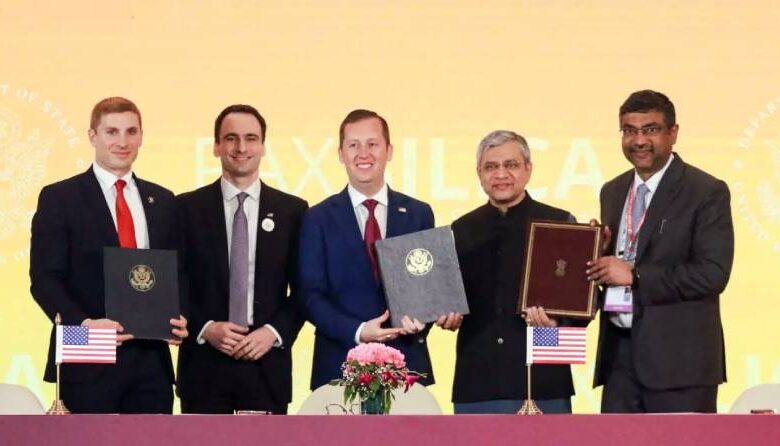
New Delhi: In an era defined by artificial intelligence, semiconductor dominance, and intense global competition over technology supply chains, India’s formal association with the U.S.-led Pax Silica grouping is being viewed as a landmark strategic achievement. Coming shortly after the successful hosting of a major AI Summit, the move signals India’s emergence not merely as a technology consumer, but as a creator, collaborator, and global guide in the evolving digital order.
A Strategic Shift in a Competitive Tech Era
The 21st century has become the age of AI innovation and semiconductor geopolitics. With nearly 90 percent of rare earth minerals and critical semiconductor supply chains currently dominated by China, global concerns over concentration of technological power have intensified. From computer chips and defense systems to space technologies, modern economies depend heavily on secure and diversified supply networks.
Against this backdrop, Pax Silica has been conceptualized as a multilateral framework aimed at fostering balanced, reliable, and diversified technological ecosystems. India’s participation is widely seen as more than symbolic—it represents a decisive strategic alignment that strengthens the global push toward multipolarity in technology governance.
India’s robust engineering capabilities, vast young talent pool, and rapidly developing semiconductor ecosystem are expected to add significant momentum to the grouping. Rather than signaling confrontation, the move underscores India’s commitment to stabilizing global supply chains through cooperation and diversification.
Leadership and Policy Foundations
Under the leadership of Narendra Modi, India has consistently positioned technology at the center of governance and development. Initiatives such as Digital India, Startup India, Make in India, and the Semiconductor Mission have laid the groundwork for technological self-reliance and innovation.
India’s digital public infrastructure—anchored by platforms like Aadhaar and UPI—has become a global model for inclusive digital transformation. Building on this foundation, the country is now accelerating investments in chip design, AI research, and advanced manufacturing.
Global corporations increasingly view India as a stable democracy with skilled human resources and long-term policy clarity. Membership in Pax Silica is expected to facilitate joint research, capital inflows, and supply chain resilience, while reducing overdependence on single-source suppliers.
Strengthening Global Partnerships
Through Pax Silica, India is poised to deepen cooperation with major technology powers such as the United States, Japan, South Korea, and European nations. The partnership is anticipated to bolster national security, enhance economic stability, and reinforce India’s position within the global technology landscape.
Analysts suggest that this move strengthens India’s credibility as a reliable technology partner capable of balancing economic ambition with ethical considerations.

Technology with a Human-Centric Vision
Beyond economics and geopolitics, India emphasizes a values-driven approach to artificial intelligence. Inspired by the civilizational ethos of “Vasudhaiva Kutumbakam” — the world as one family — India advocates for AI development that prioritizes human welfare over dominance.
The government envisions AI applications in healthcare, education, agriculture, and disaster management, ensuring that technological advancements reach the Global South and underserved communities. Policymakers argue that when technology remains concentrated in the hands of a few, global imbalances deepen. Conversely, when democratic and inclusive nations shape innovation, it can become a tool for shared prosperity.
India’s philosophical legacy, shaped by figures such as Mahatma Gandhi and Gautama Buddha, reinforces the principle that progress must be guided by ethics, compassion, and coexistence.
Toward a Balanced Global Order
Today’s global landscape appears divided between centralized technological dominance and cooperative multilateralism. India’s ascent offers the potential to bridge this divide. Rather than choosing confrontation or passivity, India is pursuing what experts describe as “active balance”—a model that combines self-reliance with global partnership.
Through Pax Silica, India and its partners could establish a new paradigm where technological innovation serves collective advancement, supply chains remain transparent, and power distribution becomes more stable.
With AI and semiconductor technologies defining the future, India’s latest move is widely regarded as historic. As the country strengthens its technological capabilities, it simultaneously presents a vision where innovation becomes an instrument of coordination and peace rather than rivalry.
In the coming years, India’s growing role in AI governance and semiconductor collaboration may well shape a new global architecture—one where technological power is balanced, inclusive, and aligned with human progress.