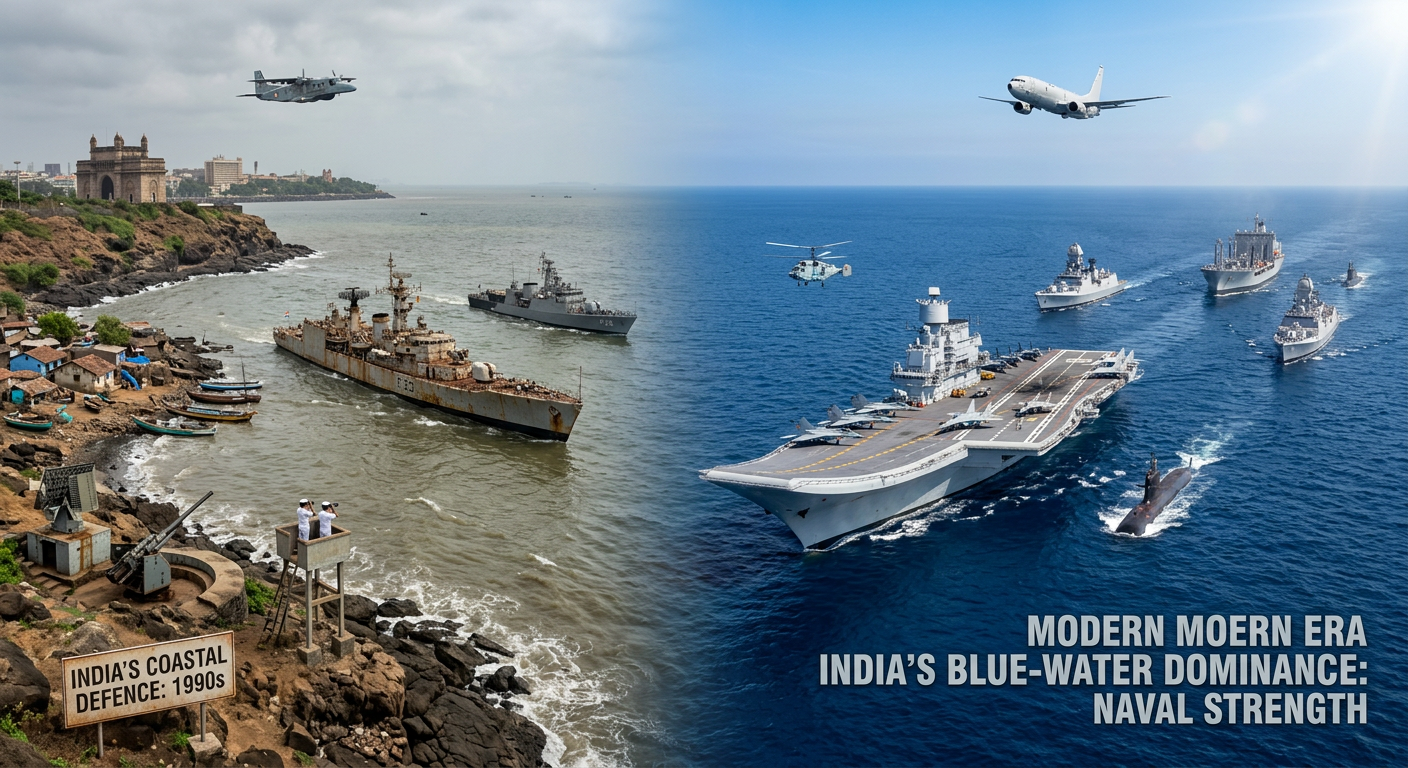
New Delhi: India’s maritime security architecture has undergone a profound transformation over the past two decades. Once primarily focused on coastal defence and traditional naval warfare, India’s maritime framework has evolved into a complex, technology-driven, multi-agency ecosystem designed to address conventional threats, asymmetric warfare, geopolitical competition, and emerging non-traditional challenges.
With over 7,500 km of coastline, 1,382 islands, and a vast Exclusive Economic Zone (EEZ) of more than 2 million square kilometres, India’s maritime domain is not just a strategic frontier — it is an economic lifeline. Nearly 95% of India’s trade by volume and 70% by value moves by sea. Energy security, blue economy ambitions, undersea resources, and strategic sea lanes of communication (SLOCs) make maritime security central to India’s national power calculus.
The Post-26/11 Turning Point
The 2008 Mumbai terror attacks exposed glaring vulnerabilities in India’s coastal security apparatus. The infiltration of terrorists through the sea route forced a structural overhaul of maritime surveillance, coordination, and response mechanisms. The government responded by strengthening the role of the Indian Navy as the overall maritime security authority and enhancing coordination between the Coast Guard, Marine Police, intelligence agencies, and port authorities.
The creation of the National Command, Control, Communication and Intelligence (NC3I) network marked a technological leap. Coastal radar chains, Automatic Identification Systems (AIS), and vessel traffic management systems were integrated to ensure real-time maritime domain awareness.
The shift was clear: maritime security was no longer just about naval warfare — it was about layered, integrated surveillance and deterrence.
Strategic Geography: The Indian Ocean Imperative
India sits astride the Indian Ocean, a region through which nearly one-third of global shipping passes. The rise of China’s maritime footprint — through the Belt and Road Initiative (BRI), port acquisitions, and a growing presence of the People’s Liberation Army Navy (PLAN) — has sharpened India’s strategic focus.
Chinese submarines docking in Sri Lanka and expanding infrastructure in the Maldives and Pakistan (Gwadar Port) have altered the maritime balance. In response, India has expanded its naval deployments, enhanced maritime partnerships, and strengthened its island territories such as the Andaman and Nicobar Islands.
The Andaman and Nicobar Command — India’s only tri-service theatre command — plays a pivotal role in monitoring the Malacca Strait, a crucial chokepoint for global trade.
Naval Modernisation and Force Projection
The Indian Navy has gradually transitioned from a “brown-water” coastal force to a “blue-water” navy capable of sustained operations across the Indo-Pacific. Aircraft carriers such as INS Vikramaditya and the indigenously built INS Vikrant symbolize this ambition.
Submarine capabilities are expanding under Project 75 and Project 75(I), enhancing underwater deterrence. Nuclear-powered ballistic missile submarines (SSBNs) strengthen India’s sea-based nuclear deterrent, completing the strategic triad.
Modern destroyers, frigates, maritime patrol aircraft (P-8I Poseidon), and anti-submarine warfare systems have enhanced surveillance and combat readiness.
Importantly, India is investing heavily in indigenous defence production under the “Atmanirbhar Bharat” initiative, reducing dependence on foreign suppliers.
Maritime Domain Awareness (MDA): The Technological Edge
Modern maritime security is data-driven. India’s Information Fusion Centre – Indian Ocean Region (IFC-IOR), based in Gurugram, acts as a hub for maritime data sharing with partner nations. It monitors shipping movements, suspicious vessels, and regional developments.
Satellite surveillance, long-range drones, coastal radar chains, and integrated databases enable near real-time tracking of maritime activities. Artificial Intelligence and predictive analytics are increasingly being used to detect anomalies in shipping patterns.
The emphasis has shifted from reactive security to proactive detection.
Multilateral Engagements and Strategic Partnerships
India’s maritime strategy increasingly relies on partnerships. The Quad (India, US, Japan, Australia) has maritime security at its core, including joint exercises and intelligence sharing.
Malabar naval exercises have expanded in scale and sophistication, enhancing interoperability with partner navies.
India has signed logistics agreements with several countries, enabling access to overseas military facilities for refuelling and maintenance. This extends operational reach across the Indo-Pacific.
Through initiatives like SAGAR (Security and Growth for All in the Region), India positions itself as a net security provider in the Indian Ocean, offering humanitarian assistance, disaster relief, anti-piracy patrols, and capacity building to smaller nations.
Coastal Security Architecture
India’s maritime paraphernalia now includes multiple layers:
- Indian Navy (blue-water operations and strategic deterrence)
- Indian Coast Guard (law enforcement and coastal protection)
- Marine Police (state-level coastal monitoring)
- Port authorities and customs
- Intelligence agencies
Joint Operation Centres (JOCs) ensure coordination across agencies. Regular coastal security exercises test preparedness and inter-agency response.
Fishing communities are also integrated into the security framework through awareness programmes, turning them into the “eyes and ears” of coastal surveillance.
Emerging Threats: Beyond Conventional Warfare
Maritime threats have evolved beyond traditional naval battles. Key emerging challenges include:

- Maritime Terrorism
- Piracy and Armed Robbery at Sea
- Illegal, Unreported and Unregulated (IUU) Fishing
- Cyber Threats to Ports and Shipping Networks
- Drone and Autonomous Underwater Vehicle (AUV) Threats
- Grey-Zone Warfare
The weaponisation of civilian maritime infrastructure — including ports and undersea cables — has added complexity. Protection of subsea communication cables, which carry over 95% of global internet traffic, has become critical.
India’s maritime strategy now integrates cyber defence and infrastructure protection alongside naval preparedness.
The Blue Economy and Security Linkage
India’s ambition to expand its blue economy — fisheries, offshore energy, seabed mining, maritime tourism — requires secure waters. The economic dimension has made maritime security a development issue, not merely a defence concern.
Ports under the Sagarmala initiative aim to enhance connectivity and trade. However, increased traffic also demands enhanced surveillance and safety mechanisms.
Energy security remains vital. A significant portion of India’s crude oil imports pass through the Strait of Hormuz and the Bab-el-Mandeb — chokepoints vulnerable to geopolitical instability.
Ensuring uninterrupted maritime trade is now directly tied to economic growth targets.
Indigenous Innovation and Defence Reforms
India’s defence reforms, including the creation of the Chief of Defence Staff (CDS) and push toward theatre commands, aim to enhance jointness in maritime operations.
Domestic shipyards such as Mazagon Dock and Cochin Shipyard have increased production of warships and submarines. Indigenous aircraft carrier development reflects technological maturity.
The integration of private sector participation in defence manufacturing marks a structural shift.
Climate Change and Humanitarian Roles
Climate change is emerging as a maritime security challenge. Rising sea levels, extreme weather events, and increased frequency of cyclones demand rapid-response capabilities.
The Indian Navy has repeatedly undertaken Humanitarian Assistance and Disaster Relief (HADR) missions in the Indian Ocean Region — from tsunami relief to evacuation operations.
This dual role — warfighting and humanitarian assistance — defines modern maritime forces.
Strategic Autonomy in a Polarised Indo-Pacific
India’s maritime evolution reflects its broader strategic doctrine: multi-alignment without alliance dependency. While strengthening ties with Western democracies, India maintains engagement with diverse actors.
Its maritime security apparatus is designed not just to counter threats but to assert strategic autonomy in an increasingly polarised Indo-Pacific.
The Indian Ocean is no longer a secondary theatre — it is central to global power competition.
The Road Ahead
Despite progress, challenges remain:
- Gaps in submarine numbers
- Delays in defence procurement
- Coordination challenges between central and state agencies
- Expanding Chinese maritime footprint
- Technological disruptions
Future priorities include:
- Expanding unmanned maritime systems
- Enhancing anti-submarine warfare capabilities
- Securing undersea infrastructure
- Strengthening island infrastructure
- Developing integrated theatre commands
India’s maritime security paraphernalia is no longer static. It is adaptive, layered, and increasingly technology-centric.
India’s maritime transformation reflects a deeper strategic awakening. From reactive coastal defence to proactive Indo-Pacific engagement, the country has recalibrated its maritime doctrine to match emerging realities.
As global trade flows intensify, geopolitical rivalries sharpen, and non-traditional threats multiply, maritime security will remain at the heart of India’s national security architecture.
The sea, once viewed as a protective boundary, is now recognised as a strategic domain of opportunity, influence, and contestation.
India’s changing maritime security paraphernalia is therefore not merely a military evolution — it is a statement of strategic intent.