New Delhi: As 2025 came to a close, India’s economic reform journey revealed a decisive shift from policy expansion to tangible delivery. The year stood out for its focus on simplifying systems, easing daily interactions between citizens and the state, and strengthening confidence among businesses through predictable governance.
Reforms across taxation, labour, rural employment, MSMEs, GST, and trade were anchored in three core objectives: improving ease of living, enhancing ease of doing business, and building long-term economic resilience. Together, they reflected a more mature, outcomes-oriented policy framework aligned with India’s development ambitions.
Tax Reforms: Boosting Disposable Income
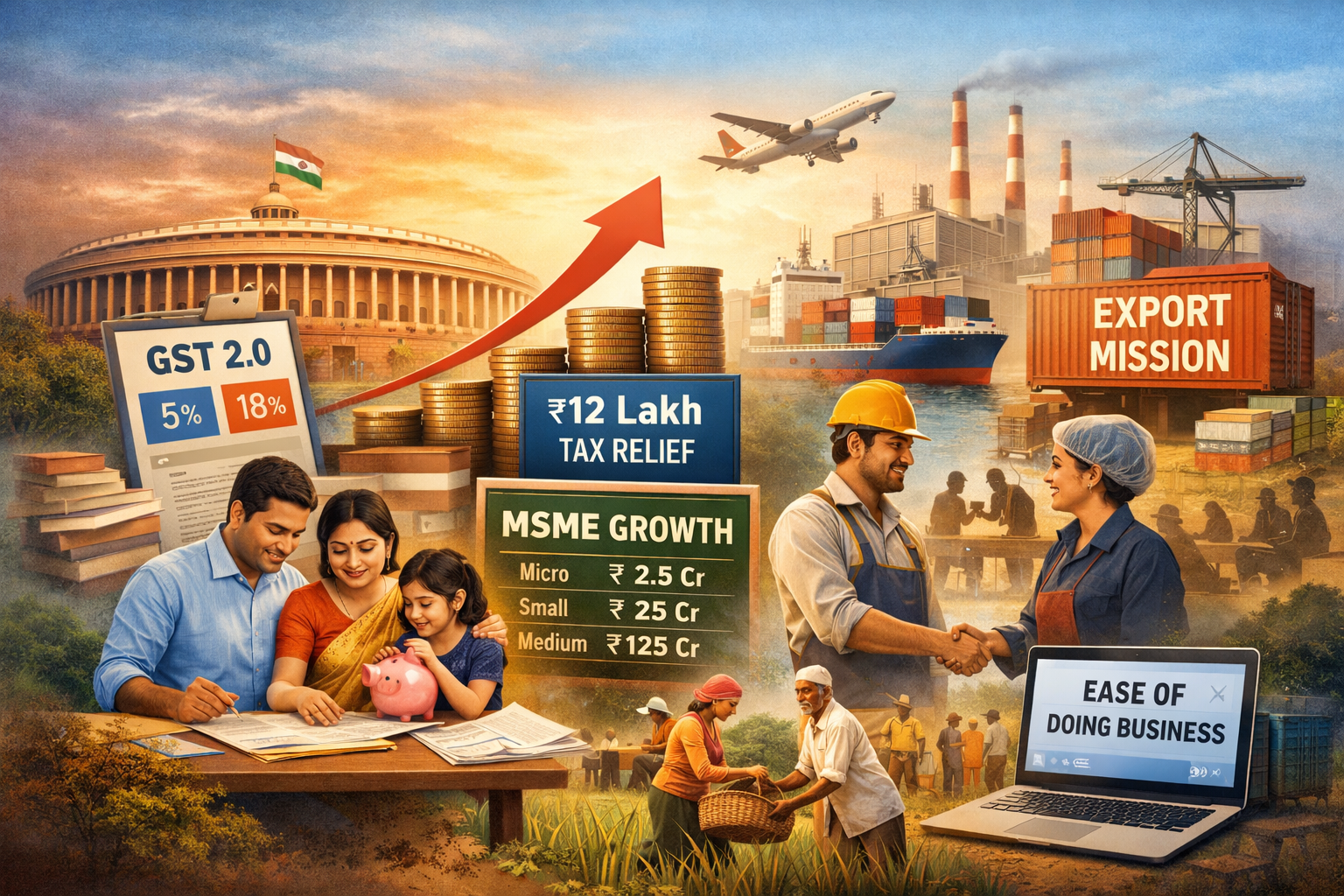
Direct tax reforms announced in the Union Budget 2025–26 delivered immediate relief to the middle class. Under the new tax regime, annual income up to ₹12 lakh was made tax-free, with salaried individuals effectively enjoying exemption up to ₹12.75 lakh due to the standard deduction. This increased disposable income for millions, supporting consumption, savings, and household investment.
Equally significant was the introduction of the Income Tax Act, 2025, which replaced the decades-old 1961 law. Rather than altering tax rates, the reform focused on simplification. Redundant provisions were removed, legal language modernised, and the structure reorganised to reduce disputes and improve clarity. The adoption of a single “Tax Year” simplified compliance, while faceless administration, consolidated TDS rules, and enhanced digital enforcement strengthened transparency.
Labour Reforms: Simplicity with Security
The consolidation of 29 labour laws into four Labour Codes became operational in 2025, creating a unified framework covering wages, industrial relations, social security, and workplace safety. The reforms balanced compliance ease for employers with expanded protections for workers, including gig and platform workers.
Uniform wage definitions reduced ambiguity, social security coverage widened to nearly 10 million gig workers, and improved safety norms and maternity provisions enhanced workforce inclusion. Overall, the framework extended protection to over 50 crore workers nationwide.

Rural Employment: From Wages to Assets
Rural employment policy was reshaped through the Viksit Bharat – Guarantee for Rozgar and Ajeevika Mission (Gramin) Act, 2025, which replaced MGNREGA. The new law guarantees 125 days of employment per rural household and links wage work with the creation of durable assets in water conservation, infrastructure, and climate resilience.
Decentralised planning through Viksit Gram Panchayat Plans, digitally integrated with PM Gati Shakti, strengthened local governance while improving coordination across ministries.
MSMEs, GST, and Trade: Reducing Friction, Expanding Scale
MSME reforms eased compliance and improved credit access through expanded loan guarantees, flexible quality standards, and a revised MSME definition enabling scale and job creation. GST reforms moved toward a simplified two-rate structure, faster refunds, and smoother compliance, expanding the taxpayer base and stabilising revenues.
Trade reforms culminated in a unified Export Promotion Mission, combining finance, logistics, compliance, and market access to boost India’s global competitiveness.