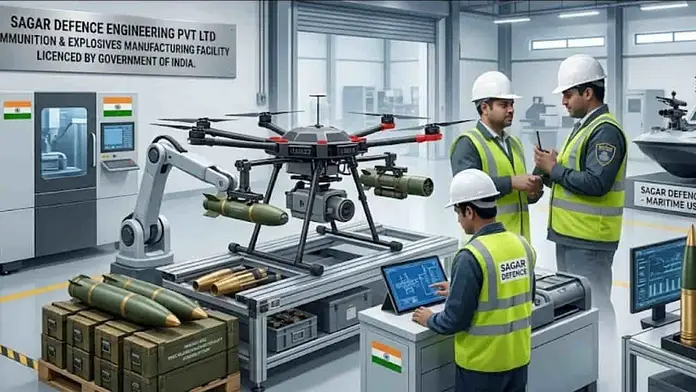
New Delhi | Signalling a major shift in military strategy, the Indian Army has released its first comprehensive roadmap for unmanned aerial systems (UAS) and loitering munitions, placing drones at the heart of future warfare.
Developed in collaboration with the Army Design Bureau and the Drone Federation of India, the roadmap outlines how emerging technologies will reshape battlefield dynamics and enhance operational capabilities.
Drones Redefining Modern Warfare
Recent global conflicts, including the Iran–Israel conflict and the Russia–Ukraine War, have demonstrated the growing role of drones. Low-cost unmanned systems are increasingly being used to neutralize high-value military assets, conduct surveillance, execute precision strikes, and support logistics.
Military planners believe that dominance in drone and autonomous systems will be critical in determining outcomes of future conflicts.
Understanding UAS and Loitering Munitions
Unmanned Aerial Systems (UAS) are not just drones but integrated platforms that include sensors, cameras, communication links, and ground control stations. Loitering munitions—often referred to as “kamikaze drones”—are designed to hover over a target area before striking with precision, destroying both the target and themselves.
Five-Pillar Drone Strategy
The roadmap is structured across five key operational segments:

- Surveillance Systems: High- and medium-altitude drones capable of long-endurance flights will provide real-time intelligence, particularly along sensitive and high-altitude borders.
- Specialised Mission Drones: These include armed drones, swarm systems, and electronic warfare platforms capable of jamming enemy communications or deploying coordinated multi-drone operations.
- Loitering Munitions: A mix of low-cost and high-precision strike drones designed to target bunkers, vehicles, and critical infrastructure with minimal detection.
- Logistics Drones: Unmanned systems that can deliver supplies such as food, ammunition, and medical aid to remote or high-risk areas, reducing reliance on traditional transport.
- Air Defence Systems: Counter-drone technologies designed to detect, intercept, and neutralize enemy drones, including swarm attacks.
Boost for Indigenous Development
A key highlight of the roadmap is its focus on domestic innovation. For the first time, the Army has consolidated its requirements—covering nearly 30 different platforms—into a single document, giving clear direction to industry players, startups, and research institutions.
This move is expected to bridge the gap between military needs and industry capabilities, encouraging targeted development of advanced defence technologies within India.
Strategic Importance
The initiative aligns with the government’s broader push for self-reliance in defence manufacturing. By promoting indigenous design and production, the Army aims to reduce dependence on imports while building a robust domestic ecosystem.
Preparing for Next-Generation Warfare
With warfare rapidly evolving, speed, precision, and adaptability have become decisive factors. Experts note that even small drones can now disrupt or destroy expensive military systems, making them indispensable in modern combat.
The Indian Army’s roadmap reflects a clear recognition of this shift, marking a transition from traditional heavy platforms to agile, technology-driven systems that will define the battlefield of the future.