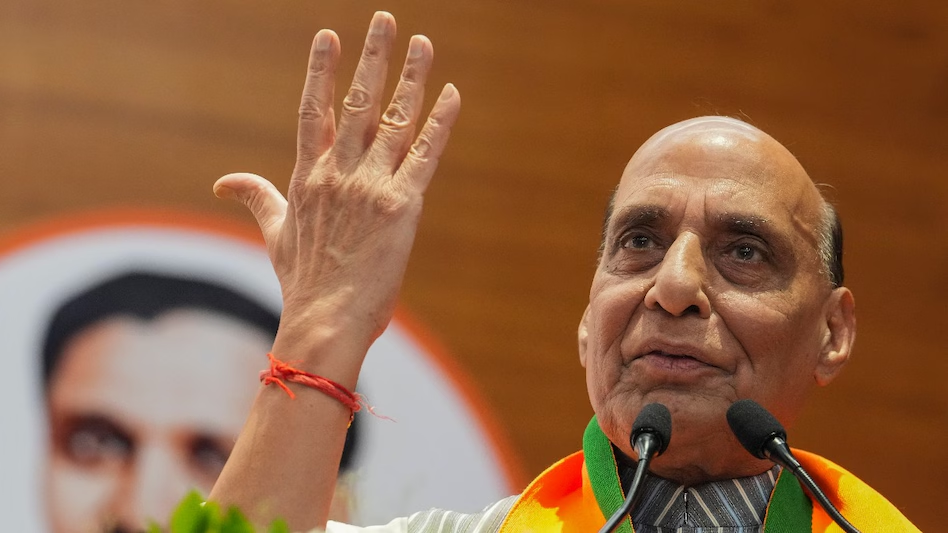
New Delhi : At a high-profile Defence Conclave in New Delhi, Defence Minister Rajnath Singh outlined an ambitious roadmap for India’s future, stating that the nation is well on its way to becoming both a developed economy and the world’s leading military power. His remarks underscored a clear push toward self-reliance, innovation, and strategic resilience in the defence sector.
Addressing the gathering, Singh emphasized that the government is determined to shift from a dependence on defence imports to a robust domestic ecosystem capable of meeting both internal needs and international demand. “India’s defence industry is now a cornerstone of national self-reliance, and we are set to become a key player in making global supply chains more resilient,” he said.
The Minister pointed out that initiatives like Make in India are strengthening not just India’s military capabilities, but also the flexibility and reliability of global defence production systems. “Our aim is to insulate critical defence manufacturing from global disruptions, while boosting our strategic autonomy,” he noted.
He also reiterated that India’s growing military power is a force for peace. “Our defence capabilities act as credible deterrents. Peace can only be maintained if we remain strong,” Singh asserted.
As warfare evolves, with increasing significance of cyber, space, and information domains, the Minister highlighted the need for constant reform. Declaring 2025 as the ‘Year of Reforms’ in defence, Singh pointed to the transformation of the over two-century-old Ordnance Factory system into profit-making units as a landmark reform.
Outlining the government’s efforts to promote indigenisation, he noted that five positive indigenization lists have been released by the Armed Forces and five more by Defence Public Sector Undertakings (DPSUs). Combined, these include over 5,500 items—ranging from high-end weapon systems to key components—that will now be sourced domestically.
India has also set aside 75% of its defence capital procurement budget for domestic manufacturers. As a result, defence production has surged from ₹40,000 crore in 2014 to over ₹1.27 lakh crore in 2024–25, with a target of ₹3 lakh crore by 2029.

On defence exports, Singh highlighted a sharp rise from ₹686 crore in 2013–14 to ₹23,622 crore in the current fiscal. “Our defence products are now being exported to nearly 100 countries. We expect exports to cross ₹30,000 crore this year and hit ₹50,000 crore by 2029,” he said.
Promoting innovation remains a priority, especially among startups and young entrepreneurs. Singh mentioned schemes like iDEX and iDEX Prime, which offer financial support ranging from ₹1.5 crore to ₹10 crore for developing cutting-edge technologies. The newly introduced ADITI scheme extends that support further to ₹25 crore. To date, defence purchases worth over ₹2,400 crore have been approved from startups and MSMEs.
Highlighting India’s strategic edge, the Minister cited achievements in missile technology (Agni, BrahMos), nuclear submarines (INS Arihant), aircraft carriers (INS Vikrant), and modern systems such as AI, drones, and cyber defence. “We are in discussions with global leaders like Safran, GE, and Rolls Royce to strengthen our capability in aero engine manufacturing—our next big frontier,” he noted.
India’s shipbuilding success was also a key highlight. Singh shared that over 97% of Indian Navy and Coast Guard warships are now constructed in Indian shipyards. Indian-built vessels are also being exported to friendly nations including Mauritius, Sri Lanka, Vietnam, and Maldives.
The conclave was attended by top defence officials and experts, including former service chiefs, DRDO leadership, and senior government secretaries, reflecting the collaborative push towards a secure, self-reliant, and strategically empowered India.