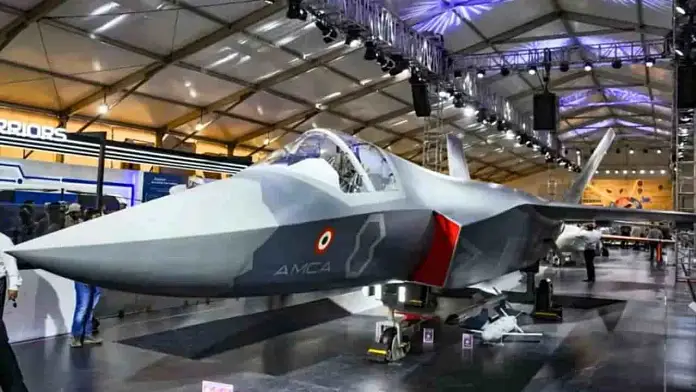
New Delhi | In a major development for India’s indigenous defence capabilities, the Ministry of Defence has shortlisted three industry consortia for the development of the Advanced Medium Combat Aircraft (AMCA), India’s ambitious fifth-generation stealth fighter programme. The AMCA is expected to form the backbone of the Indian Air Force (IAF) in the coming decades.
According to Defence Secretary Rajesh Kumar Singh, the selection was made after evaluating seven industry consortia that participated in the pre-qualification phase. The assessment was based on technical expertise, financial strength, and advanced aerospace manufacturing capabilities.
While the government has not officially disclosed the names of the shortlisted consortia, defence industry sources suggest that major Indian players such as Larsen & Toubro (L&T), Tata Group, Adani Defence and Aerospace, and the Kalyani Group (Bharat Forge) are likely contenders. The move signals the government’s intent to give the private sector an equal and significant role alongside public sector undertakings in strategic defence programmes.
RFP to Be Issued in March–April 2026
The Ministry of Defence stated that a Request for Proposal (RFP) will be issued to the three shortlisted consortia within the next two to three months, indicating that the formal bidding process could begin by March–April 2026. The RFP will seek technical and financial bids for the development, prototype construction, and initial production of the AMCA.
Following this stage, the L1 bidder—the consortium offering the lowest cost while meeting all technical requirements—will be selected. The defence secretary noted that the entire selection process is expected to be completed within three months after the RFP is issued.
Strong Industry Participation
A total of seven consortia had submitted bids for the AMCA project, with the process concluding in October 2025. Almost all major Indian defence and aerospace companies are involved in one form or another. Hindustan Aeronautics Limited (HAL) remains a central pillar of the programme and is participating as a lead or partner in multiple consortia.
L&T has reportedly partnered with Bharat Electronics Limited (BEL) and Dynamatic Technologies, while Tata Advanced Systems Limited (TASL) is considered a key player due to its extensive aerospace experience. Adani Defence and Aerospace has formed a consortium with Hyderabad-based MTAR Technologies, and Kalyani Strategic Systems (Bharat Forge) is working alongside Data Patterns and BEML.
Other players such as BrahMos Aerospace Thiruvananthapuram Limited and Axiscades Technologies were also part of the initial competition.

Notably, during the Expression of Interest (EoI) stage, over 28 private companies had shown interest in partnering with HAL. After rigorous evaluation, only seven consortia qualified for the final bidding stage, underscoring the government’s emphasis on quality and capability over numbers.
Five Prototypes Planned
Under the current roadmap, the selected industry partnership will build five AMCA prototypes. The first prototype is expected to be ready within three to four years, with the maiden flight likely around 2029, provided the programme proceeds as planned. The government has earmarked over ₹15,000 crore for the prototype development phase.
Officials indicated that while the prototype phase will be relatively short, reaching full-scale production could take close to 10 years, a timeline considered standard for fifth-generation fighter programmes globally.
Engine Strategy: Imported First, Indigenous Later
The initial version of the AMCA—covering the first two squadrons—will be powered by the GE F414 engine from US-based General Electric. The same engine has been selected for the Tejas Mk-2 programme. Defence officials said the use of an imported engine in the early phase is essential to avoid delays and ensure timely induction.
In the long term, India plans to equip the AMCA with a 120 kN-class indigenous high-thrust engine, expected to be developed by 2036–37. The project is being pursued under a co-development model, with potential collaboration from global engine manufacturers such as France’s Safran, with the goal of achieving full control over critical engine technology.
Key Features and Strategic Importance
The AMCA is being designed as a native stealth platform from the outset. Key features include low-observable shaping, internal weapons bays, advanced sensor fusion, AI-enabled avionics, and supercruise capability—allowing sustained supersonic flight without afterburners.
With the Indian Air Force set to retire legacy platforms such as the Mirage 2000, MiG-29, and Jaguar over the next two decades, the AMCA is expected to play a crucial role in maintaining air superiority beyond 2035. Current plans envision the induction of at least 125 AMCA fighter jets, forming seven squadrons, with the possibility of higher numbers in the future.