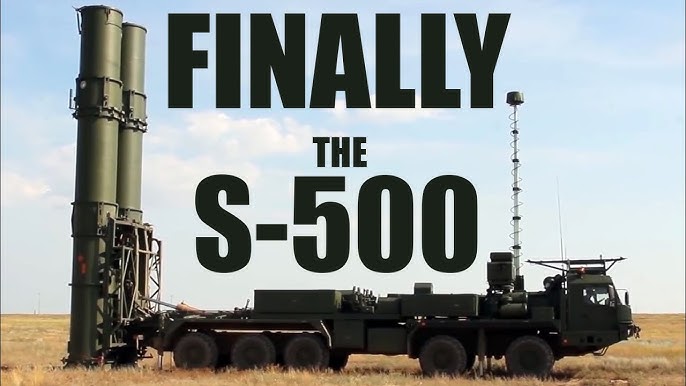
New Delhi: India’s missile defence network is on the verge of a major enhancement with the potential induction of Russia’s advanced S-500 surface-to-air missile system. Currently, India operates the S-400 Triumf, which has proven its operational efficiency in exercises and missions such as Operation Sindoor.
The country is simultaneously building a multi-layered missile defence shield, incorporating space-based assets through programs like Mission Sudarshan Chakra and the SBS-3 satellite initiative. These programs aim to counter high-speed threats, including hypersonic weapons, while providing early warning capabilities that go beyond conventional radar coverage.
While the S-400 can intercept aircraft, cruise missiles, and ballistic threats up to altitudes of 30–40 km, the S-500 offers a quantum leap by extending interception ranges to nearly 200 km—well into near-space territory. This enhanced range could allow India to neutralise intercontinental ballistic missiles (ICBMs) in their midcourse phase, providing critical reaction time and safeguarding key strategic assets.
A defining advantage of the S-500 lies in its ability to tackle hypersonic missiles, which travel at speeds exceeding Mach 5 with highly unpredictable trajectories. Existing systems like the S-400 face significant limitations against such threats, but the S-500’s state-of-the-art radar and missile technology is specifically engineered to detect and destroy hypersonic glide vehicles and manoeuvring warheads.
The S-500’s radar network also enables early threat detection beyond conventional ranges, allowing for pre-emptive action—an increasingly vital capability in modern warfare, where engagement windows are rapidly shrinking due to the pace and sophistication of emerging weapons.

Integration of the S-500 would bolster India’s layered missile defence strategy. While the S-400 provides a robust mid-altitude intercept layer, the S-500 would create an additional high-altitude layer, capable of neutralising threats earlier in their trajectory and strengthening resilience against saturation attacks.
From a strategic standpoint, acquiring the S-500 also signals deepening defence cooperation between India and Russia, reaffirming the countries’ strong bilateral ties in advanced military technology. Joint collaboration, highlighted in recent Putin-Modi meetings, underscores India’s commitment to enhancing its strategic deterrence while maintaining reliable defence partnerships.
Operational deployment of the S-500 will necessitate upgrades to India’s radar integration, command and control infrastructure, and personnel training. India’s experience with the S-400, coupled with ongoing defence R&D initiatives, positions the country to effectively absorb this advanced system and potentially benefit from technology transfer to accelerate indigenous missile defence capabilities.
Once inducted, the S-500 is expected to reshape India’s missile defence landscape, delivering unmatched coverage, speed, and accuracy against both ballistic and hypersonic threats, further strengthening the nation’s strategic deterrence posture in an evolving security environment.