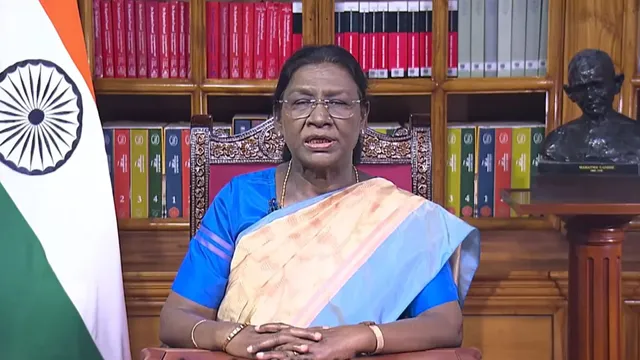
New Delhi | On the eve of the 77th Republic Day, President Droupadi Murmu extended warm greetings to the people of India and delivered a comprehensive address to the nation, reflecting on India’s democratic journey, constitutional values, and future direction. She described Republic Day as a vital bridge connecting the nation’s past, present, and future, offering an opportunity for collective introspection on India’s path and priorities.
From Independence to the Constitution: A Historic Journey
President Murmu recalled that with the attainment of Independence on August 15, 1947, India began shaping its own destiny. This journey reached a defining milestone on January 26, 1950, when the Constitution came fully into force, formally establishing India as a sovereign constitutional republic. She noted that this marked the beginning of India’s enduring commitment to constitutional ideals and democratic governance.
Strength of the Constitution and India’s Democratic Legacy
Calling India the “mother of democracy,” the President said the nation emerged from colonial rule to establish a people-driven republican system. She described the Constitution of India as the foundational text of the world’s largest republic, embodying the ideals of justice, liberty, equality, and fraternity, which form the very soul of the Republic. The framers of the Constitution, she said, provided a strong constitutional framework to safeguard national unity and integrity.
India’s Rapid Economic Rise
Highlighting India’s economic progress, President Murmu said that the country has already become the world’s fourth-largest economy and is rapidly moving towards becoming the third-largest economy in the near future. She acknowledged the contribution of India’s hardworking workforce, describing labourers as the backbone of nation-building. She added that the talent and energy of India’s youth and children are strengthening the foundation of the country’s bright future.

Sardar Patel’s Legacy and National Unity
The President paid tribute to Sardar Vallabhbhai Patel, the Iron Man of India, for his historic role in national integration. She noted that his 150th birth anniversary, celebrated nationwide on October 31 last year, reinforced the spirit of unity and national pride. The commemorative events associated with the occasion continue to inspire a deeper sense of oneness among citizens.
Cultural Unity and the Pride of ‘Vande Mataram’
Emphasising India’s cultural unity, President Murmu said that the fabric of national integration stretching from north to south and east to west was woven by the nation’s ancestors. She praised all efforts aimed at keeping this unity vibrant. The President also noted that celebrations marking 150 years of the composition of ‘Vande Mataram’ began on November 7. The iconic song, venerating the nation as a divine mother figure, continues to ignite patriotic भावना and strengthen national consciousness.
Concluding her address, President Murmu urged citizens to draw inspiration from India’s constitutional values and collective heritage to work together for a stronger, more inclusive, and developed India.