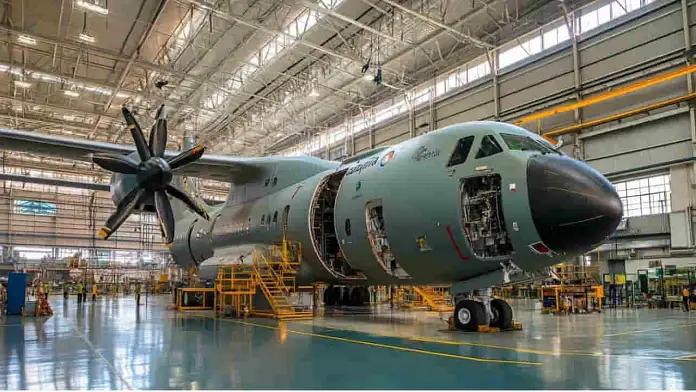
New Delhi: India’s first “Made in India” C-295 military transport aircraft for the Indian Air Force (IAF) has entered its final phase of production, with a rollout expected by September 2026 from the Tata-Airbus plant in Vadodara, Gujarat.
The announcement was made on January 21 by External Affairs Minister Dr. S. Jaishankar in New Delhi, who highlighted India’s evolving role in defense collaboration with Spain—from a buyer of technology to a co-manufacturer.
From 2021 Deal to 2026 Rollout
The C-295 is a medium-range, twin-engine turboprop tactical transport aircraft originally developed by Airbus Defence and Space of Spain. The project began in 2021 under a ₹21,935 crore agreement between the Indian government and Airbus. The deal entails the acquisition of 56 C-295 aircraft for the IAF.
The first 16 aircraft were fully manufactured in Spain and delivered to India, while the remaining 40 will be built and assembled domestically under Tata Advanced Systems Limited (TASL). The final assembly line in Vadodara was inaugurated jointly by Prime Minister Narendra Modi and the Spanish Prime Minister in October 2024.
Replacing Aging Avro Aircraft
The C-295 will replace the IAF’s aging Avro-748 fleet, which has served for decades but no longer meets modern operational and logistical requirements. The aircraft is designed for rapid troop deployment, cargo transport, medical evacuation, and disaster relief operations. Its short take-off and landing (STOL) capability enables operations from small airstrips, making it highly suitable for mountainous, island, and border regions.
Made in India: How Local Is It?
The C-295 project has drawn attention for its level of indigenization. Over 85% of the structural work is carried out in India, and around 13,000 component parts are manufactured by Indian companies. Engines and certain key systems are still imported from Spain, along with associated technology transfers. Defense experts note that no modern military aircraft is fully produced in a single country today, and India is now part of the global aerospace supply chain rather than only performing assembly work.
Key Capabilities
The C-295 can carry approximately nine tons of payload or transport up to 71 troops or paratroopers at once. Its STOL capabilities allow it to operate from short runways, crucial for rapid deployment and logistical operations in remote or difficult terrain.

Defense analyst Ravi Kumar Gupta emphasizes that viewing the project purely through the lens of “indigenous vs. foreign” is misleading. He points out that modern military aircraft like the Tejas fighter jet also rely on multinational components. The C-295 strengthens India’s position in the global aerospace ecosystem and reduces vulnerability to supply chain disruptions.
From Buyer to Defense Partner
Senior advocate Mahesh Jethmalani describes the C-295 project as “industrial geopolitics at scale,” marking India’s transition from a mere purchaser to a defense partner. For the first time, large-scale production of a military transport aircraft is happening in India. This shift enhances India’s self-reliance in design, manufacturing, and maintenance, while reinforcing strategic deterrence, particularly in regions where supply disruptions could be used as a strategy.
Towards an Aerospace Hub
Under the “Make in India” initiative, India’s aerospace sector could reach $100 billion by 2040, with projects like the C-295 contributing to 20–30% growth in exports. Other initiatives include Adani Group and Embraer planning assembly lines for commercial aircraft (70–146 seats) in Gujarat and Andhra Pradesh, and Tata-Airbus already running two final assembly lines for the Airbus A320.
The government is also considering a new PLI (Production-Linked Incentive) scheme to boost local aircraft manufacturing over the next six years, aiming to establish a full-fledged aerospace ecosystem rather than just assembly operations.
Impact on Jobs, Skills, and Supply Chain
The C-295 project is expected to generate over 18,000 jobs in India, strengthening local supply chains, engineering skills, and maintenance capabilities. In the coming years, India will not only manufacture these aircraft but also maintain and upgrade them independently. Experts believe this model could pave the way for other military aircraft and helicopter projects in the future.
In sum, the C-295 project represents more than a new transport aircraft—it signifies India’s shift from dependence to strategic leverage, moving toward sovereign capability and positioning itself as a strong player in the global defense market.