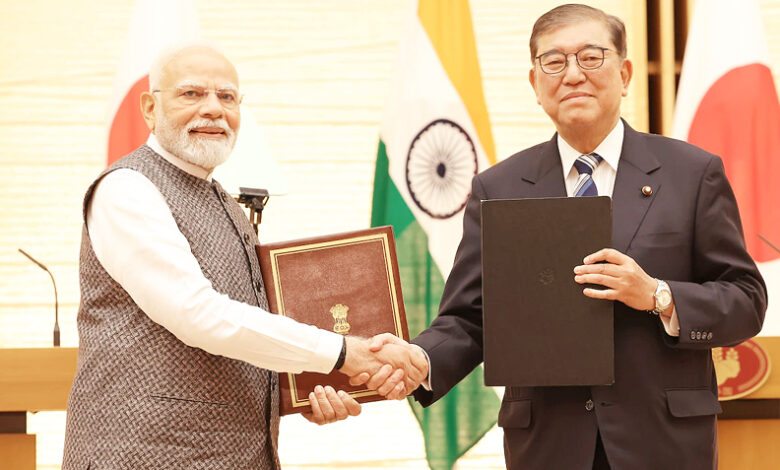
Tokyo/ New Delhi: Prime Minister Narendra Modi’s visit to Japan is more than a diplomatic formality—it signals a new structure of Asian power in the 21st century. The visit marks a fresh chapter in India-Japan friendship, poised to influence global trade, security, and strategic balance. Addressing the India-Japan Joint Economic Forum, Modi emphasized how Japanese technology combined with Indian talent could reshape the global landscape.
India’s development journey has long been supported by Japan—from metros and manufacturing to semiconductors and startups. As the world’s fastest-growing major economy, India is expected to soon become the third-largest economy globally. Closer India-Japan ties promise to unlock new avenues of growth, innovation, and regional influence.
Strategic Opportunities Amid Global Trade Tensions
The ongoing U.S.-China trade conflict, including high tariffs imposed by the U.S., has disrupted global supply chains and impacted emerging markets like India. At this juncture, closer collaboration with Japan—renowned for its technology, capital, and innovation—offers India a strategic opportunity. India brings a vast workforce, a growing market, and immense development potential. Modi’s trip aims to bridge the gaps created by trade tensions, strengthening bilateral engagement on multiple fronts.
India faces the challenge of a 50% tariff imposed by the U.S., but Japanese partnership can help offset these economic pressures. Modi will also visit China for the SCO summit, where he may meet President Xi Jinping and Russian President Vladimir Putin. In this context, India-Japan cooperation acts as a “balancing power,” promoting peace, stability, and free trade in the Indo-Pacific region.
A Legacy of Friendship
India and Japan share centuries-old historical and cultural ties. In the 8th century, Indian monk Bodhisena consecrated a Buddha statue at Nara’s Todai-ji temple, marking the first historical contact. Figures like Swami Vivekananda, Rabindranath Tagore, Subhas Chandra Bose, and Justice Radha Binod Pal further strengthened these relations. During India’s independence struggle, Japan supported Netaji Subhas Chandra Bose and the Azad Hind Fauj. Post-World War II, India and Japan formalized relations through a peace treaty, and today their partnership spans defense, science, education, culture, and strategic security. Modi’s visit marks his eighth trip to Japan, underscoring the enduring legacy of cooperation.

Economic and Technological Synergies
India must address bureaucratic complexity, infrastructure gaps, and policy unpredictability to attract Japanese investors. Japan, in turn, must view India as a market of partnerships rather than just consumers. High-tech collaboration—covering semiconductors, AI, robotics, and green energy—positions India and Japan as a new technological axis in Asia. Such cooperation strengthens trade stability, supply chains, and regional development, while reducing Japan’s dependence on China. Japanese investments in India’s bullet trains, smart cities, Digital India, and renewable energy initiatives accelerate both countries’ growth trajectories.
Strategic, Economic, and Moral Partnership
India-Japan ties are not limited to strategy or commerce; they are grounded in shared human values, fostering soft power and global peace. This partnership offers a model distinct from Western capitalism or Chinese-style state-driven economics. Through cooperation based on democracy, technology, peace, and ethical principles, India and Japan aim to set a new global precedent.
Modi’s two-day visit signals more than enhanced bilateral relations—it strengthens India’s role in Asian diplomacy. The India-Japan partnership sends a clear message: global power balance is shaped not solely by military might, but through collaboration, development, and shared values. The future of Asia, and its stability, will be shaped by this strategic friendship.