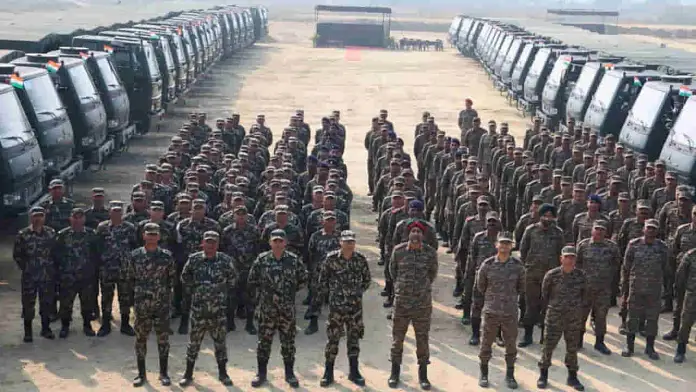
New Delhi | India has handed over 50 military utility vehicles to the Nepal Army, marking another significant step in strengthening long-standing defence ties between the two neighbouring countries. The handover took place near the India–Nepal border in Maharajganj, Uttar Pradesh, officials said on Tuesday.
Indian defence authorities described the move as a symbol of mutual trust, cooperation, and enduring military partnership between India and Nepal. While the vehicles were technically transferred at the border, they will be formally presented during a ceremony in Kathmandu by the Indian Ambassador to Nepal.
Details of the Vehicles
The consignment includes 20 vehicles with a 7.5-tonne carrying capacity and 30 vehicles with a 2.5-tonne capacity, enabling the Nepal Army to address a wide range of operational requirements.
The heavier vehicles are expected to be used for logistics, equipment transport, and troop movement, while the lighter vehicles will support rapid mobility, field operations, and tactical support, particularly in difficult terrain.
Officials Present at the Handover
The handover was attended by Colonel Japendra Singh and Major Arjun Chauhan from the Indian Army. The vehicles were formally received by Colonel Hari Prasad Bhattarai of the Nepal Army. Personnel from the Sashastra Seema Bal (SSB) were also present during the transfer.
Strengthening Nepal Army’s Capabilities
Officials said the initiative is aimed at enhancing capacity building within the Nepal Army. India has consistently supported Nepal through training programmes, defence equipment, and technical assistance, and the latest transfer is seen as a continuation of that cooperation.
India and Nepal share not only formal defence agreements but also deep historical and people-to-people military ties. The two armies regularly conduct joint exercises, exchange visits at senior levels, and cooperate on humanitarian and disaster relief missions.

Deep Historical Roots
The military relationship between the two nations dates back to the 1816 Treaty of Sugauli, after which the tradition of Gorkha recruitment into the Indian Army began. Even today, thousands of Gorkha soldiers serve in the Indian Army, with official estimates indicating around 34,000 active Gorkha personnel as of 2025, alongside a large number of veterans.
Post-Independence, India has continued to provide Nepal with specialised training courses, modern equipment, and military education opportunities. A unique feature of the relationship is the tradition of awarding honorary General ranks to the serving Army Chiefs of both countries.
Recent Engagements and Challenges
In January, a 33-member Nepal Army band participated in the Indian Army Day Parade held in Jaipur, a gesture widely seen as reflecting the close bond between the two forces.
While differences emerged after the introduction of India’s Agnipath recruitment scheme in 2022, leading to a pause in Gorkha recruitment due to concerns raised by Nepal, defence cooperation between the two countries has continued uninterrupted.
Strategic Importance
With an open border, shared cultural ties, and common security interests, defence cooperation between India and Nepal plays a vital role in regional stability, particularly in the Himalayan region. The newly delivered vehicles are expected to enhance Nepal’s operational capabilities in mountainous and remote areas, as well as during disaster response operations.
For India, the move reinforces its commitment to supporting a key neighbour and maintaining strategic stability and trust in South Asia.