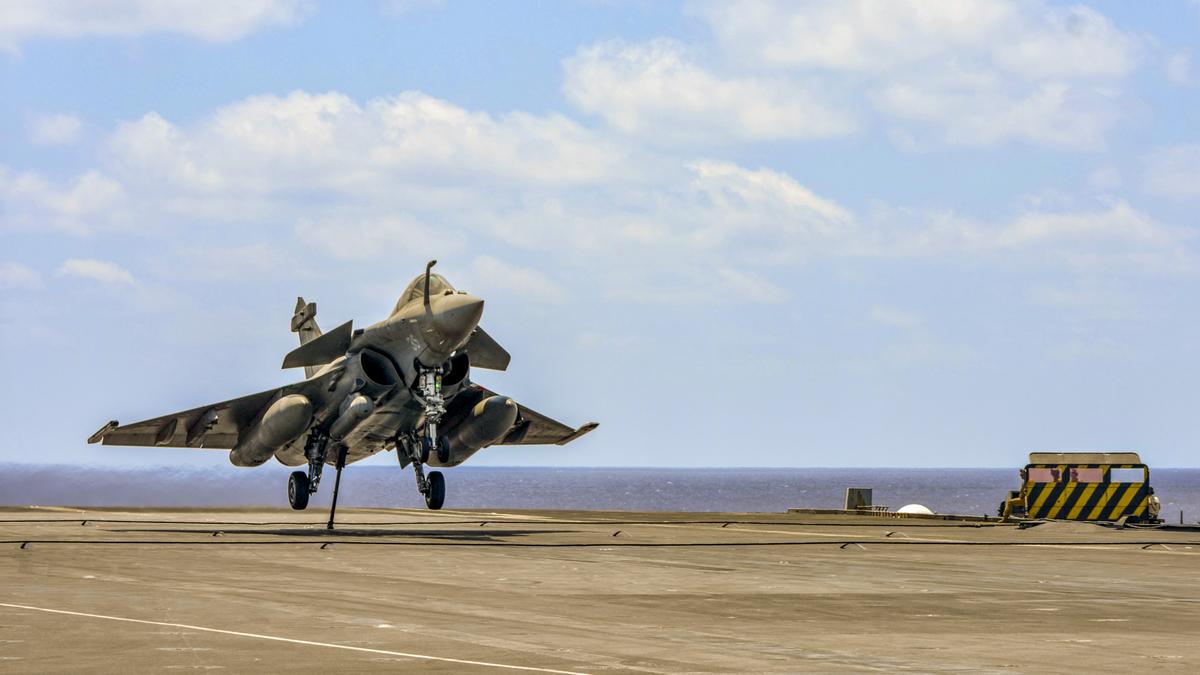
New Delhi: India is reportedly in advanced discussions with France to procure 31 additional carrier-capable Rafale Marine fighter jets for the Indian Navy, according to French media reports. The move comes alongside New Delhi’s massive 114-aircraft Multi-Role Fighter Aircraft (MRFA) program for the Indian Air Force, potentially cementing the Rafale platform as the backbone of India’s future combat aviation fleet.
A report in the French publication La Tribune stated that India has formally conveyed its interest in expanding its naval Rafale fleet. The development follows the Defence Acquisition Council’s recent grant of Acceptance of Necessity (AoN) for the MRFA program — a critical procedural milestone that enables the procurement process to advance to the next stage.
Expanding the Rafale Footprint
India’s existing Rafale fleet originates from a 2016 intergovernmental agreement with France, under which 36 Rafale fighters were inducted into the Indian Air Force. Manufactured by Dassault Aviation, the Rafale has since become a central pillar of India’s air combat capability.
In April 2025, the Indian Navy concluded a separate agreement to acquire 26 Rafale Marine aircraft. Deliveries are expected to be completed by 2030. If the additional 31 jets are approved, the Navy’s total Rafale Marine strength would rise to 57 aircraft — exceeding the French Navy’s fleet of 41 Rafale Marines.
The anticipated ₹3,23,000 crore ($39 billion) MRFA deal for 114 additional Rafale jets is likely to gain political momentum during French President Emmanuel Macron’s scheduled visit to India from February 17 to 19, 2026. High-level diplomatic engagements between Paris and New Delhi have historically coincided with major defence announcements.
Naval Requirements and Carrier Compatibility
A decisive factor behind the Navy’s preference for the Rafale Marine was its demonstrated compatibility with India’s STOBAR (Short Take-Off But Arrested Recovery) aircraft carriers. In 2022, Dassault conducted extensive trials at India’s Shore Based Test Facility in Goa, successfully validating short take-offs and arrested landings.
These tests simulated operations from India’s two carriers — INS Vikrant and INS Vikramaditya — both of which operate under STOBAR configuration. Notably, the French Navy’s Rafale Marine typically flies from the CATOBAR-equipped Charles de Gaulle, requiring technical adjustments to meet Indian specifications.
The successful trials alleviated concerns about major design modifications, positioning the Rafale Marine as the frontrunner for India’s carrier aviation needs.
Replacing the MiG-29K
A primary objective of the naval expansion is to gradually phase out the Indian Navy’s MiG-29K fleet. These Russian-origin fighters have faced persistent serviceability challenges, including corrosion issues and low availability rates, affecting operational readiness.

The Rafale Marine offers advanced avionics, the Spectra electronic warfare suite, and compatibility with long-range Meteor beyond-visual-range missiles. It is also capable of integrating indigenous systems such as India’s Astra air-to-air missile, supporting New Delhi’s push for greater self-reliance in defence technology.
Strategic and Economic Dimensions
The MRFA program is aimed at addressing the Indian Air Force’s squadron shortages. While competitors such as the Eurofighter Typhoon and F/A-18 Super Hornet have been evaluated, the Rafale is widely viewed as the leading contender due to operational commonality and logistical advantages.
Procuring additional Rafales across both services could significantly reduce lifecycle costs through shared training, maintenance infrastructure, and supply chains. India’s existing experience with the aircraft is expected to facilitate faster integration.
Reports also suggest that future contracts may include expanded local production under the ‘Make in India’ initiative, potentially benefiting Hindustan Aeronautics Limited and other domestic defence firms.
Regional Security Context
The expansion of India’s carrier-based aviation capability comes amid China’s growing naval presence in the Indian Ocean Region. Strengthening maritime airpower is seen as essential to enhancing India’s sea control, deterrence posture, and blue-water ambitions.
With deliveries of the initial 26 naval Rafales scheduled by 2030 — coinciding with INS Vikrant’s full operational deployment — the addition of 31 more aircraft could ensure long-term fleet cohesion and sustained operational readiness.
If finalised, the combined Air Force and Navy procurements would reinforce India’s multi-domain military integration strategy, firmly establishing the Rafale as a central element of its future combat architecture.