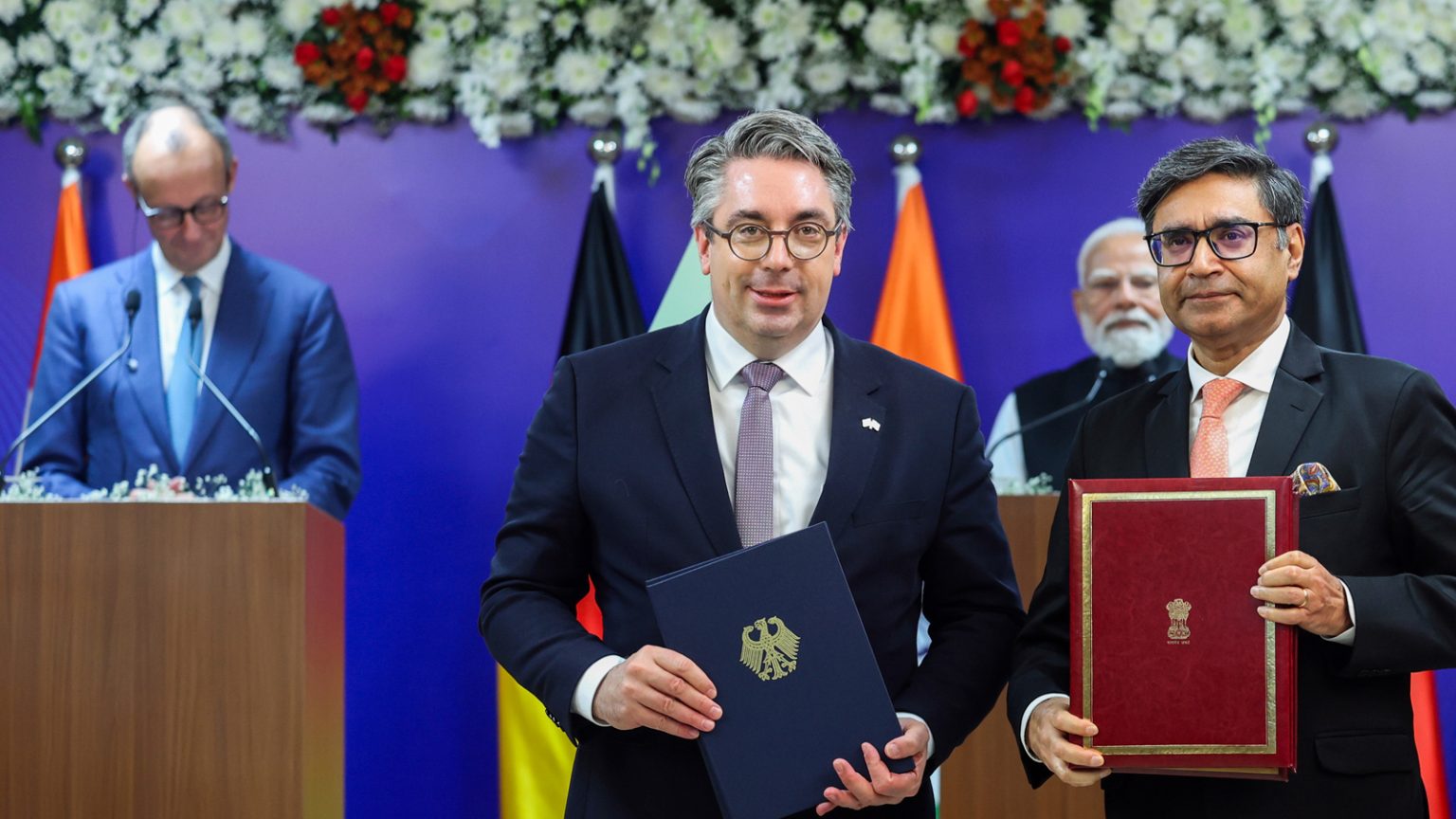
Mumbai: Prime Minister Narendra Modi and German Chancellor Friedrich Merz reaffirmed their commitment to deepen India-Germany ties across defence, economy, technology, climate action, and people-to-people exchanges during Merz’s official visit to India, according to a joint statement.
Chancellor Merz, accompanied by a delegation including 23 leading German CEOs, made his first official visit to India and Asia since taking office, underlining Germany’s prioritisation of India as a key strategic partner in the Indo-Pacific. The visit marks 25 years of India-Germany Strategic Partnership and 75 years of diplomatic relations.
The visit began in Ahmedabad, where both leaders paid tribute to Mahatma Gandhi at the Sabarmati Ashram and participated in the International Kite Festival, highlighting cultural ties. They also addressed the India-Germany CEOs Forum, promoting industrial collaboration and investment. Chancellor Merz is scheduled to visit Bengaluru for technology and innovation engagements.
Defence and Security Cooperation
The two leaders agreed to strengthen defence and security collaboration, including staff talks, joint exercises, military exchanges, and the launch of a Track 1.5 Foreign Policy and Security Dialogue. Germany will participate in key defence exercises, including Naval Exercise MILAN, Air Combat Exercise TARANG SHAKTI, and will deploy a Liaison Officer to the Information Fusion Centre–Indian Ocean Region.
A Joint Declaration of Intent was signed to develop a Defence Industrial Cooperation Roadmap, promoting co-development, co-production, and technology partnerships. Both sides reaffirmed their strong stance against terrorism and pledged enhanced counter-terrorism cooperation through international mechanisms.
Trade, Economy and Technology
Bilateral trade in goods and services exceeded USD 50 billion in 2024. Both leaders reiterated support for the India-EU Free Trade Agreement, expected to unlock further economic potential. Agreements were signed to boost collaboration in semiconductors, critical minerals, telecom, digitalisation, artificial intelligence, and innovation, including institutional dialogues across the semiconductor value chain.

Green and Sustainable Development
The Green and Sustainable Development Partnership (GSDP) was reviewed, noting that nearly €5 billion of Germany’s €10 billion commitment to 2030 has been allocated to renewable energy, green mobility, climate-resilient infrastructure, and sustainable urban development. New funding commitments were announced, with joint working groups on battery storage, solar manufacturing, wind energy, and green hydrogen, alongside a green ammonia offtake agreement.
Global and Regional Issues
India and Germany reaffirmed support for a free and open Indo-Pacific, respect for international law, and announced a bilateral Indo-Pacific consultation mechanism. Both leaders voiced concern over conflicts in Ukraine and Gaza and stressed the need for dialogue, humanitarian access, and peaceful resolution. Climate action and climate finance for developing countries were also emphasised.
Education, Mobility and Culture
The leaders highlighted growing exchanges of students, researchers, and skilled professionals. Germany’s decision to allow visa-free transit for Indian passport holders was welcomed as a boost to travel and exchange programs. New agreements were signed on higher education, skilling, renewable energy training, sports, maritime heritage, and youth exchanges.
Chancellor Merz thanked PM Modi for the warm hospitality, and both leaders agreed to hold the next India-Germany Inter-Governmental Consultations in Germany later in 2026, reaffirming their commitment to elevating the Strategic Partnership.