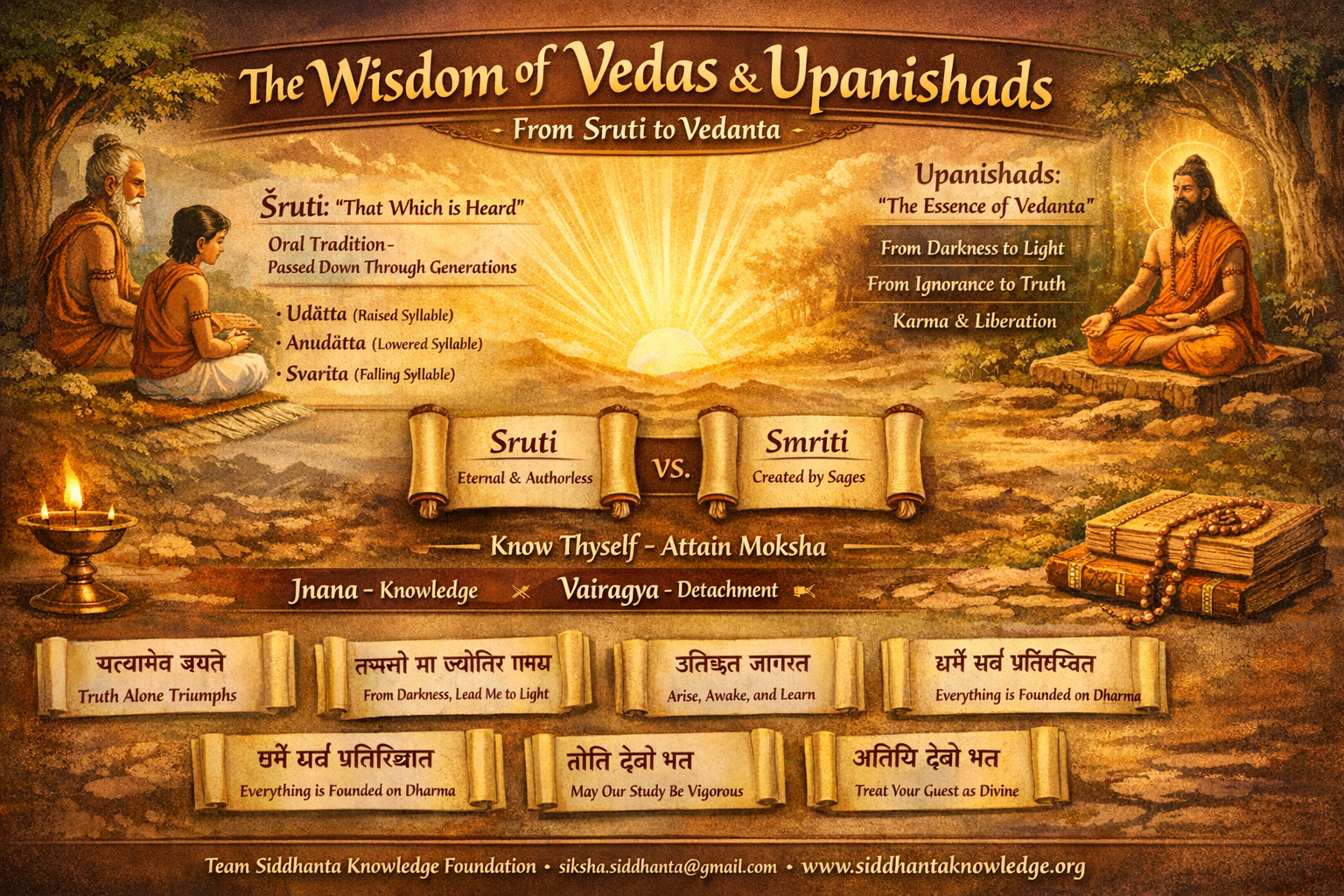
Lucknow: The Vedas are called Sruti, which means, ‘what is heard.’ The Vedashave been handed down orally from generation to generation and have not been taught orlearned from any written text. That is how they got the name of Śruti. The oral tradition preserved the correct chanting and pronunciation with the tonal variations and proper accent that cannot be represented in any script. The three well-known tonal variations in Vedic chanting are: udātta (raised syllable), anudātta (lowered syllable) and svarita (falling syllable). Error in chanting can bring about differences in the vibrations caused by the sounds and consequently in the divine forces that govern nature and our corresponding feelings.
Sacred texts other than Sruti are categorized as Smṛti. They have secondary authority andin fact, they derive their authority from Sruti. Whereas Srutis are considered authorless and eternal in nature, Smṛtis are the creations of seers and sages for the times they lived in.
The Upaniṣhads are the fountain head of Indian philosophy, a treasure trove of the finestphilosophical doctrines and part of the Vedas. They are also called the Vedanta which means the conclusion (anta) of the Vedas. The Upanishads impart the knowledge that leads man from falsehood to truth, from darkness to light and from death to immortality.
The word ‘Upanishad’ is derived from the verbal root ‘sad’ which has several meanings:loosening the clutches of ignorance, moving from lower level to higher levels and annihilation of ignorance. Putting all these three senses together, the word ‘Upanishad’ refers to that divine knowledge or wisdom which loosens the bonds of saṁsāra or worldly existence of a person, removes his ajñāna or ignorance of his real nature and leads him to the Absolute. The word also means ‘sitting devotedly near,’ indicating the close bond between student and teacher when it comes to higher learning.
There are many Upanishads available but ten are considered as important. These are Isa, Kena, Katha, Prasna, Manduka, Mandukya, Aitareya, Taittiriya, Chandogya and Brihadaranyaka. The Upanishads teach about the nature of God, man and the universe. They also guide man on how to live so as to attain peace of mind, develop detachment from worldly anxieties and gain enlightenment.

- i) Cultivation of detachment, Vairagya: the three disciplinary stages, ashramasare prescribed – those of the religious student, brahmacharya, the householdergarhastya and the anchorite, vaanaprastha. This training leads to sannyasa,which in the Upanishads refer to the transcending of the triple mode of ashramalife and is regarded as a consequence of Brahma-knowledge rather than a meansof attaining it.
- ii) Acquisition of knowledge, jnana: evil comes about due to a misconception ofthe nature of Reality, i.e. wrong knowledge and superstition, its removal can onlybe through right knowledge.
The law which governs the kind of birth which such a jiva gets every time itdies, is known as the law of karma. It signifies that nothing can happen withouta sufficient cause in the moral as in the physical world – that each life with allits pain and pleasures is the necessary result of past lives and becomes in itsturn the cause, through its own activities, of future births. It traces all sufferingeventually to ourselves and thus removes bitterness against God or our neighbour.
What we have makes us what we are. According to it the future lies entirely inour own hands so that the belief in this law serves as a perpetual incentive to right.
Here are a few well-known mottos taken from the Upanishads.
- सत्यमेवजयते। “Truth alone triumphs.” (National motto of India)
- धर्मेसर्वंप्रतिष्ठितम्। “Everything in the world is founded on dharma.” (NALSAR, Hyderabad)
- तेजस्विनावधीतमस्तु। “May our study be vigorous and effective.” (IIM, Bangalore)
- अतिथिदेवोभव। “Treat your guest as divine.” (Tourism Development Corporation of India)
- उत्तिष्ठतजाग्रतप्राप्यवरान्निबोधत। “Arise, Awake and Learn by approaching excellent teachers.” (Indian School of Mines, Dhanbad)
- तमसोमाज्योतिर्गमय। “From darkness, lead me to light.” (IIT, Kanpur)
- Team Siddhanta Knowledge Foundation
- siksha.siddhanta@gmail.com
- https:/siddhantaknowledge.org/