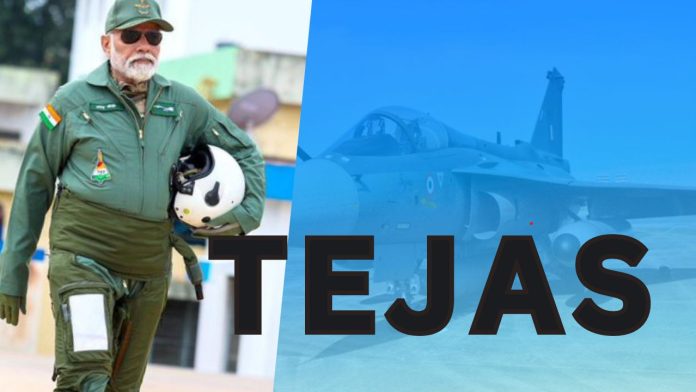
New Delhi | The Indian Air Force (IAF) commemorated the 25th anniversary of the maiden flight of the TEJAS Light Combat Aircraft (LCA), marking a landmark moment in India’s journey towards self-reliance in defence aerospace manufacturing.
Sharing a message on social media, the IAF highlighted the collective effort behind the indigenous fighter programme, acknowledging the contributions of scientists from the Aeronautical Development Agency (ADA), engineers from Hindustan Aeronautics Limited (HAL), test pilots, and personnel from the IAF and Indian Navy. The post underscored the spirit of Atmanirbhar Bharat, concluding with an aspirational message: “The sky is the limit.”
The historic first flight of TEJAS took place on January 4, 2001, when Wing Commander Rajiv Kothiyal flew the Technology Demonstrator-1 (TD-1) from HAL Airport in Bengaluru. The 18-minute sortie marked the beginning of the aircraft’s flight-testing phase, laying the foundation for its transformation from a prototype into an operational fighter.
The TEJAS programme was initiated in 1983, aimed at replacing the IAF’s ageing fighter fleet with a modern, indigenous alternative. Over the decades, the aircraft has evolved steadily, culminating in advanced variants such as the TEJAS Mk-1A, which are now being inducted to strengthen India’s air combat capabilities.
In a major boost to the programme, HAL secured an order in late 2025 for 97 additional TEJAS Mk-1A aircraft, valued at over ₹62,370 crore. This follows an earlier contract for 83 jets, significantly enhancing production scale and reinforcing the IAF’s fighter strength.
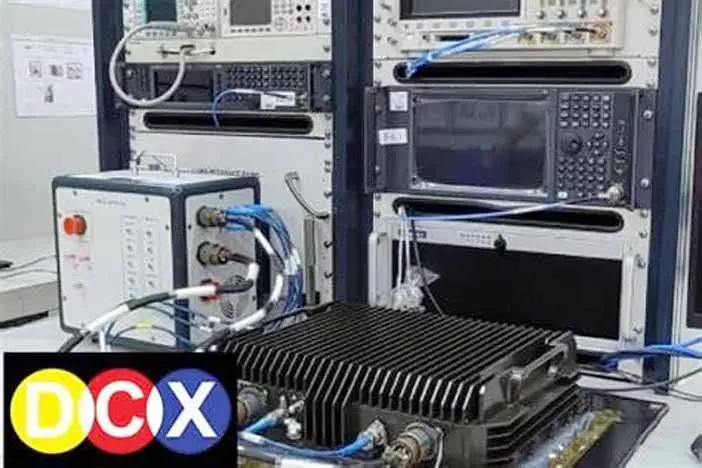
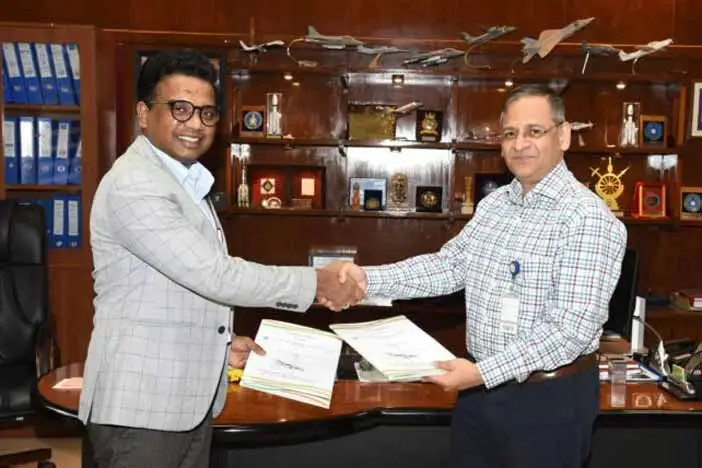
Private sector participation has also gained momentum. In May 2025, Hyderabad-based VEM Technologies delivered the first centre fuselage assembly for the TEJAS Mk-1A to HAL—marking the first instance of a private Indian firm manufacturing a major structural component for the aircraft. The milestone reflected India’s expanding defence manufacturing ecosystem beyond public sector units.

The platform has also seen notable weapons and systems integration milestones. In March 2025, the indigenous ASTRA Beyond Visual Range Air-to-Air Missile (BVRAAM) was successfully test-fired from a TEJAS Mk-1 prototype, achieving a direct hit on an aerial target. Developed by DRDO, ASTRA has a strike range exceeding 100 km and significantly enhances the aircraft’s air superiority role.
During the same period, DRDO’s Defence Bio-Engineering and Electro Medical Laboratory (DEBEL) successfully completed high-altitude trials of the Indigenous On-Board Oxygen Generating System (OBOGS)-based Integrated Life Support System (ILSS) for TEJAS. Tested up to 50,000 feet and under high-G conditions, the system met all aeromedical standards, improving pilot safety and endurance.
Together, these achievements highlight the maturity of the TEJAS programme—from its first flight to advanced combat and life-support integrations. As production of the Mk-1A accelerates and private industry participation grows, TEJAS is set to remain a cornerstone of India’s air power strategy in the years ahead.