
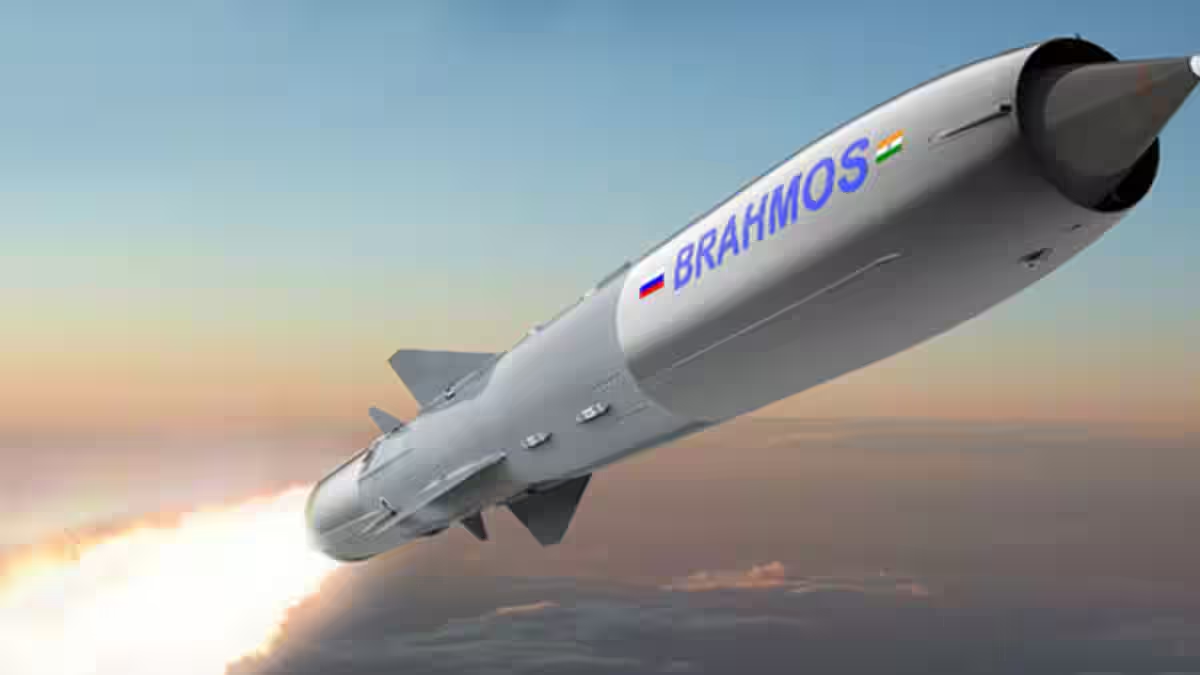
New Delhi: BrahMos Aerospace is advancing its next-generation missile programs, aiming to strengthen India’s offensive and defensive capabilities across multiple combat domains.
Dr. Jaiteerth Raghavendra Joshi, Chairman and Managing Director of BrahMos Aerospace, highlighted that the organization is pursuing several cutting-edge initiatives that mark a significant technological leap for India’s indigenous defence manufacturing.
Air-Launched Lightweight Variant
A key priority is a sleeker, lighter variant designed for integration with India’s Light Combat Aircraft, the Tejas. By reducing the missile’s weight and diameter, this development enables the Tejas to carry multiple BrahMos missiles while maintaining optimal aerodynamic performance, transforming the fighter into a formidable long-range strike platform for both land and naval targets.
Submarine-Launched Configurations
BrahMos Aerospace is also focused on submarine-launched variants. Building on successful 2013 test firings from submerged platforms, the new versions will retain supersonic capabilities while fitting the dimensional constraints of torpedo tubes and vertical launch systems.
Hypersonic BrahMos-II
The most ambitious project is the BrahMos-II hypersonic variant, expected to operate at speeds of Mach 7 to Mach 8, far exceeding the current Mach 2.8–3.0 range. Powered by DRDO’s scramjet technology, recently demonstrated in April 2025 with sustained combustion for over 1,000 seconds, BrahMos-II will feature stealth shaping, radar-absorbent coatings, and advanced trajectory-modulation systems, coupled with India’s G3OM navigation module for precise targeting. The system will carry conventional warheads weighing 200–300 kilograms, with an operational range of approximately 1,500 kilometres.

Production and Human Capital
Scaling production of these advanced systems requires highly skilled personnel across multiple technical domains. Telangana has emerged as a strategic hub for aerospace and defence manufacturing, hosting DRDO labs, public sector undertakings, and a network of supporting enterprises, providing a strong foundation for next-generation missile production.
Bharat Dynamics Limited (BDL) echoed this vision, noting the need for increased production capacity and expanded testing infrastructure to meet rising domestic and international demand. BDL has doubled monthly production of the Akash surface-to-air missile from 50 to 100 units and is expanding facilities in Jhansi and Hyderabad. Backward integration in assembly, seeker manufacturing, warheads, and high-temperature carbon composites has enhanced production resilience.
Strategic Outlook
The convergence of hypersonic development, advanced submarine and air-launched variants, increased manufacturing capacity, testing infrastructure, and private sector participation underscores India’s transition from a production-focused to an innovation-led defence ecosystem. The initiatives presented at the Telangana Rising Global Summit 2025 signal India’s growing ability to compete globally while fulfilling critical domestic security needs.