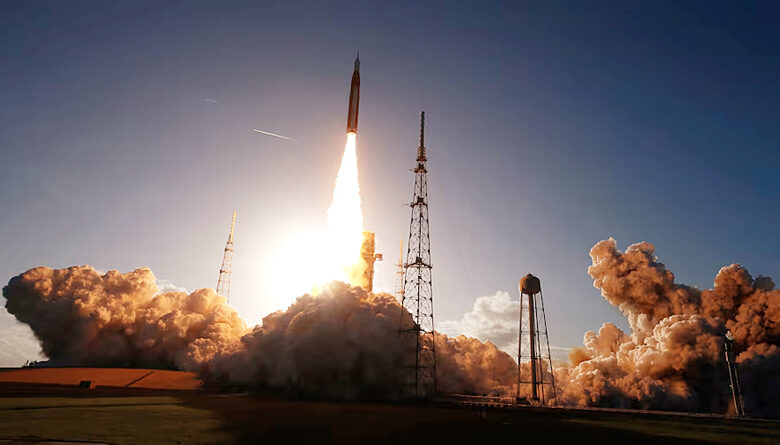
New Delhi: In a landmark moment for space exploration, NASA has successfully launched its ambitious Artemis II mission, marking humanity’s return to deep space travel toward the Moon after more than five decades.
The mission lifted off on April 1, 2026 (April 2, 3:54 AM IST) from the Kennedy Space Center aboard the powerful Space Launch System, carrying the Orion spacecraft with four astronauts on board. This is the first human mission to travel such a distance since the Apollo Program ended in 1972.
Crew and Mission Timeline
The Artemis II crew includes Reid Wiseman, Victor Glover, Christina Koch, and Jeremy Hansen of the Canadian Space Agency. Notably, Koch already holds the record for the longest single spaceflight by a woman.
After launch, the crew spent nearly 25 hours orbiting Earth before setting course for the Moon. The 10-day mission will see astronauts travel approximately 400,000 kilometers, venturing farther than any humans have before.
Breaking Records Beyond Apollo 13
Artemis II is expected to surpass the distance record set during the Apollo 13 mission, which reached about 400,171 kilometers from Earth. While Apollo 13 was forced to abort its lunar landing due to an onboard explosion, it became historic for executing a safe return via a “free-return trajectory.”
In contrast, Artemis II is a planned lunar flyby mission. The Orion spacecraft will travel nearly 5,000 miles beyond the Moon before looping back toward Earth, offering astronauts a rare view of the Moon’s far side—regions never directly observed by humans.

Scientific and Strategic Significance
During the mission, astronauts will conduct observations and capture images of previously unseen lunar terrain, including features like the Orientale Basin. The spacecraft will not land on the Moon or enter its orbit but will follow a distant trajectory to test systems critical for future missions.
The Artemis program represents a long-term vision by NASA to establish a sustainable human presence on the Moon. This includes plans to land astronauts near the lunar south pole by 2028—an area believed to contain water ice and vital resources.
Renewed Global Space Race
The mission also reflects intensifying global interest in lunar exploration. While the United States leads with Artemis, China is preparing for a human Moon mission by 2030. Meanwhile, ISRO aims to send astronauts to the Moon by 2040, building on the success of Chandrayaan-3.
A New Era of Space Exploration
The Artemis II mission is widely seen as a stepping stone toward future crewed lunar landings and eventual missions to Mars. It signals a new era of technological advancement, international collaboration, and human ambition in space.
As humanity looks beyond Earth once again, the Moon is set to become not just a destination—but a gateway to deeper space exploration.