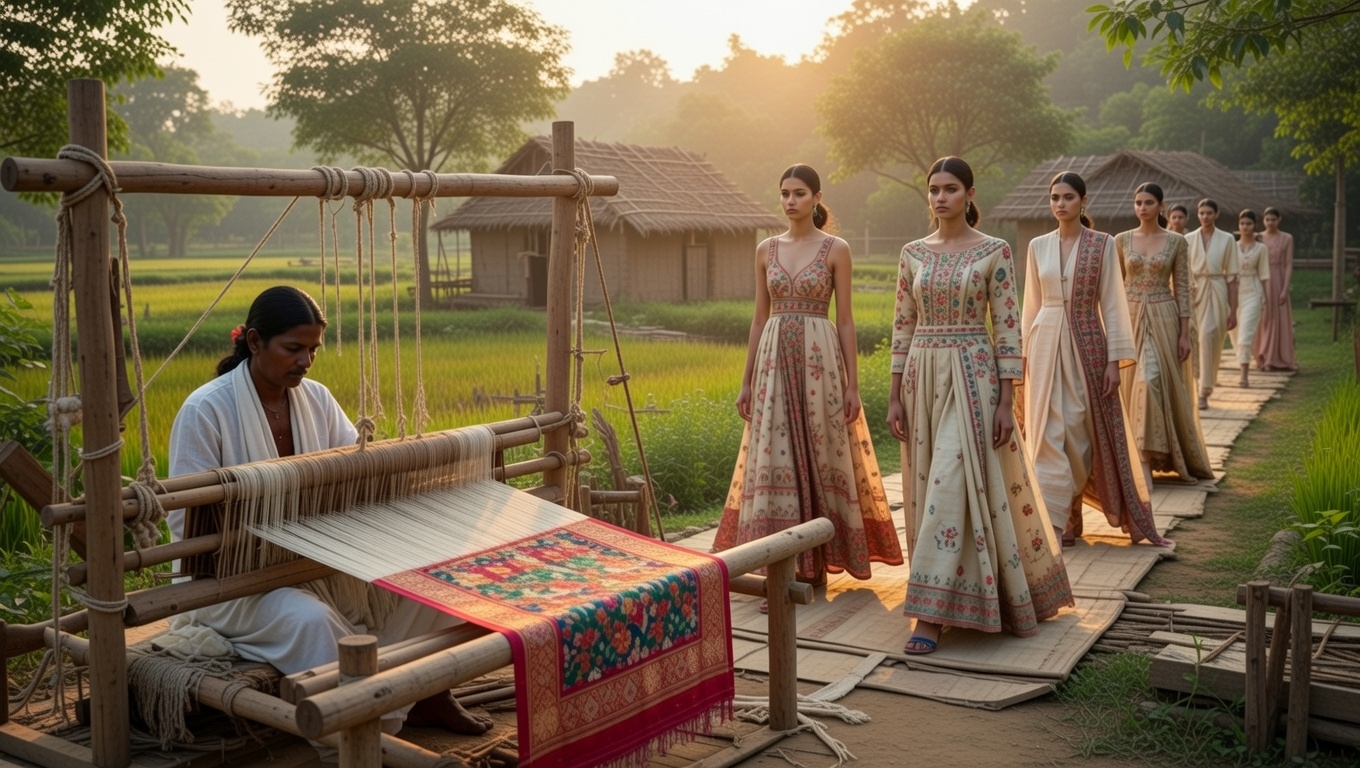
Lucknow: While fashion capitals like Paris, Milan, and New York continue to dominate headlines with glittering runways, celebrity showstoppers, and trend forecasts, the true soul of high-end fashion in 2025–2026 lies far from these urban epicentres. It lives in the quiet villages of Uttar Pradesh, Madhya Pradesh, West Bengal, Odisha, Gujarat, Telangana, and Rajasthan, where handlooms hum, dyes simmer in copper vessels, and centuries-old skills are passed meticulously from one generation to the next.
Rural India, long perceived as peripheral to the glamorous narrative of luxury fashion, has emerged as its most authentic backbone. From Banarasi brocades and Chanderi silks to Jamdani muslin, Ajrakh block prints, khadi, ikat, and intricate zardozi embroidery, the fabrics and techniques shaping contemporary couture originate in village clusters where craft is not merely a profession — it is a way of life.
“Every luxury garment today carries the fingerprint of a rural artisan,” says Rahul Mishra, India’s first designer on the Paris Haute Couture calendar. “Without villages, there is no sustainable luxury.”
The Vast Rural Foundation of Handloom Excellence
India’s handloom sector remains the largest cottage industry in the world, operating nearly 2.8 million looms and employing between 3.5 and 4.3 million people. According to the Fourth All India Handloom Census (2019–20), the workforce stands at 35.22 lakh, including 26.73 lakh weavers — of whom 72–77% are based in rural areas.
Equally remarkable is the gender dimension. Over 70% of handloom workers are women, many from economically marginalised communities. They balance weaving with farming, caregiving, and household responsibilities, ensuring the survival of centuries-old traditions under challenging circumstances.
In Varanasi, families like that of Mohammad Irfan Ansari, a fifth-generation Banarasi weaver, continue to create silk brocades for global couture.
“My grandfather wove sarees for weddings. Today, my silk goes to Europe,” Irfan says. “The loom is the same. Only the destination has changed.”
Similarly, in Chanderi, Madhya Pradesh, master weaver Sunita Bai produces feather-light silks that grace Indian and international designer collections.
“Designers ask for modern colours and shapes,” she explains. “But the weaving technique is what my mother taught me. That is what gives our fabric its soul.”
From Village Looms to a Booming Global Market
Rural craftsmanship is no longer just culturally valuable — it is economically critical. Handloom contributes nearly 19% of India’s textile production, providing livelihoods in regions with few industrial alternatives. Beyond domestic consumption, these fabrics are increasingly coveted on international runways.
The global handloom products market is valued at approximately USD 8.95 billion in 2025 and is projected to reach USD 16.62 billion by 2032, growing at a CAGR of 9.24%. This surge is driven by rising demand for artisanal, ethical, and eco-conscious textiles, as luxury buyers increasingly seek stories behind the garments.
“Luxury buyers today don’t just ask who designed the garment,” says Anita Dongre, founder of House of Anita Dongre. “They want to know who made it — and how.”
Rural India is, therefore, not only supplying materials but shaping the ethos of global couture. Every weave, dye, and embroidery speaks of heritage, patience, and authenticity — qualities that modern luxury consumers prize above mass-produced glamour.
Sustainability: Rural India’s Inherent Advantage
As the fashion industry worldwide grapples with the environmental footprint of fast fashion, rural India’s handloom practices have emerged as a gold standard for sustainability. Unlike powerloom or synthetic production, handloom weaving:
- Uses minimal electricity
- Relies on natural or low-impact dyes
- Employs regenerative fibres like khadi and organic cotton
- Generates negligible waste
Khadi, famously championed by Mahatma Gandhi, has re-entered luxury conversations as a climate-positive textile. Contemporary designers are reimagining it into sharply tailored jackets, gowns, and layered couture that rivals the finesse of imported fabrics.
“We were sustainable before sustainability became fashionable,” says Savita Patel, an artisan from Kutch. “We just didn’t call it that.”
The Indian sustainable fashion market, heavily reliant on rural handlooms, is projected to grow from USD 272.51 million in 2024 to USD 1.59 billion by 2033, clocking a 21.96% CAGR — one of the fastest-growing segments globally.
Direct Collaborations: Artisans Step Into the Spotlight
One of the most transformative shifts in 2025–2026 has been the rise of direct designer–artisan collaborations. Rural creators are no longer anonymous suppliers hidden in supply chains; they are recognised co-creators, celebrated for their expertise and creativity.

At Lakmé Fashion Week x FDCI 2025 (Silver Jubilee Edition), the spotlight shone on artisan-designers from Somaiya Kala Vidya, Kutch. Names like Zaid Khatri (Ajrakh), Amruta Vankar (Mashru), Mubbasirah Khatri, Muskan Khatri, and Shakil Ahmed (Neel Batik) presented collections that seamlessly merged heritage techniques with contemporary silhouettes.
“For the first time, we were not backstage,” says Zaid Khatri. “We were the designers.”
Internationally, houses like Burberry, Hermès, and Louis Vuitton increasingly source handwoven textiles from Indian clusters. Indian labels such as Rahul Mishra, Gaurav Gupta, and Raw Mango integrate rural craftsmanship as an intrinsic part of their couture narrative, showcasing a seamless dialogue between tradition and modernity.
Ethical Luxury and the Question of Fair Wages
Despite growing recognition, challenges persist. Fair compensation, credit attribution, and long-term sustainability remain pressing concerns for rural artisans. Luxury pricing does not always translate to dignity for the creators, and middlemen often absorb profits disproportionately.
“Visibility must translate into dignity,” says Shilpa Sharma, founder of Jaypore. “Luxury pricing should benefit the hands that create it.”
Brands like Dressfolk, which partners with over 800 weavers, and platforms such as Okhai, GoCoop, and Flipkart Samarth are attempting to bridge this gap through transparent sourcing, fair-trade models, and empowering artisans to become entrepreneurs themselves.
Government and Institutional Support
Policy support has been pivotal in strengthening rural fashion ecosystems. The National Handloom Development Programme (NHDP 2021–2026) has focused on:
- Infrastructure upgrades
- Skill development and training
- Market access for rural artisans
In 2023–24 alone, the Raw Material Supply Scheme distributed over 340 lakh kilograms of yarn to weavers at subsidised rates. More than 1.75 lakh weavers were onboarded onto the Government e-Marketplace (GeM) platform, opening digital channels for direct sales.
Women-led Self-Help Groups (SHGs), GI tagging of regional textiles, and initiatives like Vocal for Local have further empowered rural communities. International collaboration has also played a role. The EU–India textile partnership, including a EUR 9.5 million grant in 2025, benefits over 35,000 artisans across states, fostering innovation, skill enhancement, and global exposure.
Challenges and the Road Ahead
Rural artisans face enduring challenges:
- Low and inconsistent wages
- Competition from imitation powerlooms
- Youth migration to cities seeking higher-paying jobs
- Rising raw material costs
Yet hope is rising with education, digital access, and skill diversification. Young artisans are learning design, branding, and entrepreneurship, ensuring craft continuity even as market dynamics evolve.
“I don’t want to leave the village,” says Rukhsar Bano, a 22-year-old Jamdani weaver from Phulia. “I want the world to come to us.”
Government schemes, NGO interventions, and designer initiatives are increasingly focusing on holistic development — combining heritage preservation with economic empowerment and digital literacy.
Rural India: The Quiet Power of Global Luxury
In 2026, rural India is no longer an invisible contributor to fashion’s success. It is a leader in ethical luxury, a custodian of sustainability, and a source of cultural depth that global fashion desperately seeks.
The threads woven in village looms do more than create garments — they weave livelihoods, resilience, heritage, and future possibilities. Rural India has demonstrated that luxury need not be synonymous with excess; it can be about integrity, craftsmanship, and ecological responsibility.
As the world of fashion redefines itself in an era of climate consciousness and cultural respect, rural India is not merely catching up. It is leading — quietly, masterfully, and irreversibly.
In the quiet hum of village looms, in the deft hands of artisans like Irfan, Sunita, Savita, and Rukhsar, global luxury finds its soul. The story of couture is no longer just about cities; it is about villages, their people, and their enduring craft.