
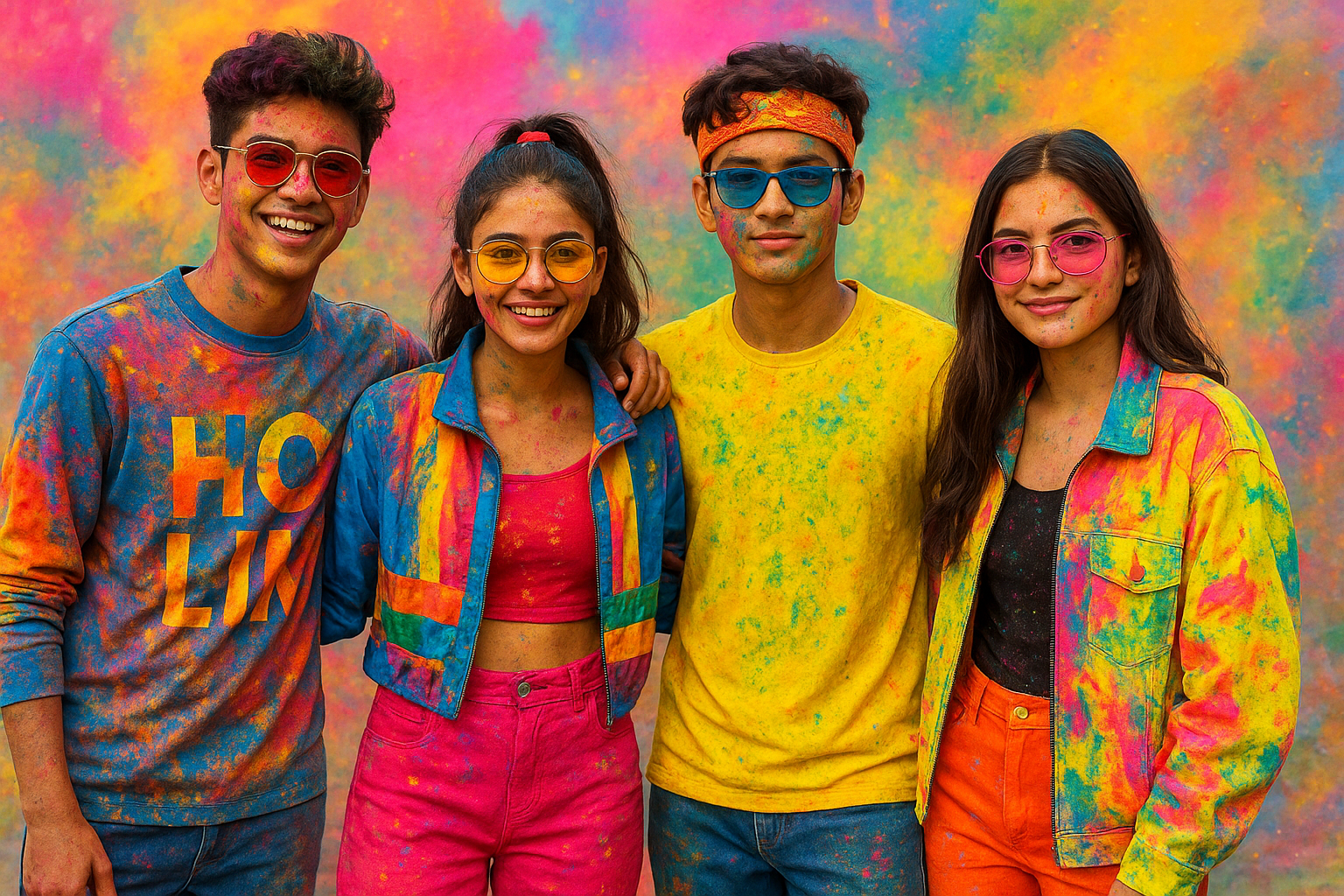
Lucknow: In an era defined by escalating geopolitical turbulence — from the grinding war between Russia and Ukraine to the devastating conflict between Israel and Gaza Strip, alongside broader Middle East tensions involving Iran — the search for creative pathways to peace has taken on renewed urgency. Amid military offensives, sanctions regimes, and hardened rhetoric, the idea of “Holi diplomacy” emerges as an intriguing proposition. Could India’s ancient Festival of Colours — rooted in renewal, forgiveness, and the triumph of good over evil — serve as a subtle yet meaningful instrument of cultural diplomacy in troubled times?
Holi, celebrated across India and far beyond, marks the symbolic burning away of negativity during Holika Dahan and the exuberant celebration of life the following day. It is a festival that dissolves hierarchies, encourages reconciliation, and affirms the resilience of human connection. In a fractured world, its ethos appears strikingly relevant.
The Power of Cultural Diplomacy
Cultural diplomacy — the strategic use of culture, arts, and shared traditions to foster mutual understanding — has long functioned as a quiet counterbalance to hard power politics. During the Cold War, American jazz legends toured Eastern Europe and the Soviet Union, presenting a human face of the United States that transcended ideological rivalry. Soviet ballet companies performed in Western capitals, offering audiences glimpses of shared artistic excellence beyond political hostility.
These exchanges did not end the Cold War. Yet they softened perceptions, opened informal communication channels, and humanized adversaries. In more recent decades, Israeli and Palestinian musicians have collaborated in joint orchestras, creating platforms for dialogue where official negotiations stalled. Cultural spaces often succeed where formal diplomacy falters — not by resolving disputes overnight, but by nurturing empathy.
Festivals are particularly powerful vehicles of such engagement. Shared celebration disrupts the rigid narratives of conflict. Music, colour, dance, and food create temporary neutral zones where identity becomes expansive rather than exclusionary. Holi, with its emphasis on equality and joy, fits squarely within this tradition.
Holi’s Symbolism: Renewal and Reconciliation
Rooted in Hindu mythology, Holi commemorates the triumph of devotion and righteousness over tyranny, symbolized by the story of Prahlada and Holika. The ritual of Holika Dahan — the ceremonial bonfire — represents the burning away of past grievances, ego, and negativity. The following day, vibrant colours blur distinctions of caste, class, age, and status.
On Holi, strangers embrace. Friends mend broken ties. Old grudges are symbolically washed away in showers of gulal. A common refrain captures its spirit: “Bura na mano, Holi hai” — take no offense, it is Holi. Beneath the playful surface lies a deeper philosophical message: forgiveness liberates both the giver and the receiver.
In divided societies, such symbolism carries profound resonance. Reconciliation requires not only political agreements but also emotional transformation. Holi’s egalitarian ethos offers a metaphorical framework for that transformation.
Holi Beyond Borders
Over the past decades, Holi has transcended its origins to become a global cultural phenomenon. Indian diaspora communities organize large-scale Holi celebrations in cities from London to Johannesburg, from New York to Sydney. Universities, public parks, and cultural centers host colour festivals that attract diverse participants, many with no direct connection to India.
During the ongoing conflict between Russia and Ukraine, diaspora communities in Kyiv held modest Holi gatherings, seeking moments of solidarity and normalcy amid wartime disruption. Such celebrations, though small, symbolized resilience — a reminder that culture endures even when politics fracture societies.
Indian peacekeepers serving with UN missions have also hosted Holi celebrations in regions affected by civil strife, blending cultural exchange with peacekeeping responsibilities. In Israel, collaborative “Holi-Purim” events have creatively merged India’s festival of colours with the Jewish festival of Purim, emphasizing shared themes of survival, deliverance, and joy after adversity. Such initiatives highlight how cultural parallels can build bridges between traditions.
Indian diplomatic missions frequently organize Holi receptions that invite local officials, diplomats, and civil society leaders. These events, while celebratory, carry a subtle message: India positions itself as a civilization that values pluralism, renewal, and coexistence.
Track II Diplomacy: Where People Meet
Holi diplomacy would function most effectively within the realm of “Track II” diplomacy — informal, people-to-people exchanges that complement official negotiations. In deeply polarized environments, formal talks often become hostage to political pressures. Cultural engagement, however, can create alternative channels of trust.
Consider historical precedents. The 1971 “ping-pong diplomacy” between the United States and China paved the way for President Nixon’s landmark visit to Beijing, reshaping global geopolitics. In divided Cyprus, bicommunal art exhibitions have provided spaces for Greek and Turkish Cypriots to interact beyond political rhetoric. In post-apartheid South Africa, cultural expression played a crucial role in national healing.
These examples suggest that symbolic gestures, when embedded in broader strategies, can shift atmospheres. Holi’s emphasis on equality and joy could serve a similar function — offering moments of shared humanity amid entrenched hostility.

The Limits of Colour
Yet optimism must be tempered by realism. Major global conflicts are driven by deep-rooted territorial, ideological, and strategic calculations. The war in Ukraine involves questions of sovereignty, security architecture, and great power rivalry. The Israel-Gaza conflict encompasses historical grievances, existential fears, and regional power dynamics. In such contexts, festivals alone cannot alter battlefield realities.
Hard power considerations — military operations, economic sanctions, and alliances — frequently overshadow soft power initiatives. Cultural events risk being dismissed as superficial or even propagandistic. A brightly coloured Holi celebration in a war-torn region could be criticized as insensitive if it appears disconnected from the suffering of civilians.
Moreover, Holi’s origins in Hindu tradition may limit its resonance in certain societies unfamiliar with or wary of Indian cultural influence. In polarized environments, even well-intentioned initiatives can provoke backlash, especially if perceived as advancing national branding rather than genuine reconciliation.
Making Holi Diplomacy Meaningful
For Holi diplomacy to transcend symbolism, it would require careful integration into structured peacebuilding efforts:
Multilateral Platforms: Organizations such as the United Nations or UNESCO could host global Holi-themed cultural forums focused on dialogue, inviting artists, youth leaders, and civil society representatives from conflicting nations to participate in workshops centered on forgiveness and coexistence.
Inclusive Diplomatic Hosting: Indian embassies could design Holi events that foreground universal values rather than religious symbolism, ensuring participation from diverse communities and framing the festival as a shared human celebration of renewal.
Hybrid Engagement: In conflict zones where physical gatherings are difficult, virtual Holi exchanges — connecting classrooms, cultural groups, and diaspora communities across borders — could foster cross-cultural dialogue without logistical barriers.
Cultural Partnerships: Pairing Holi with equivalent spring or renewal festivals in other traditions can amplify its universal appeal. Collaborative events linking Holi with local celebrations would emphasize common themes rather than cultural differences.
India’s Soft Power Moment
In 2026, amid sustained global instability, India’s projection of Holi abroad contributes to its broader soft power strategy. The festival showcases a narrative of pluralism and civilizational continuity. As New Delhi seeks a greater role on the global stage — from the G20 presidency in recent years to expanded diplomatic outreach — cultural diplomacy reinforces its image as a bridge-builder.
However, credibility matters. Cultural gestures gain power when aligned with consistent diplomatic messaging and principled foreign policy. If Holi diplomacy is perceived merely as spectacle, its impact will be fleeting. If embedded in authentic efforts to encourage dialogue and humanitarian cooperation, it may yield incremental but meaningful dividends.
A Splash of Hope
Ultimately, Holi diplomacy cannot end wars single-handedly. Conflicts require political courage, negotiation, compromise, and sometimes painful concessions. Cultural celebration does not substitute for ceasefires or treaties.
Yet peace is not forged solely in conference rooms. It begins in the human imagination — in the willingness to see an adversary as a fellow person rather than an abstract enemy. Shared laughter, colour-streaked faces, and symbolic acts of forgiveness remind participants of common humanity.
In that sense, Holi offers more than spectacle. It embodies a philosophy: that renewal is possible even after darkness, that grievances can be released, and that joy can coexist with resilience. In a world weary of division, such reminders matter.
As bonfires glow and colours fill the spring air, Holi’s message resonates beyond India’s borders. It may not redraw maps or rewrite treaties. But in nurturing empathy and sustaining connection, it plants small seeds of hope — and sometimes, in diplomacy as in nature, it is the smallest seeds that eventually transform the landscape.






