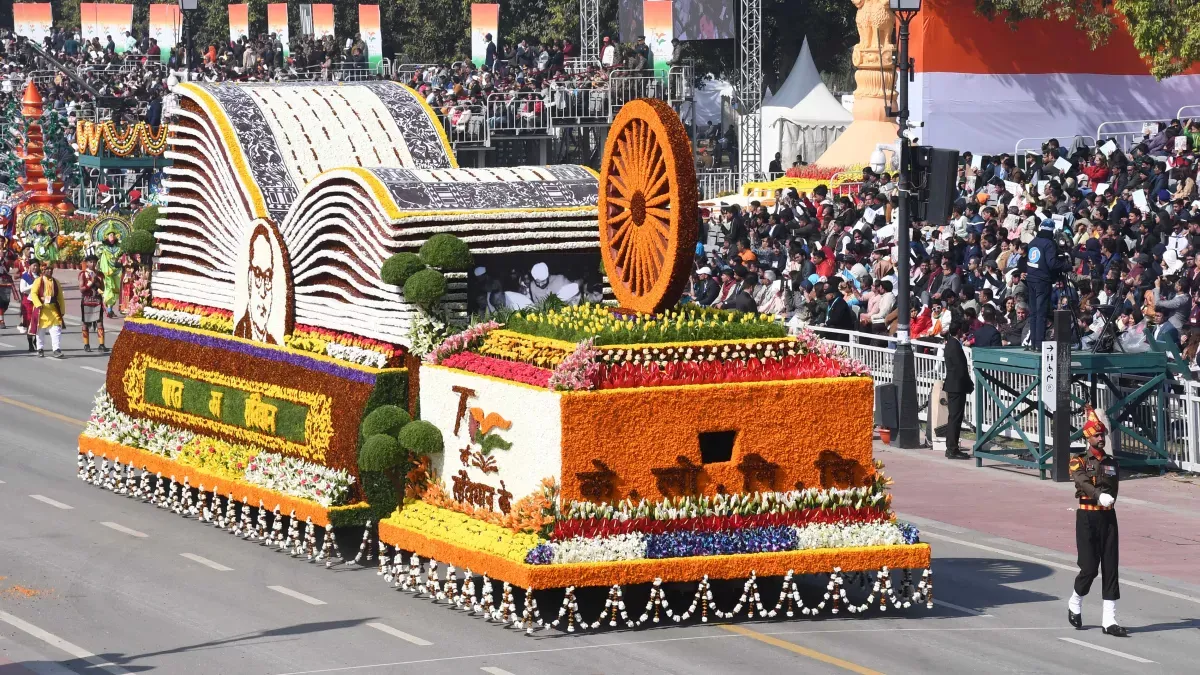
New Delhi: India’s rich cultural, social, and developmental diversity will once again be on full display at the Republic Day Parade 2026 through a grand presentation of tableaux on Kartavya Path. The parade, to be held on January 26, will feature a total of 30 tableaux, including 17 from states and Union Territories and 13 from Central Government ministries and departments.
This year, the tableaux will revolve around the shared themes “Mantra of Freedom — Vande Mataram” and “Mantra of Prosperity — Atmanirbhar Bharat”, reflecting both India’s historical journey and its aspirations for self-reliant growth.
Focus on 150 Years of Vande Mataram and Atmanirbhar Bharat
A key highlight of Republic Day 2026 is the commemoration of 150 years of Vande Mataram. The tableaux aim to underline the spirit of national unity, freedom, self-reliance, inclusive development, and collective progress. Through visual narratives, they will portray India’s cultural heritage, technological advancement, and ongoing social transformation.
States and Union Territories Selected
The states and Union Territories whose tableaux will feature in the parade include Assam, Chhattisgarh, Gujarat, Himachal Pradesh, Jammu & Kashmir, Kerala, Maharashtra, Manipur, Nagaland, Odisha, Puducherry, Rajasthan, Tamil Nadu, Uttar Pradesh, West Bengal, Madhya Pradesh, and Punjab. Each tableau will highlight the unique cultural identity, flagship development initiatives, and key achievements of the respective region.
13 Central Ministries to Present Tableaux
Alongside the states, 13 Central Government ministries and departments will also showcase tableaux. These include the Indian Air Force Headquarters, Naval Headquarters, Department of Military Affairs, Ministry of Culture, Department of School Education and Literacy, Ministry of AYUSH, Ministry of Home Affairs (NDMA–NDRF), Ministry of Home Affairs (BPR&D), Ministry of Housing and Urban Affairs (CPWD), Ministry of Information and Broadcasting, Ministry of Panchayati Raj, Ministry of Power, and the Ministry of Skill Development and Entrepreneurship.

States and UTs Not Included This Year
Several states and Union Territories will not be represented by tableaux in this year’s parade. These include Arunachal Pradesh, Mizoram, Tripura, Sikkim, Meghalaya, Jharkhand, Goa, Delhi, Karnataka, Telangana, and Andhra Pradesh. Notably, Delhi, which has featured tableaux seven times over the past two decades, did not make the cut this year.
Rotation Policy and Rigorous Screening
According to officials, the selection process is overseen by a screening committee under the Ministry of Defence, which follows a detailed and stringent evaluation procedure. A rotation policy, implemented over the past two years, ensures that all states and Union Territories receive opportunities over time. Due to this policy and strict evaluation criteria, several proposals could not be accommodated this year.
Role of Padma Awardees and Experts
The expert committee responsible for final selection includes renowned artists and Padma awardees from various fields. The committee conducts an in-depth assessment of each proposal based on its theme alignment, concept, design, aesthetics, and visual impact. Officials noted that some proposals failed to meet the prescribed standards, leading to their exclusion.
The Republic Day Parade 2026 tableaux are expected to offer a powerful visual celebration of India’s past, present, and future, reinforcing the spirit of unity, self-reliance, and national pride.