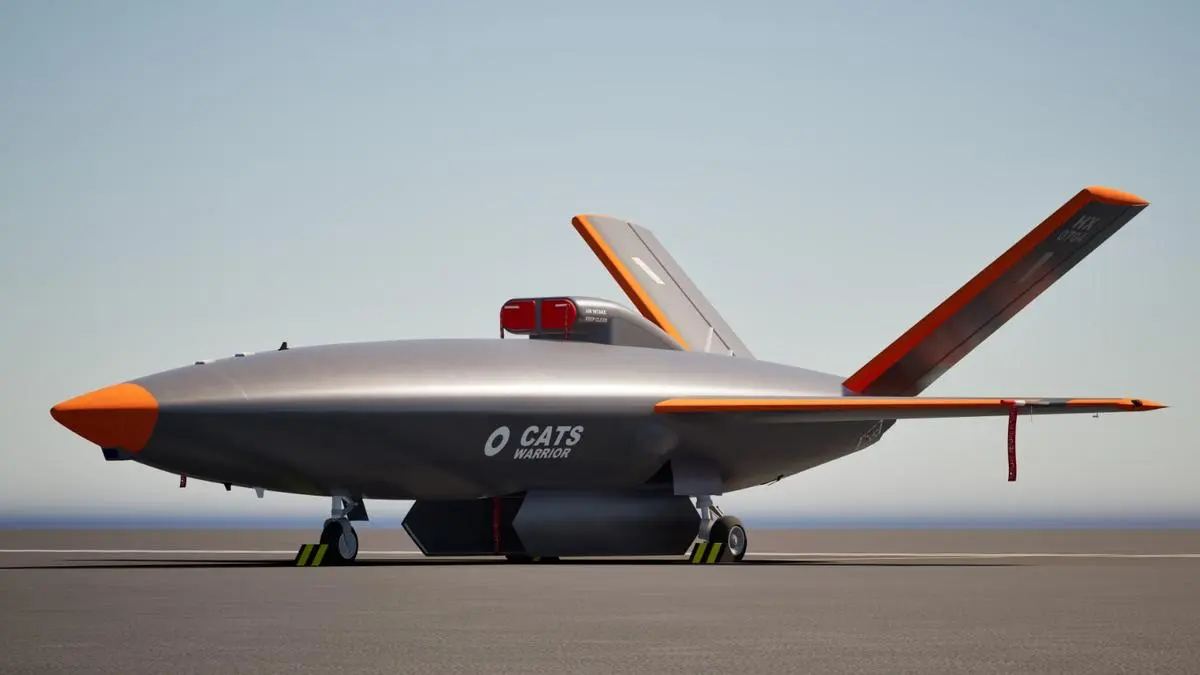
This platform pairs seamlessly with the TEJAS mothership, executing high-risk tasks like strike missions, surveillance, reconnaissance, electronic warfare, decoy roles, and swarm operations. Its low-observable design and Autonomous Take-off and Landing (ATOL) features minimise risks to manned pilots in contested airspace.
TATA Elxsi collaborated closely with HAL, delivering expertise in airframe assembly, fuel storage, and landing gear for the full-scale demonstrator. This partnership fused TATA Elxsi’s aerospace engineering prowess with HAL’s aviation heritage, achieving a demonstrator in just 14 weeks—a timeline that surpassed expectations and set benchmarks for future indigenous defence projects under Make in India.
The project faced a formidable challenge: completing design, engineering, fabrication, and validation within 14 weeks. Precision was paramount, with requirements for dimensional accuracy, structural symmetry, adherence to weight targets, and a fully leakproof fuel system. Complex air duct fabrication added layers of difficulty, demanding innovative solutions under relentless pressure.
The process began with material selection and preliminary design, allocating the first two weeks to rigorous evaluation. Engineers scrutinised composites, alloys, and advanced materials for stealth, strength, and lightweight properties. Finite element analysis (FEA) tools simulated initial loads, ensuring the airframe could withstand combat stresses while meeting low-observable radar cross-section goals.
Preliminary sketches evolved into 3D models using CAD software, incorporating aerodynamic shaping for supersonic dashes and subsonic loiter. HAL’s inputs on LCA integration refined the design, prioritising modularity for swarm scalability. This phase established a digital twin, slashing iteration times and paving the way for detailed engineering.
Next came stress analysis in weeks three and four, employing advanced simulations to validate structural integrity. Multi-physics tools assessed aerodynamic loads, vibration modes, and thermal stresses from internal systems. Critical areas like wing roots and fuselage joints underwent fatigue testing virtually, confirming margins of safety exceeded DRDO standards.
Optimisation loops refined thicknesses and reinforcements, balancing weight against durability. Modal analysis predicted flutter boundaries, essential for ATOL stability. This phase uncovered potential weak points in air ducts, prompting redesigns that enhanced airflow efficiency without compromising stealth coatings.
Airframe detailed design and development spanned weeks five to seven, translating analyses into production-ready blueprints. Parametric modelling enabled rapid tweaks, with over 5,000 components detailed—from composite skins to titanium fasteners. Fuel tank baffles were engineered for zero-leakage under 9G manoeuvres, integrating bladder materials resistant to jet fuels like JP-8.
Landing gear mechanisms drew on TATA Elxsi’s prior work, featuring retractable struts with carbon-fibre oleos for rough-field ops. Internal bays accommodated munitions and sensors, with doors engineered for minimal drag. Digital mock-ups facilitated clash detection, ensuring seamless integration with avionics harnesses.
Assembly jig design and development followed in weeks eight and nine, creating bespoke fixtures for precision mating. Modular jigs, CNC-machined from aluminium alloys, aligned fuselage halves to sub-millimetre tolerances. Laser-guided systems monitored symmetry, while ergonomic features accelerated manual operations in HAL’s facilities.
These jigs incorporated adjustment mechanisms for thermal expansions during curing, vital for composite layups. Finite element models of the jigs themselves ensured they withstood assembly loads without deflection. This investment halved setup times, directly contributing to the aggressive timeline.
Demonstrator development dominated weeks ten to twelve, shifting from digital to physical realisation. Composite panels underwent autoclave curing, followed by meticulous assembly on the jigs. Fuel systems were plumbed with self-sealing lines, rigorously pressure-tested for leaks using helium spectrometry.
Landing gear was installed with hydraulic actuators, cycled thousands of times to simulate ATOL cycles. Air ducts, fabricated via additive manufacturing for complex geometries, integrated seamlessly with environmental controls. Surface finishes applied radar-absorbent materials, verified through initial RCS scans.
Testing and validation occupied week thirteen, a frenzy of ground trials at HAL’s Bengaluru campus. Structural load tests on wing spars confirmed 150% safety factors. Fuel system endurance runs simulated 500 hours of flight, with zero leaks recorded. Vibration tables replicated engine harmonics, validating airframe resonance avoidance.
Non-destructive testing (NDT) via ultrasonics and X-rays cleared all welds and bonds. Landing gear drop tests met 10m/s impact criteria, while symmetry checks using photogrammetry achieved 0.2mm accuracy. Minor tweaks, like duct damping pads, were iterated on-site, showcasing the team’s agility.
System integration capped the 14 weeks, fusing airframe with CATS avionics in week fourteen. Data buses linked flight controls to the LCA mothership, enabling autonomous teaming demos. Power distribution harnesses powered EW suites and sensors, with EMI shielding preventing interference.
Ground-run simulations validated ATOL algorithms, with the demonstrator taxiing under remote command. Swarm logic uplinks were tested, confirming decoy and strike handoffs. The full-scale prototype emerged flight-ready, exceeding weight targets by 2% under and primed for Aero India 2025 unveiling.
This 14-week triumph underscores India’s defence manufacturing maturity, compressing what typically spans years into months. HAL and TATA Elxsi’s synergy not only delivered a CATS Warrior demonstrator but accelerated pathways to serial production, bolstering IAF’s next-gen combat edge.
---------------------------------------------------------------------------------------------------