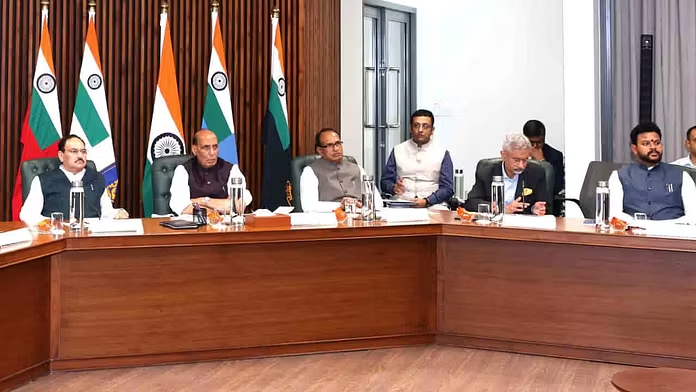
New Delhi | Amid escalating tensions in West Asia, the Centre has stepped up preparedness to safeguard essential supplies, with a key announcement made during a high-level meeting of the Informal Group of Ministers (IGoM) chaired by Defence Minister Rajnath Singh.
The government has decided to double the supply of 5-kg LPG cylinders, a move aimed at providing relief to daily wage workers and economically weaker sections. The decision comes as part of a broader strategy to ensure uninterrupted availability of critical resources such as energy, food, and fuel.
Focus on Preparedness and Coordination
During the meeting, Singh directed all departments to remain fully prepared for any emerging situation and to strengthen inter-ministerial coordination. He emphasized that the government’s approach is centered on preparedness, resilience, and seamless coordination to minimize the impact of global uncertainties on the country.
Officials informed the IGoM that supplies of LPG, petrol, diesel, and fertilizers remain stable, with close monitoring of supply chains to avoid disruptions for consumers.
Energy Security Under Watch
The government highlighted that in the past 40 days, India has successfully ensured safe passage of multiple shipments through the Strait of Hormuz. A total of eight LPG vessels carrying around 340,000 metric tonnes of gas reached India safely—equivalent to nearly 11 days of national demand.
Authorities confirmed there is no shortage of LPG across the country, and domestic supply continues as normal. In addition to boosting 5-kg cylinder availability, LPG supply for industrial use has also been increased, with nearly 70% of fuel allocation directed towards key sectors such as pharmaceuticals, food processing, steel, agriculture, and packaging.
Push for PNG Adoption
The meeting also reviewed efforts to promote piped natural gas (PNG). Around 316,000 new PNG connections have been added under government initiatives—three times higher than last year. Notably, over 16,000 consumers have voluntarily surrendered LPG connections, indicating a gradual shift towards alternative fuel sources.

Food Security and Market Stability
The government assured that adequate stocks of rice and wheat are available to meet demand under the public distribution system. It may also release additional grains under the Open Market Sale Scheme if needed to stabilize prices.
Procurement for the 2026–27 rabi marketing season has already begun in coordination with state governments, with adequate arrangements in place for storage and packaging.
Edible Oils and Sugar Supply Stable
Supply of edible oils remains steady, supported by imports from countries such as Indonesia, Malaysia, Argentina, and Brazil, along with improved domestic mustard production. Sugar stocks are also sufficient, with production expected to remain strong in 2025–26. So far, 1.58 million metric tonnes of sugar exports have been approved, with about 373,000 metric tonnes already shipped.
Monitoring Prices and Supply Chains
The government is closely tracking prices of 40 essential commodities through 578 monitoring centers nationwide. While prices have largely remained stable, a slight increase has been observed in edible oils. Procurement for onion buffer stock is expected to begin soon to keep prices in check.
Overall, the Centre reiterated its commitment to maintaining robust supply chains and ensuring that essential goods remain available without disruption, even as global uncertainties continue to evolve.