
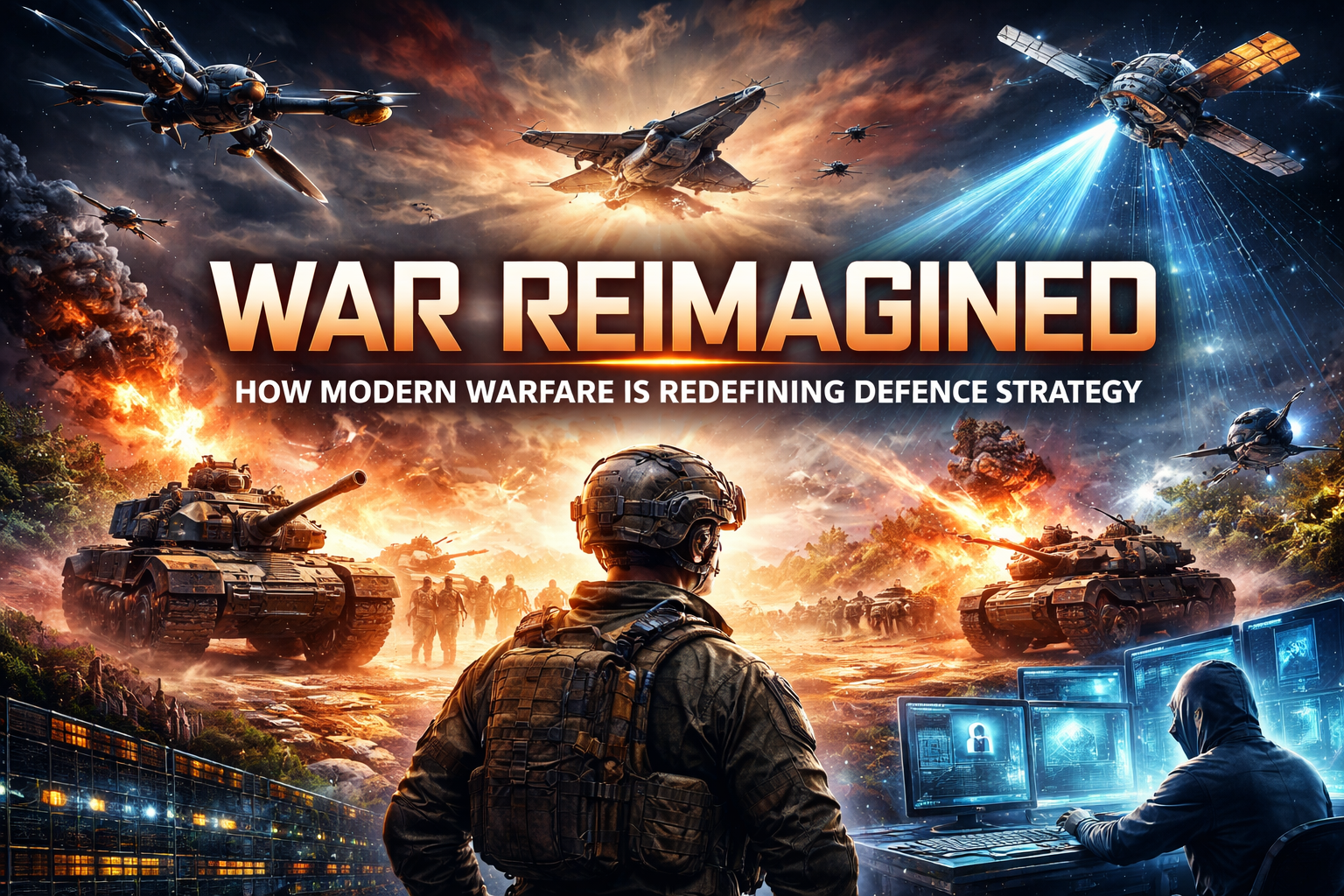
New Delhi / Lucknow: Modern defence strategy doctrine is undergoing a profound transformation as warfare evolves beyond conventional battlefields into complex, multi-domain environments. Traditional doctrines—once centered on territorial defence, large standing armies, and kinetic engagements—are being reshaped by rapid technological innovation, asymmetric threats, and the blurring of lines between war and peace. The emergence of cyber warfare, artificial intelligence, autonomous systems, and hybrid tactics has compelled militaries worldwide to rethink how wars are fought, deterred, and won.
One of the most significant shifts is the move from conventional warfare to what is often termed multi-domain operations. This concept integrates land, air, sea, space, and cyberspace into a unified operational framework. Modern militaries aim to achieve superiority not just in physical battlespaces but also in invisible domains such as digital networks and satellite systems. For instance, disabling an adversary’s communication infrastructure through cyberattacks can be as decisive as destroying tanks or aircraft. This integration demands seamless coordination between different branches of the armed forces, supported by real-time data sharing and advanced command-and-control systems.
Closely linked to this is the growing importance of information dominance. In modern conflicts, information itself is a weapon. Control over intelligence, surveillance, and reconnaissance (ISR) systems enables faster decision-making and precise targeting. Technologies like drones, satellites, and AI-powered analytics allow militaries to process vast amounts of data instantly. This has given rise to the concept of “decision superiority,” where the side that can observe, orient, decide, and act faster gains a critical advantage. Consequently, defence doctrines now prioritize data integration, secure communication networks, and resilience against electronic and cyber interference.
Cyber warfare has emerged as a central pillar of modern defence strategy. Nations are investing heavily in both offensive and defensive cyber capabilities to protect critical infrastructure such as power grids, financial systems, and military networks. Unlike traditional warfare, cyber operations can be conducted anonymously and below the threshold of open conflict, making attribution difficult and deterrence more complex. This has led to the development of doctrines that emphasize continuous engagement in cyberspace, rather than reactive responses. Cyber commands are now integral components of national defence structures, reflecting the recognition that future wars may be fought as much in code as on the battlefield.
Another transformative element is the use of artificial intelligence and autonomous systems. AI is being integrated into everything from predictive maintenance of equipment to battlefield decision-making and autonomous weapons. Unmanned aerial vehicles (UAVs), robotic ground systems, and naval drones are increasingly used for surveillance, reconnaissance, and even combat roles. These technologies reduce the risk to human soldiers while enhancing operational efficiency. However, they also raise ethical and legal questions, particularly regarding the use of lethal autonomous weapons. Defence doctrines are evolving to address these challenges while leveraging the strategic advantages offered by AI.
Modern warfare is also characterized by the rise of hybrid warfare, which combines conventional military force with irregular tactics such as disinformation campaigns, economic coercion, and proxy conflicts. This approach seeks to exploit vulnerabilities across multiple domains, often avoiding direct confrontation. Hybrid tactics have been observed in several recent conflicts, where state and non-state actors use a mix of cyberattacks, propaganda, and limited military engagement to achieve strategic objectives. In response, defence doctrines are placing greater emphasis on resilience, societal preparedness, and inter-agency coordination to counter such multifaceted threats.
The increasing role of space as a strategic domain is another critical development. Satellites are essential for communication, navigation, and intelligence gathering, making them prime targets in modern conflicts. Anti-satellite weapons (ASAT) and space-based surveillance systems are reshaping defence strategies, prompting nations to develop capabilities to protect their space assets while potentially denying adversaries the same advantage. Space commands and dedicated military units for space operations are becoming more common, reflecting the growing importance of this domain.
Precision warfare has replaced the massed firepower strategies of the past. Advances in guided munitions, sensor technologies, and targeting systems allow for highly accurate strikes with minimal collateral damage. This shift not only enhances military effectiveness but also aligns with political and ethical considerations by reducing civilian casualties. However, it also increases the reliance on technological superiority, making systems vulnerable to electronic warfare and cyber disruption. As a result, modern doctrines emphasize redundancy, resilience, and the ability to operate in degraded environments.

The concept of deterrence is also evolving. During the Cold War, deterrence was largely based on nuclear capabilities and the threat of mutually assured destruction. Today, deterrence is more complex and multidimensional, encompassing conventional forces, cyber capabilities, economic leverage, and diplomatic influence. The aim is to deter adversaries across multiple domains simultaneously, creating a comprehensive deterrence posture. This has led to the development of integrated strategies that combine military strength with non-military tools of statecraft.
Another notable change is the increasing importance of alliances and partnerships. Modern threats are often transnational, requiring collective responses. Defence doctrines now emphasize interoperability, joint exercises, and intelligence sharing among allied nations. Organizations like NATO have adapted their strategies to address emerging challenges such as cyber threats and hybrid warfare. Regional partnerships are also gaining prominence, reflecting the need for coordinated responses to shared security concerns.
The role of urban warfare is expanding as conflicts increasingly occur in densely populated areas. Fighting in cities presents unique challenges, including the presence of civilians, complex terrain, and the need for precise operations. Modern doctrines are adapting to these realities by focusing on specialized training, advanced technologies such as surveillance drones, and strategies to minimize collateral damage. Urban warfare also underscores the importance of winning “hearts and minds,” as public perception can significantly influence the outcome of conflicts.
Logistics and supply chain resilience have gained renewed attention in modern defence strategy. The COVID-19 pandemic and recent conflicts have highlighted vulnerabilities in global supply chains, prompting militaries to prioritize self-reliance and secure supply networks. Advanced technologies such as 3D printing and automated logistics systems are being explored to enhance operational readiness and reduce dependence on external sources.
Finally, the human dimension remains central to modern warfare, despite technological advancements. Training, leadership, and morale continue to play a decisive role in military effectiveness. However, the skills required of modern soldiers are changing. They must be proficient not only in traditional combat but also in operating advanced technologies, understanding cyber threats, and navigating complex information environments. This has led to reforms in military education and training programs, emphasizing adaptability and continuous learning.
In conclusion, defence strategy doctrine is evolving to meet the challenges of a rapidly changing security landscape. The integration of multiple domains, the rise of cyber and space warfare, the use of AI and autonomous systems, and the increasing complexity of hybrid threats are reshaping how militaries prepare for and conduct operations. While technology is a key driver of this transformation, the fundamental principles of strategy—such as adaptability, coordination, and resilience—remain as relevant as ever. The nations that can effectively integrate these elements into their defence doctrines will be best positioned to navigate the uncertainties of modern warfare and maintain strategic advantage in the years to come.