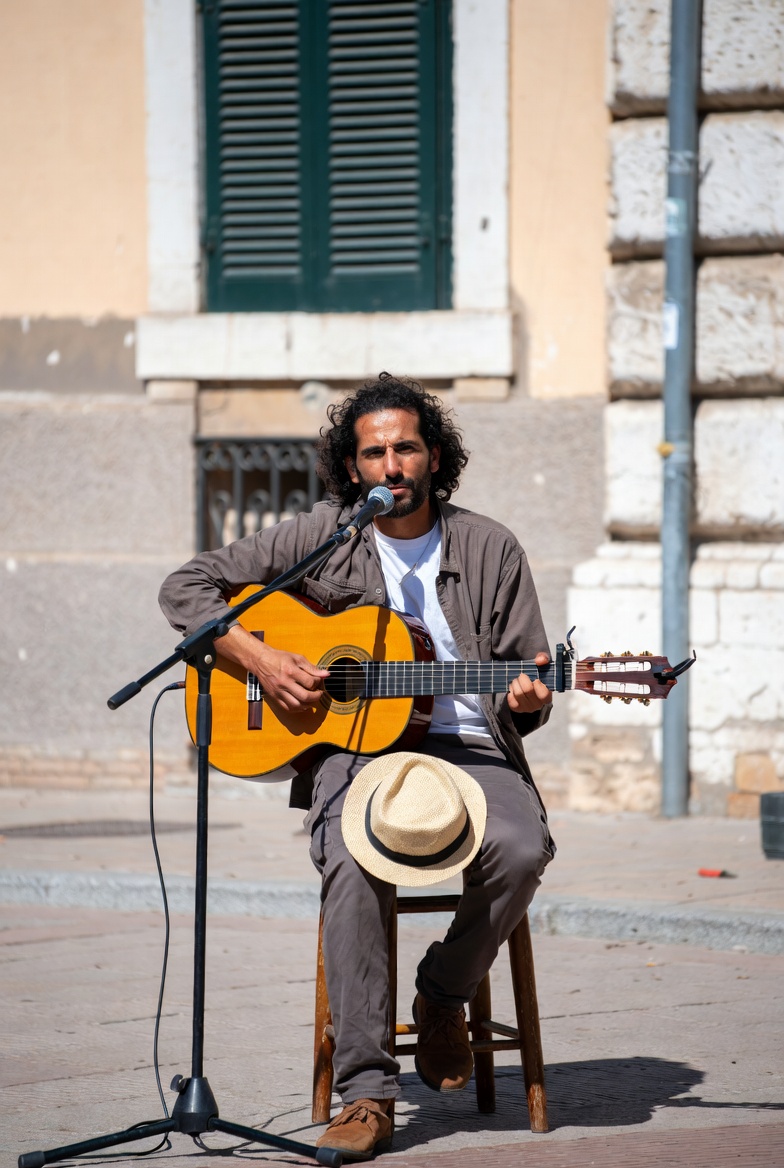
Under the sprawling expanse of twilight, the city came alive with a symphony of sounds. The hum of conversation blended with the distant wail of sirens, while the clatter of footsteps on pavement created an unintentional rhythm. It was in this vibrant atmosphere that Jack Darnell, a busker, carved out his humble existence.
Night after night, he stood at the bustling corner of Fifth and Main, his guitar slung low across his body, the instrument worn from countless performances. With every strum, he poured his heart into music—a mix of rock and blues that echoed through the streets like a siren’s call.
Jack had always been drawn to music. As a child, he spent hours listening to vinyl records his father had collected, mesmerized by the raw energy of rock legends. In high school, while others chased popularity, he found solace in songwriting. His lyrics spoke of heartache, dreams, and the relentless pursuit of freedom.
But life had not been kind to him. After his parents’ divorce, he found himself adrift—a young man with talent but no clear path. With little more than a suitcase and his guitar, Jack moved to the city, lured by the promise of opportunity.
The streets became his stage, a place where he could share his music with anyone willing to stop and listen. He learned to read the crowd, to sense when their spirits soared and when they needed something softer to soothe their weariness.
Each night, he played for coins tossed into his open guitar case, but the true currency he sought was connection—the silent exchange between performer and listener.
As months turned into years, Jack’s reputation grew. Regulars began to gather at his corner, drawn not only by his talent but by the authenticity of his performance. He became a fixture of the downtown scene—a man whose passion for music was impossible to ignore.
Some nights the crowd was small, just a handful of strangers. Other nights, he stood before a sea of faces, all captivated by his melodies.
It was during one of those vibrant evenings that fate shifted.
A talent scout, searching for fresh acts for a rising record label, happened upon Jack’s performance. Intrigued by his raw energy and emotional depth, the scout lingered in the shadows as Jack poured his heart into a song about lost love.
The audience swayed, entranced. Jack felt electricity in the air, as if the universe itself had aligned.
When the final chord faded, the scout approached him, introduced himself, and expressed admiration. Jack hesitated, unsure of what it meant. The streets had become his sanctuary.
Yet the idea of sharing his music with a wider audience was impossible to ignore.
After days of reflection, he took a leap of faith and signed a contract that would change his life.
With the label’s support, Jack began recording his first album. The process was both exhilarating and overwhelming. In the professional studio, surrounded by seasoned musicians and producers, he experienced a world unlike anything he had known.
Still, he remained rooted in his beginnings. Every track carried the soul of the street performer he once was.
When the album was released, it met unexpected acclaim. Critics praised his authenticity and emotional resonance. Songs once heard only on street corners now filled radio waves, and the city that had been his stage embraced him as a rising star.
The busker from Fifth and Main had become a rock icon.

But fame brought challenges. The pressure to deliver hit after hit weighed heavily on him. Jack struggled to balance artistic vision with industry expectations.
He missed the simplicity of street performances—the raw, immediate connection with his audience. Yet he could not deny the thrill of performing before thousands beneath dazzling lights.
Each concert became a whirlwind of sound and spectacle, a stark contrast to his quiet beginnings.
Still, Jack remained grounded in memory. He never forgot the regulars, the strangers who dropped coins into his case, or the friends who believed in his dream.
Wanting to give back, he organized charitable concerts to support local musicians struggling to find their voice.
Years passed, and his music evolved. He blended genres, experimented freely, but always kept rock at its core. Each album reflected his growth—not just as an artist, but as a person.
He became a voice for those unheard, writing songs that echoed the struggles and hopes of his listeners.
One evening, years after he first played on that busy corner, Jack returned to Fifth and Main.
The city had changed, but its spirit had not.
He set down his guitar case and began to play—a simple melody drifting through the streets.
People stopped. Some recognized him. Others simply felt drawn to the music.
But in that moment, none of it mattered.
Jack played for the joy of it—for the love of music, and for the connection that had started it all.
As he looked over the crowd, a quiet peace settled within him.
His journey from busker to rock icon had been filled with trials and triumphs, but music had always been his true north.
No matter how far he went, he would always carry the spirit of the streets within him—a reminder that a musician’s heart beats strongest when shared.