
New Delhi: In a world unsettled by geopolitical shocks, supply-chain realignments and uneven global recovery, India’s services sector has emerged as the economy’s quiet stabiliser—and increasingly, its boldest growth frontier. What was once seen as a steady anchor has now transformed into a dynamic force reshaping exports, employment, investment flows and innovation.
The Economic Survey 2025–26 captures this shift with striking clarity. India’s services exports growth has more than doubled, rising from an average 7.6% in the pre-pandemic years (FY16–FY20) to 14% during FY23–FY25. This acceleration signals not just recovery, but reinvention.
The Growth Backbone of FY26
FY26 marked an across-the-board expansion in services. With the sector clocking 9.1% growth, it emerged as the single largest driver of Gross Value Added (GVA), outperforming other sectors amid global uncertainty. Almost all major sub-segments recorded growth in the 8–9.9% range, underscoring the breadth of momentum rather than reliance on a few narrow drivers.
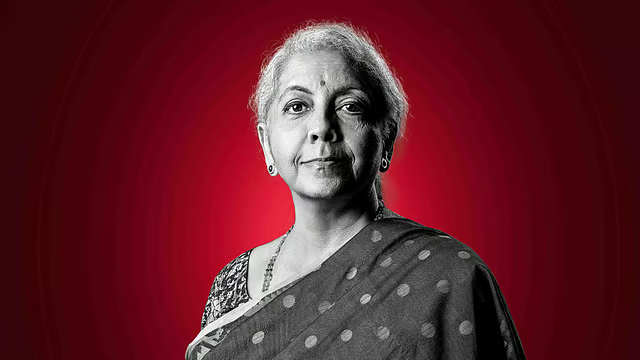
Today, services contribute more than half of India’s GVA, acting as a high-growth, low-volatility anchor for the economy. As Finance Minister Nirmala Sitharaman noted while tabling the Survey in Parliament, services have consistently delivered 7–8% annual growth, in contrast to the sharper cyclical swings seen in agriculture and industry.
India in the Global Services Map
India is now the world’s seventh-largest exporter of services, with its share in global services trade more than doubling—from 2% in 2005 to 4.3% in 2024. At a time when global goods trade remains subdued, services have become India’s critical external buffer.
Services exports now average 9.7% of GDP, up from 7.4% before the pandemic, and rose further to 10% in the first half of FY26. This growing weight highlights how deeply services are embedded in India’s macroeconomic resilience.
Capital, Confidence and Convergence
Global trends show capital steadily pivoting towards services—and India mirrors this shift sharply. During FY23–FY25, services accounted for over 80% of India’s total FDI inflows, compared to 77.7% before the pandemic. Information and communication services, professional services, finance, energy and trading together dominate these inflows, reinforcing India’s strength in digital, skill-intensive and infrastructure-linked services.
This convergence of capital and capability has reinforced sectors like financial and professional services as core growth engines, while public administration and defence-related services continue to expand on the back of steady government spending.

Exports: Beyond IT, Into New Horizons
Software services remain the backbone—contributing over 40% of total services exports—with growth accelerating to 13.5% in FY23–FY25, nearly three times the pre-pandemic pace. Professional and management consulting has emerged as a powerful second pillar, growing at 25.9% and sharply increasing its export share.
Yet the most compelling story lies ahead. Media and entertainment, space technologies, data centres, live events and ocean-based services are emerging as new frontiers. Together, they represent the evolving face of India’s services economy—creative, technology-driven and globally competitive.
The Orange Economy, driven by live events, digital content and cultural industries, is creating strong spillovers into tourism and urban economies. India’s space services, already commercially launching satellites for dozens of countries, underline its growing role in high-value, technology-intensive global markets.
Jobs, Cities and Contrasts
Services are also India’s leading employment generator. Urban employment in services now accounts for nearly 62% of jobs, while over half of net formal employment additions in FY26 came from the sector. Rising employment elasticity in the post-COVID phase highlights its role as a labour shock absorber.
Regionally, modern services remain concentrated in states like Karnataka, Maharashtra, Tamil Nadu and Telangana. At the same time, contrasts persist—some states rely heavily on low-value services, while others have seen a relative decline, reminding policymakers that the services transition is neither uniform nor automatic.
The Road Ahead
The Survey’s message is clear: India’s services story is no longer just about stability—it is about scale, sophistication and new frontiers. Sustaining momentum will require continuous re-skilling, deeper digital diffusion, reliable energy and data infrastructure, and supportive policies for innovation.
From concert economies to data centres, marine services to space commerce, the next chapter of growth is already unfolding. If the past decade was about anchoring India’s economy through services, the next may well be about redefining its global economic identity through them.