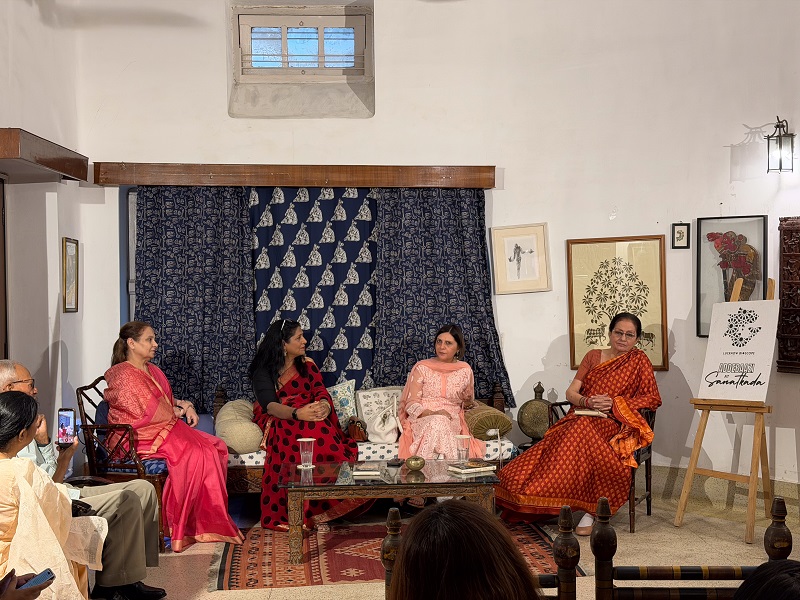
Lucknow: An engaging afternoon of literature and gastronomy unfolded in the city as Lucknow Bioscope hosted Panno Ke Bheetar, a special book reading and discussion featuring An Invitation to Feast by noted food writer and journalist Sona Bahadur. The event was held on Sunday at a heritage venue on J. C. Bose Road in Qaiser Bagh, Lucknow, drawing food enthusiasts, readers and culture lovers.
Bahadur’s book, which recently won the prestigious Gourmand Cookbook Awards, is an extensively researched exploration of eleven iconic Indian dishes, including Biryani, Dosa, Butter Chicken, Vada Pav, Dhansak, Goan Fish Curry, Undhiyu, Shami Kebab, Chole, smoked pork and the beloved dessert Rasgulla.
Reflecting on her journey as an author, Bahadur shared a candid insight into how the project began. “This book just found me,” she remarked, explaining that her curiosity about India’s culinary heritage gradually evolved into a deeper exploration of the country’s iconic dishes.
She also noted that while Indians are deeply passionate about food, discussions around gastronomy often remain limited. “We tend to take our cuisines for granted. Though we are passionate food lovers, we don’t really talk about gastronomy as such. The best way to pay tribute to any cuisine is to talk about its classics,” she said.
Discussing her inclusion of Shami Kebabs in the book, Bahadur described the dish as a deeply personal choice. Growing up with the flavours of the kebab shaped her perception of its importance in India’s culinary memory. She also highlighted the fascinating regional adaptations of the dish, including inventive vegetarian versions made with turai ke chilke (ridge gourd peels).
The reading session flowed into a lively conversation on the festive cuisines of Awadh, with participants sharing memories of food traditions linked to festivals such as Ramadan and Holi.

Culinary researcher Dr Neera Sharma, founder of Navrasa, spoke about the social importance of festive cooking. She observed that certain traditional foods inherently encourage togetherness. “Gujiya cannot be made alone—you need people around you. The process itself creates social bonding and a sense of community,” she said, adding that festive cooking is as much about shared moments as it is about flavour.
Entrepreneur Sabiha Ansari offered a warm glimpse into the city’s Sehri traditions during Ramadan. “Sehri ki subah din hi hota hai, bas suraj nahin nikla hota (Sehri mornings are practically daytime, just without the sun),” she said with a smile, describing the comforting foods associated with the pre-dawn meal—baasi rotis, daliya, lachcha, khagina and balayi.
The conversation ultimately celebrated the uniquely intertwined cultural fabric of Lucknow, where communities enthusiastically partake in each other’s festivals, sharing not just food but traditions and stories that keep the city’s culinary heritage alive.
About the Author:
Sona Bahadur, currently based in Mumbai, is an independent food and travel journalist, restaurant critic and curator of culinary experiences. She writes extensively at the intersection of food, culture and travel, and previously served as editor of BBC Good Food Magazine India, the country’s first international food magazine.