Team Siddhanta Knowledge Foundation
Lucknow: We use words every day to convey information and to express our feelings. Have you ever wondered how they function? How is a sentence formed seamlessly with a number of words, what is the relation between a word and its meaning? Let us explore the fascinating world of Vyakarana that explains where words come from and how language functions.
What are the building blocks of language? It is words which are understood separately and then strung into sentences. A word and its meaning form an inseparable pair. After all, a word by definition is something that has a specific meaning. So pada and arthaform a pair. So much so that padārtha which means a ‘thing’ is actually ‘the thing that is meant by a word.’ So anything that we can understand and name is called a padārtha! That is why the word artha refers to both, the ‘meaning’ and ‘thing’.
This is a very profound classification of everything that we understand. Word and meaning define the world, just as nāma and rūpa – name and form define the world according to Vedanta philosophy. The ‘sabda’ corresponds to knowledge while the ‘artha’ corresponds to the entity. Between the two, there is no other entity in the universe!
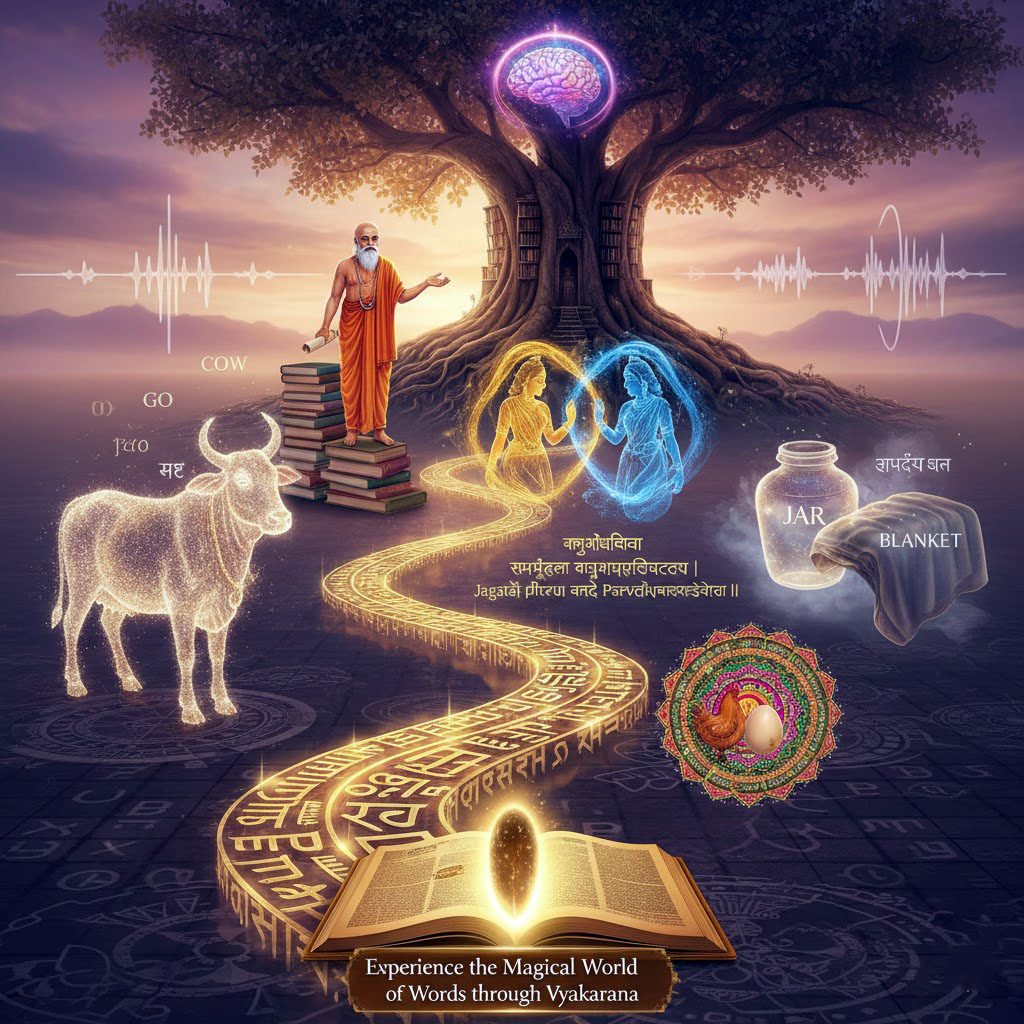
The word is the most useful tool to define the various entities in the world as it is the easiest, most economical and universally understood method. In the Vyakarana Mahabhashya, Patanjali asks what a word is and defines it in two ways.1.“(For example, the word ‘cow’) is that upon uttering which the meaning of an animal with dewlap, tail, hump, hoofs and horns flashes in the mind.” 2. “Or, in other words, a sound that conveys a specific meaning is considered a word in the world.” We notice that Patanjali in his two definitions, has taken care of both aspects of what a word is. The first definition presents the word as a concept. The second definition takes care of the audible aspect.
The next question is whether a word is permanent or impermanent; nitya or anitya; eternal or transitory. The grammarian school takes a practical stand even in the definition of what is nitya in the field of Vyakarana. ‘Nitya’ is taken as synonymous with ‘siddha’ which means ‘ready’ – so what they mean is that the words are already in currency in the world – we only select them and use them according to our requirement. When we require a jar or a blanket, we could go to a potter or weaver and ask him to make a jar or a blanket, but when we require a word, we do not go to a Grammarian and ask for a word!
They say that even when the word is repeatedly innumerable times, we can consider that it is nitya, or always there, available. This is explained by saying that the form or pattern or class is permanent whereas the object or individual is transitory. Many individuals may come and go, but we will consider that they are all of the same type. Hence the type is enduring. For example, when one jar is broken, there are many others that still exist and hence the class of ‘jar’ still exists. When one cow or ox may cease to exist, there would still be many others that keep the class of ‘cow’ alive.
Another way of looking at it is by viewing the form or shape as transitory but the basic substance as permanent. For instance, while pots and jars may be formed and destroyed, the underlying clay is the same enduring base material. While many ornaments of different shapes are fashioned from gold, upon melting, they all become the same metal.
So Patanjali and Bhartrhari say that whether the word is eternal or permanent or created, in any case they do not have a beginning that we take into consideration. It is like the chicken and the egg, which we can consider as an unending series.

So by now we have established what a word is and what is its meaning. Now the next big question is as to the relation between them. How is a word related to its meaning? We all take for granted that a word and meaning are associated. Sanskrit linguistics goes into this question and defines the relation quite precisely as ‘pratyāyya- pratyāyaka bhāva relation. This is what has come to be known in later Western linguistics as the significand- signifee pair propounded by Ferdinand de Saussure.
The question we ask is whether the relation is a natural, physical one where they would be found together. The opponents criticize the theory by saying that were the relation natural and invariable, then the mouth should taste sweetness upon uttering the word “sugar”, ‘modak,’ etc or the tongue get cut upon uttering the word, ‘knife’! The answer is that it is not a physical association but a notional association. The word is the pratyāyaka – that which causes the understanding and the artha or meaning is the pratyāyya – that which is to be understood.
This relation between a word and its meaning is also a permanent feature. Once a meaning of a word in a known language is understood, they cannot be separated by a person fully in his senses. Thus we establish the word, meaning and the relation between them as well defined, enduring entities. This is the basis of Kalidasa’s invocation in the Raghuvamsham.
Vāgarthāviva samp.rktau vāgarthapratipattaye |
Jagataḥ pitarau vande Parvatīparameśvarau ||
He begins his great work with a prayer to Parvati and Paramesvara, the parents of the world, who are inseparable like the word and meaning, so that he can gain the right knowledge of the right word and meaning at the right place to compose his work. Let us look at the meaning word by word – vāgarthāviva – like the word and meaning. Vāk is speech or word, and artha is its meaning. Together they are vāgarthau and vāgarthau iva becomes vāgarthāviva. samprktau means – together, always conjoined. Vāgarthapratipattaye – means, for the purpose of right knowledge of word and meaning. pratipatti means knowledge, understanding. Jagataḥ piataru = means, the parents of the whole world. Vande = I salute, I venerate. Parvatiparameśvarau is Parvati and Paramesvara.