
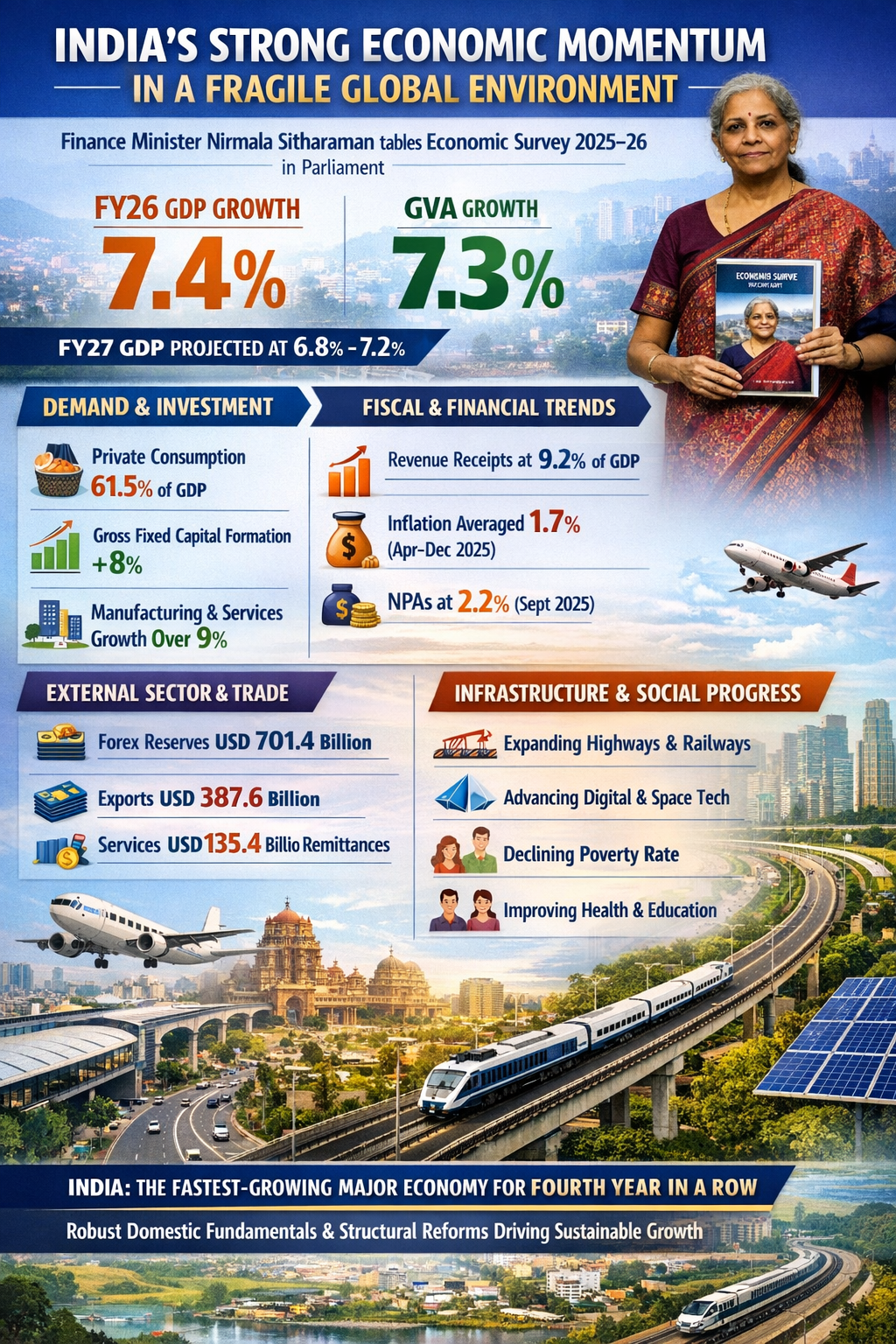
New Delhi: India’s economic momentum remains strong despite a fragile global backdrop, with the First Advance Estimates projecting real GDP growth of 7.4 per cent and GVA growth of 7.3 per cent in FY26. The Economic Survey 2025–26, tabled in Parliament by Finance Minister Nirmala Sitharaman, once again positions India as the fastest-growing major economy for the fourth year in a row.
The Survey estimates India’s potential growth at around 7 per cent, while FY27 GDP growth is projected in the range of 6.8–7.2 per cent, reflecting resilience supported by domestic demand, macroeconomic stability, and structural reforms.
Demand, Investment and Sectoral Performance
Private consumption remained the backbone of growth, with Private Final Consumption Expenditure rising to 61.5 per cent of GDP, its highest level in over a decade. Low inflation, stable employment, and rising real incomes supported both rural and urban demand. Investment activity also strengthened, with Gross Fixed Capital Formation growing nearly 8 per cent, anchored by sustained public capital expenditure and improving private investment sentiment.
On the supply side, services continued to lead, posting over 9 per cent growth in the first half of FY26. Manufacturing showed clear signs of structural recovery, with GVA expanding by 7.7 per cent in Q1 and 9.1 per cent in Q2, while agriculture benefited from a favourable monsoon and expanding allied activities.
Fiscal, Financial and Inflation Trends
Prudent fiscal management improved credibility, reflected in sovereign credit rating upgrades during 2025. The Centre’s revenue receipts increased to 9.2 per cent of GDP in FY25, supported by higher tax compliance and digitalisation. Inflation moderated sharply, averaging 1.7 per cent during April–December 2025, the lowest since the CPI series began.

India’s banking sector strengthened further, with gross NPAs declining to a multi-decadal low of 2.2 per cent by September 2025, alongside healthy credit growth and improved capital buffers.
External Sector and Trade
India’s external position remained comfortable. Foreign exchange reserves rose to USD 701.4 billion, covering about 11 months of imports. The country’s share in global merchandise exports nearly doubled between 2005 and 2024, while services exports reached a record USD 387.6 billion in FY25. India also retained its position as the world’s largest recipient of remittances, with inflows of USD 135.4 billion.
Infrastructure, Social Progress and Outlook
Public investment continued to transform infrastructure across highways, railways, aviation, power, digital connectivity, and space. Social indicators also showed steady improvement, with declining poverty levels, expanded financial inclusion, rising enrolment in education, and accelerated reductions in maternal and child mortality.
Overall, the Survey concludes that India’s growth is increasingly driven by strong domestic fundamentals, disciplined policy frameworks, and long-term structural reforms—providing stability and confidence amid global uncertainty.